‘It’s Becoming a Privilege to Own a Pet’ – Pet Acquisition Experiences for Black/African American and Hispanic/Latino Families in Four U.S. Cities
DOI:
https://doi.org/10.56771/jsmcah.v5.179Keywords:
adoption barriers, racial equity, pet ownership, human-animal bondAbstract
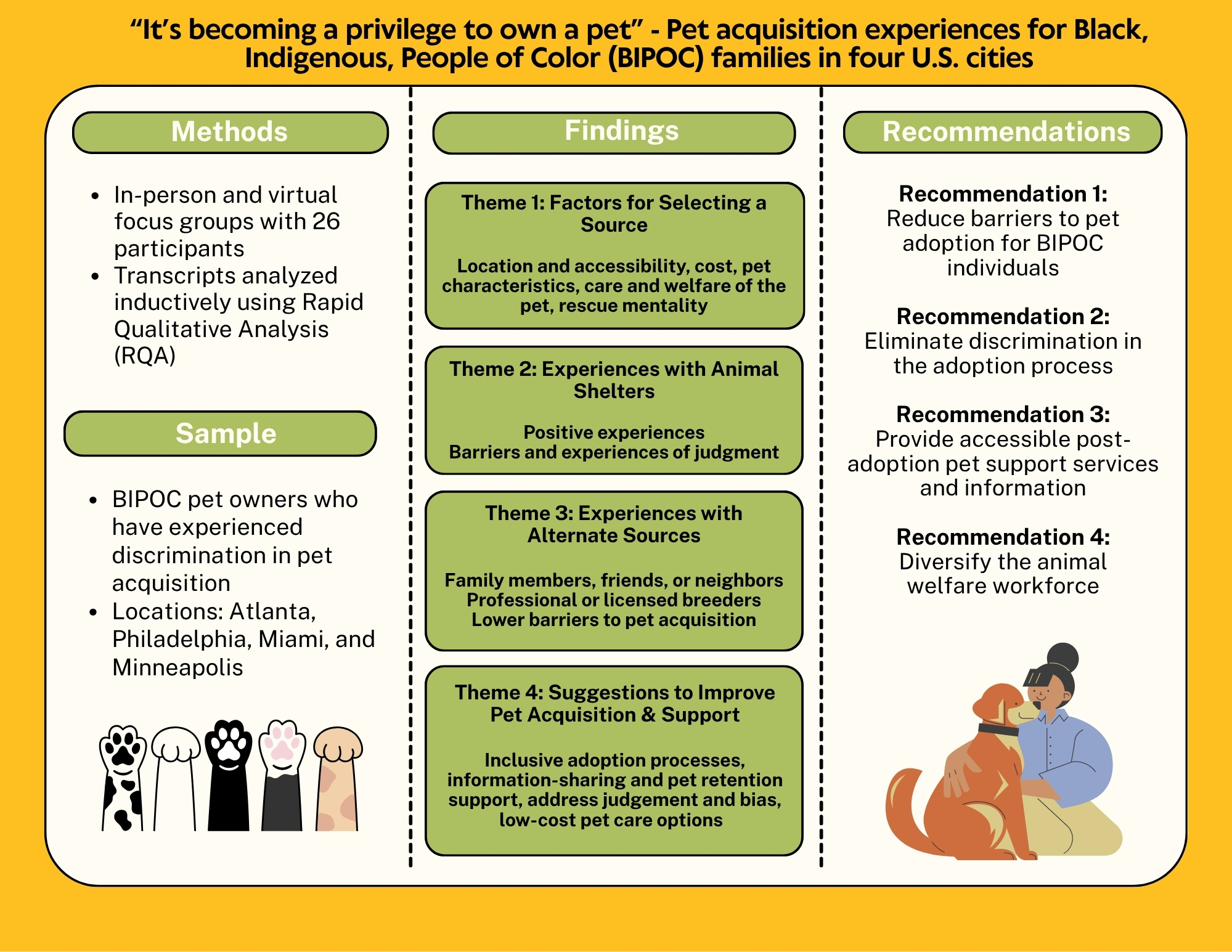
Introduction: Pet ownership has benefits for human and animal well-being. However, Black, Indigenous, and People of Color (BIPOC) in the United States (U.S.) face systemic and institutional barriers to acquiring pets. Current literature on pet acquisition largely overlooks BIPOC families’ experiences. This study aimed to explore BIPOC families’ experiences, challenges, and priorities regarding pet acquisition in four U.S. cities (Atlanta, Miami, and Minneapolis, Philadelphia).
Methods: Focus groups were conducted with 26 pet owners who identify as Black/African American or Hispanic/Latino. Participants were asked about their perceptions of and experiences with various pet acquisition sources (animal shelters and rescues, professional or licensed breeders, and family members, friends, or neighbors) and suggestions to improve the pet acquisition process. The data were analyzed inductively through rapid qualitative analysis.
Results: Participants reported varied experiences across pet acquisition sources. Barriers to shelter and rescue adoption included experiences of judgment, lengthy or intrusive screening processes, and a lack of cultural responsiveness. Some participants described experiences of discrimination from shelters and rescues, particularly related to race and income. Many relied on friends, family, and neighbors to acquire pets due to convenience, trust, and affordability.
Conclusion: The Black/African American and Hispanic/Latino pet owners in this study encountered structural and interpersonal barriers to pet acquisition that influence their source of pet acquisition. The participants’ experiences suggest that managing bias and removing barriers to pet acquisition may expand access to the human–animal bond and decrease animal shelter overpopulation and euthanasia.
Downloads
References
1.
American Pet Products Association. State of the Industry Report. American Pet Products Association; 2026. Accessed Mar 30, 2026. https://americanpetproducts.org/news/u.s.-pet-industry-reaches-158-billion-in-2025-poised-for-continued-growth-in-2026
2.
Shelter Animals Count. Annual Data Report. Shelter Animals Count; 2025. Accessed Mar 31, 2026. https://www.shelteranimalscount.org/2025-report
3.
Balcom S, Arluke A. Animal Adoption as Negotiated Order: A Comparison of Open versus Traditional Shelter Approaches. Anthrozoos. 2001;14(3):135–150. doi: 10.2752/089279301786999445
4.
Goldman K. Letting the Cat Out of the Bag: How Lack of Access to Animal Companionship and Husbandry Fosters Inequality for Black Americans. UC Irvine Law Rev. 2022;12(2):693–717. Accessed Mar 15, 2026. https://perma.cc/6D47-X73T
5.
Ly LH, Brown K, Yau E, Kenworthy B, Segurson S, Protopopova A. A Mixed-Methods Exploration of Opportunities for Barriers and Bias during Off Site Animal Adoption Events. J Shelter Med Community Anim Heal. 2024;3(1):1–18. doi: 10.56771/jsmcah.v3.66
6.
Blackwell MJ, Daugherty L, Galvez E, et al. Racial Disparities in Animal Welfare. University of Tennessee Knoxville; 2024. Accessed Mar 10, 2026. https://trace.tennessee.edu/handle/20.500.14382/51354
7.
Sinski J. ‘A Cat-Sized Hole in My Heart’: Public Perceptions of Companion Animal Adoption in the USA. In: Pregowski MP, ed. Companion Animals in Everyday Life: Situating Human-Animal Engagement within Cultures. New York, NY: Palgrave Macmillan; 2016:73–89. doi: 10.1057/978-1-137-59572-0_6
8.
Weiss E, Gramann S, Dolan ED, Scotto JE, Slater MR. Do Policy Based Adoptions Increase the Care a Pet Receives? An Exploration of a Shift to Conversation Based Adoptions at One Shelter. Open J Anim Sci. 2014;4(5):313–322. doi: 10.4236/ojas.2014.45040
9.
Hoffman CL, Thibault M, Hong J. Characterizing Pet Acquisition and Retention during the COVID-19 Pandemic. Front Vet Sci. 2021;8:1375. doi: 10.3389/FVETS.2021.781403/BIBTEX
10.
Horecka K, Neal S. Critical Problems for Research in Animal Sheltering, a Conceptual Analysis. Front Vet Sci. 2022;9:292. doi: 10.3389/fvets.2022.804154
11.
Kremer T, Neal SM. Where Do They Come from and Where Do They Go? Socioeconomic Patterns in Dog Acquisition and Rehoming. Animals. 2024;14(9):1–11. doi: 10.3390/ani14091378
12.
Olmos-Vega FM, Stalmeijer RE, Varpio L, Kahlke R. A Practical Guide to Reflexivity in Qualitative Research: AMEE Guide No. 149. Med Teach. 2023;45(3):241–251. doi: 10.1080/0142159X.2022.2057287
13.
Kowalski CP, Nevedal AL, Finley EP, et al. Planning for and Assessing Rigor in Rapid Qualitative Analysis (PARRQA): A Consensus-Based Framework for Designing, Conducting, and Reporting. Implement Sci. 2024;19(1):71. doi: 10.1186/s13012-024-01397-1
14.
Thomas DR. A General Inductive Approach for Analyzing Qualitative Evaluation Data. Am J Eval. 2006;27(2):237–246. doi: 10.1177/109821400528374815
15.
Nevedal AL, Reardon CM, Opra Widerquist MA, et al. Rapid Versus Traditional Qualitative Analysis Using the Consolidated Framework for Implementation Research (CFIR). Implement Sci. 2021;16(1):67. doi: 10.1186/s13012-021-01111-5
16.
Gale RC, Wu J, Erhardt T, et al. Comparison of Rapid vs In-Depth Qualitative Analytic Methods from a Process Evaluation of Academic Detailing in the Veterans Health Administration. Implement Sci. 2019;14(1):11. doi: 10.1186/s13012-019-0853-y
17.
Bir C, Widmar NJO, Croney CC. Stated Preferences for Dog Characteristics and Sources of Acquisition. Animals. 2017;7(8):59. doi: 10.3390/ani7080059
18.
Garrison L, Weiss E. What Do People Want? Factors People Consider When Acquiring Dogs, the Complexity of the Choices They Make, and Implications for Nonhuman Animal Relocation Programs. J Appl Anim Welf Sci. 2015;18(1):57–73. doi: 10.1080/10888705.2014.943836
19.
Arluke A, Rauktis ME. Dog Acquisition in Lower-Income Communities as Consumer Behavior: An Exploratory Qualitative Study. J Shelter Med Community Anim Health. 2024;3(1):3. doi: 10.56771/JSMCAH.V3.73
20.
Ly LH, Gordon E, Protopopova A. Inequitable Flow of Animals in and Out of Shelters: Comparison of Community-Level Vulnerability for Owner-Surrendered and Subsequently Adopted Animals. Front Vet Sci. 2021;8:784389. doi: 10.3389/fvets.2021.784389
21.
Humane World for Animals. Adopters Welcome. Humane World for Animals; 2025. Accessed Mar 15, 2026. https://humanepro.org/page/adopters-welcome-manual
22.
Dinwoodie IR, Zottola V, Kubitz K, Dodman NH. Selection Factors Influencing Eventual Owner Satisfaction about Pet Dog Adoption. Animals. 2022;12(17):2264. doi: 10.3390/ANI12172264
23.
Brown S-E. The Under-Representation of African American Employees in Animal Welfare Organizations in the United States. Soc Anim. 2005;13(2):153–162. doi: 10.1163/1568530054300217
24.
Neumann SL. Animal Welfare Volunteers: Who Are they and Why Do they Do What they Do? Anthrozoos. 2010;23(4):351–364. doi: 10.2752/175303710X12750451259372
25.
Chun R, Davis E, Frank N, et al. Can Veterinary Medicine Improve Diversity in Post-Graduate Training Programs? Current State of Academic Veterinary Medicine and Recommendations on Best Practices. J Am Vet Med Assoc. 2022;261(3):417–423. doi: 10.2460/javma.22.09.0430
26.
Kendall T. Diversity and Changing Demographics: How they Will Affect Veterinary Medicine. J Vet Med Educ. 2004;31(4):406–408. doi: 10.3138/jvme.31.4.406
27.
Martínez M. Understanding the Why: The Need for Diversity, Equity, and Inclusion in Veterinary Medicine. Vet Clin N Am Small Anim Pract. 2024;54(5):753–765. doi: 10.1016/j.cvsm.2024.06.009
28.
Powell L, Reinhard C, Satriale D, Morris M, Serpell J, Watson B. Characterizing Unsuccessful Animal Adoptions: Age and Breed Predict the Likelihood of Return, Reasons for Return and Post-Return Outcomes. Sci Rep. 2021;11(1):1–12. doi: 10.1038/s41598-021-87649-2
29.
Hawes SM, Hupe T, Morris KN. Punishment to Support: The Need to Align Animal Control Enforcement with the Human Social Justice Movement. Animals. 2020;10(10):1–8. doi: 10.3390/ani10101902
30.
PetSmart Charities-Gallup. State of Pet Care Study. PetSmart Charities-Gallup; 2025. Accessed Mar 15, 2026. https://www.gallup.com/analytics/659123/gallup-petsmart-charities.aspx
Additional Files
Published
Issue
Section
License
Copyright (c) 2026 Sloane M. Hawes, Lexis H. Ly, Diana Beltran, Celeste Morales, Jada Ford, Valli-Laurente Fraser-Celin

This work is licensed under a Creative Commons Attribution 4.0 International License.
How to Cite