A Descriptive Survey of Visitor Experience and Adoption Interest Among Patrons of a Rabbit Café
DOI:
https://doi.org/10.56771/jsmcah.v5.167Keywords:
adoption, animal café, tourism, human–animal interaction, animal welfareAbstract
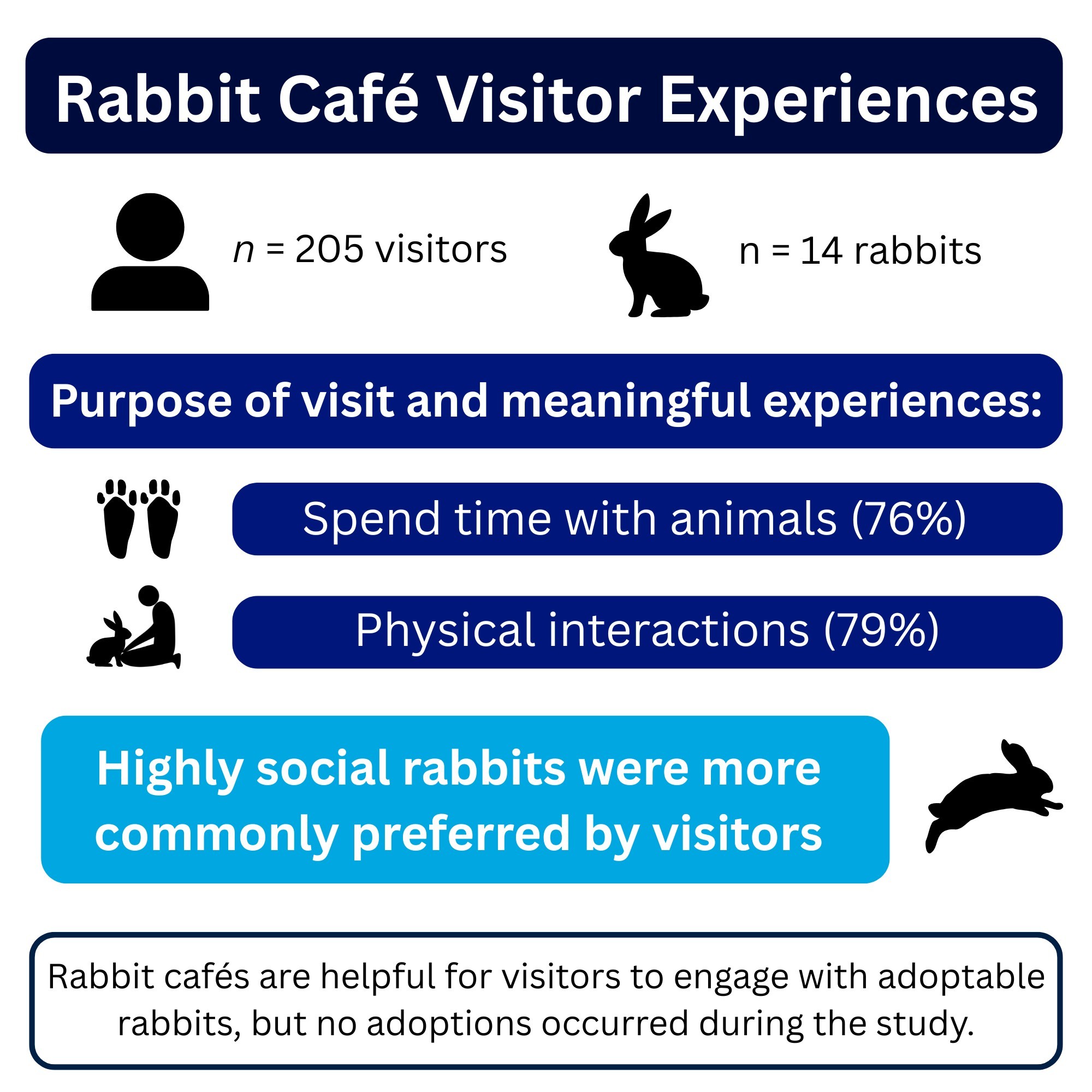
Introduction: Rabbits often experience long wait times in shelters, which may negatively impact their welfare. Pet cafés, where public members can interact with animals in a café setting, often partner with animal shelters to offer an alternative way to showcase animals to potential adopters. The use of pet cafés to promote the adoption of rabbits has yet to be studied. This study aimed to describe the motivations, experiences, and takeaways of the visitors at a rabbit café in Vancouver, British Columbia, Canada. The secondary aim was to explore the impact of rabbit morphology, behavior, and sociability as reported by staff and volunteers on perceived adoptability and visitor preference.
Methods: This study collected 205 responses (quantitative and qualitative) in a post-visit survey for patrons of the rabbit café and 23 survey responses of staff and volunteers rating the sociability of the rabbits. Data were described through cross-tabulation and analyzed through inductive thematic analysis.
Results: The results indicate that most visitors did not intend to adopt rabbits, but mainly visited the café to spend time with animals, noting physical interaction as a meaningful experience. Highly social rabbits, as rated by staff and volunteers, were generally more preferred by visitors than shy rabbits.
Conclusion: Overall, our study suggests that the rabbit café was useful for visitors to interact with rabbits, but did not result in adoptions during the study period. Future studies could address methods to improve adoption rates and length of stay (LOS) based on visitor experiences.
Downloads
References
1.
U ASY, Hou CY, Protopopova A. Rabbit Intakes and Predictors of Their Length of Stay in Animal Shelters in British Columbia, Canada. PLoS One. 2024;19(4):e0300633. doi: 10.1371/journal.pone.0300633
2.
Ropski MK, Pike AL, Ramezani N. Analysis of Illness and Length of Stay for Cats in a Foster-Based Rescue Organization Compared with Cats Housed in a Cat Café. J Vet Behav. 2023;62:1–11. doi: 10.1016/j.jveb.2023.02.002
3.
Hirsch EN, Navarro Rivero B, Andersson M. Cats in a Cat Café: Individual Cat Behavior and Interactions with Humans. Animals (Basel). 2025;15(22): 3233. doi: 10.3390/ani15223233
4.
Nghiêm-Phú B, Phạm-Lê DH. The Psychological Benefits and Costs, and the Servicescape Components of Animal Cafés: A Study in Japan. Serv Market Q. 2021;44(1):16–29. doi: 10.1080/15332969.2021.1995583
5.
Robinson AS. Finding Healing Through Animal Companionship in Japanese Animal Cafés. Med Hum. 2019;45(2):190–198. doi: 10.1136/medhum-2018-011635
6.
Harvey ND, Oxley JA, Miguel-Pacheco G, Gosling EM, Farnworth M. What Makes a Rabbit Cute? Preference for Rabbit Faces Differs according to Skull Morphology and Demographic Factors. Animals. 2019;9(10):728. doi: 10.3390/ani9100728
7.
Brown WP, Stephan VL. The Influence of Degree of Socialization and Age on Length of Stay of Shelter Cats. J Appl Anim Welf Sci. 2020;24(3):238–245. doi: 10.1080/10888705.2020.1733574
8.
Protopopova A, Wynne CDL. Adopter-Dog Interactions at the Shelter: Behavioral and Contextual Predictors of Adoption. Appl Anim Behav Sci. 2014;157:109–116. doi: 10.1016/j.applanim.2014.04.007
9.
Southland A, Dowling-Guyer S, McCobb E. Effect of Visitor Perspective on Adoption Decisions at One Animal Shelter. J Appl Anim Welf Sci. 2019;22(1):1–12. doi: 10.1080/10888705.2018.1448275
10.
Gourkow N, Hamon SC, Phillips CJC. Effect of gentle stroking and vocalization on behaviour, mucosal immunity and upper respiratory disease in anxious shelter cats. Prev Vet Med. 2014;117(1):266–275. doi: 10.1016/j.prevetmed.2014.06.005
11.
Liu S, Paterson M, Camarri S, Murray L, Phillips CJC. The effects of the frequency and method of gentling on the behavior of cats in shelters. J Vet Behav. 2020;39:47–56. doi: 10.1016/j.jveb.2020.07.007
12.
Součková M, Přibylová L, Jurčová L, Chaloupková H. Behavioural reactions of rabbits during AAI sessions. Appl Anim Behav Sci. 2023;262:105908. doi: 10.1016/j.applanim.2023.105908
13.
Kay A, Coe JB, Young I, Pearl D. Factors Influencing Time to Adoption for Dogs in a Provincial Shelter System in Canada. J Appl Anim Welf Sci. 2018;21(4):375–388. doi: 10.1080/10888705.2018.1436917
14.
Brown WP, Morgan KT. Age, Breed Designation, Coat Color, and Coat Pattern Influenced the Length of Stay of Cats at a No-Kill Shelter. J Appl Anim Welf Sci. 2014;18(2):169–180. doi: 10.1080/10888705.2014.971156
15.
Carini RM, Sinski J, Weber JD. Coat Color and Cat Outcomes in an Urban U.S. Shelter. Animals. 2020;10(10): 1720. doi: 10.3390/ani10101720
16.
Brown WP, Davidson JP, Zuefle ME. Effects of Phenotypic Characteristics on the Length of Stay of Dogs at Two No Kill Animal Shelters. J Appl Anim Welf Sci. 2013;16(1):2–18. doi: 10.1080/10888705.2013.740967
Additional Files
Published
Issue
Section
License
Copyright (c) 2026 Silvija Grava, Lexis H. Ly, Alexandra Protopopova

This work is licensed under a Creative Commons Attribution 4.0 International License.
How to Cite