Decrease in Proportion of Sterilized Dogs Entering Animal Welfare Organizations in the U.S. Post-pandemic
DOI:
https://doi.org/10.56771/jsmcah.v4.157Keywords:
animal welfare, shelter medicine, access to care, spay, neuter, population management, capacity for care, reproductive control, animal shelterAbstract
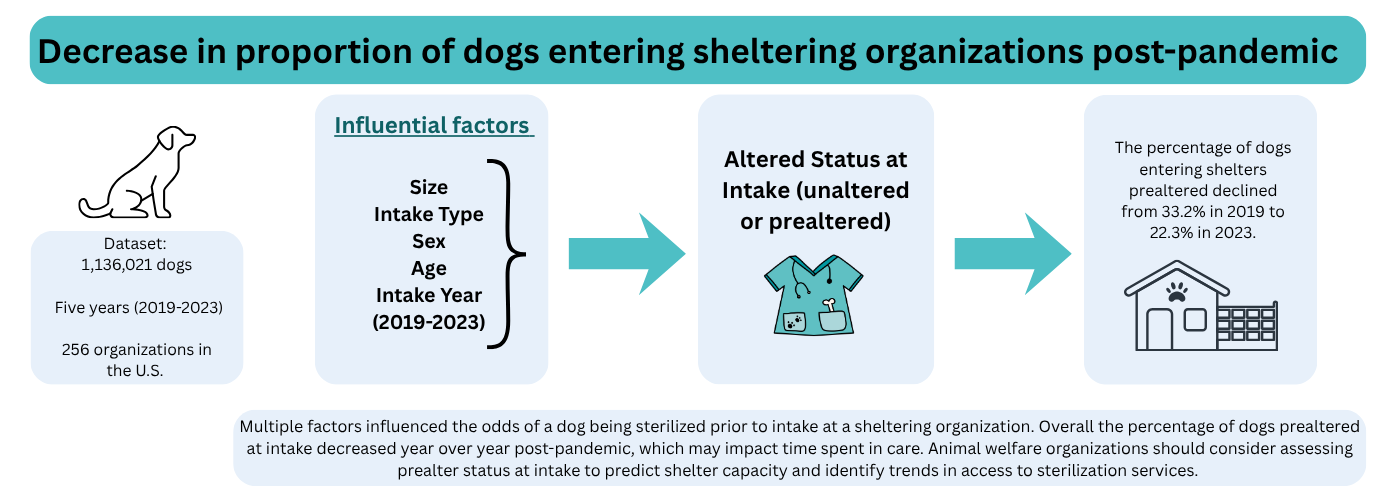
Introduction: The SARS-CoV-2 (COVID-19) pandemic disrupted spay and neuter services for owned and unowned animals in the United States; however, the impact of this deficit on animal welfare organizations’ intake and capacity has not been reported. This study examined nationwide data for trends in sterilization status of dogs entering animal shelters and rescue organizations in 2019–2023.
Methods: A retrospective analysis was conducted using a national database for dogs admitted as owner surrenders or strays and outcomed to adoption in 2019–2023. Descriptive statistics were used for prealter status as a function of region, intake type, age, size, sex, and length of stay, and binary logistic regression to evaluate predictors of prealtered status.
Results: A total of 1,136,021 dogs admitted to 256 U.S. shelters and rescues across 46 states and Washington D.C. met the study criteria. The proportion of dogs entering shelters prealtered declined from 33.2% in 2019 to 22.3% in 2023, with varied decreases across regions, intake types, and size groups. Prealtered dogs had shorter median length of stay to adoption compared to unaltered dogs. Multiple factors influenced the odds of a dog being prealtered. For example, there were higher odds of being prealtered among senior and male dogs, and lower odds among juveniles and stray dogs. Lower dog intake partially offset the total number of unaltered dogs admitted from 185,138 dogs in 2019 to 173,314 in 2023.
Conclusion: The percentage of dogs prealtered at intake decreased year over year post-pandemic, which may impact time spent in care. Animal welfare organizations should consider assessing prealter status at intake to predict shelter capacity and identify trends in access to sterilization services.
Downloads
References
1.
Shelter Animals Count. 2024 National Animal Welfare Statistics. 2024. Accessed Aug 10, 2024. https://www.shelteranimalscount.org/explore-the-data/statistics-2024
2.
Bradley J, Rajendran S. Increasing Adoption Rates at Animal Shelters: A Two-Phase Approach to Predict Length of Stay and Optimal Shelter Allocation. BMC Vet Res. 2021;17(1):1–16. doi: 10.1186/s12917-020-02728-2
3.
Koralesky KE, Rankin JM, Fraser D. Animal Sheltering: A Scoping Literature Review Grounded in Institutional Ethnography. Anim Welf. 2023;32:e3. doi: 10.1017/AWF.2022.4
4.
Protopopova A, Mehrkam LR, Boggess MM, Wynne CDL. In-Kennel Behavior Predicts Length of Stay in Shelter Dogs. PLoS One. 2014;9(12):e114319. doi: 10.1371/journal.pone.0114319
5.
McGuire B, Chan J, Jean-Baptiste K, Kok P, Rosenbaum E. Results of Behavioral Evaluations Predict Length of Stay for Shelter Dogs. Animals. 2021;11(11):3272. doi: 10.3390/ani11113272
6.
Nakamura M, Dhand NK, Starling MJ, McGreevy PD. Descriptive Texts in Dog Profiles Associated with Length of Stay via an Online Rescue Network. Animals. 2019;9(7):464–76. doi: 10.3390/ani9070464
7.
Brown WP, Davidson JP, Zuefle ME. Effects of Phenotypic Characteristics on the Length of Stay of Dogs at Two No Kill Animal Shelters. J Appl Anim Welf Sci. 2013;16(1):2–18. doi: 10.1080/10888705.2013.740967
8.
Janke N, Berke O, Flockhart T, Bateman S, Coe JB. Risk Factors Affecting Length of Stay of Cats in an Animal Shelter: A Case Study at the Guelph Humane Society, 2011–2016. Prev Vet Med. 2017;148:44–48. doi: 10.1016/j.prevetmed.2017.10.007
9.
Gunter LM, Barber RT, Wynne CDL. What’s in a Name? Effect of Breed Perceptions & Labeling on Attractiveness, Adoptions & Length of Stay for Pit-Bull-Type Dogs. PLoS One. 2016;11(3):e0146857. doi: 10.1371/journal.pone.0146857
10.
Protopopova A, Gunter LM. Adoption and Relinquishment Interventions at the Animal Shelter: A Review. Anim Welf. 2017;26(1):35–48. doi: 10.7120/09627286.26.1.035
11.
Weng HY, Kass PH, Chomel BB, Hart LA. Educational Intervention on Dog Sterilization and Retention in Taiwan. Prev Vet Med. 2006;76(3–4):196–210. doi: 10.1016/j.prevetmed.2006.05.002
12.
Manning AM, Rowan AN. Companion Animal Demographics and Sterilization Status: Results from a Survey in Four Massachusetts Towns. Anthrozoos. 1992;5(3):192–201. doi: 10.2752/089279392787011368
13.
White SC, Jefferson E, Levy JK. Impact of Publicly Sponsored Neutering Programs on Animal Population Dynamics at Animal Shelters: The New Hampshire and Austin Experiences. J Appl Anim Welf Sci. 2010;13(3):191–212. doi: 10.1080/10888700903579903
14.
Powell L, Houlihan C, Stone M, et al. Animal shelters’ response to the COVID-19 pandemic: A pilot survey of 14 shelters in the Northeastern United States. Animals. 2021;11(9):2669–82. doi: 10.3390/ani11092669
15.
Guerios SD, Clemmer G, Levy JK. The pandemic’s cruel aftermath: progressive decline in spay/neuter capacity. Front Vet Sci. 2025;12:1558235. doi: 10.3389/FVETS.2025.1558235/BIBTEX
16.
Guerios SD, Porcher TR, Clemmer G, Denagamage T, Levy JK. COVID-19 Associated Reduction in Elective Spay-Neuter Surgeries for Dogs and Cats. Front Vet Sci. 2022;9:912893. doi: 10.3389/FVETS.2022.912893/BIBTEX
17.
Kogut S, Montgomery ML, Levy JK. The Nonprofit Veterinarian Shortage: Who Will Care for the Pets Most in Need? J Shelter Med Community Anim Health. 2024;3(1):3. doi: 10.56771/JSMCAH.V3.75
18.
Eagan BH, Gordon E, Protopopova A. Reasons for Guardian-Relinquishment of Dogs to Shelters: Animal and Regional Predictors in British Columbia, Canada. Front Vet Sci. 2022;9:448. doi: 10.3389/fvets.2022.857634
19.
Hemy M, Rand J, Morton J, Paterson M. Characteristics and Outcomes of Dogs Admitted into Queensland RSPCA Shelters. Animals. 2017;7(9):67. doi: 10.3390/ANI7090067
20.
Association of Shelter Veterinarians. The Guidelines for Standards of Care in Animal Shelters. 2nd ed. Apex, NC: Journal of Shelter Medicine and Community Animal Health; 2022.
21.
Dolan ED, Scotto J, Slater M, Weiss E. Risk Factors for Dog Relinquishment to a Los Angeles Municipal Animal Shelter. Animals. 2015;5(4):1311–1328. doi: 10.3390/ani5040413
22.
Glasser CL. Attitudes Toward Spay/Neuter in the US Population: Urban/Rural, cat/Dog, and Demographic Differences. Anthrozoos. 2021;34(1):93–107. doi: 10.1080/08927936.2021.1874112
23.
White SC, Scarlett JM, Levy JK. Characteristics of Clients and Animals Served by High-Volume, Stationary, Nonprofit Spay-Neuter Clinics. J Am Vet Med Assoc. 2018;253(6):737–745. doi: 10.2460/javma.253.6.737
24.
Croney C, Applebaum JW, Delgado M, Stella J. How Does Access to Veterinary Care Relate to Animal Welfare? Adv Small Anim Care. 2025;6(1):209–21. doi: 10.1016/j.yasa.2025.06.014
25.
Protopopova A, Gilmour AJ, Weiss RH, Shen JY, Wynne CDL. The Effects of Social Training and Other Factors on Adoption Success of Shelter Dogs. Appl Anim Behav Sci. 2012;142(1–2):61–68. doi: 10.1016/j.applanim.2012.09.009
26.
Patronek GJ, Crowe A. Factors Associated with High Live Release for Dogs at a Large, Open-Admission, Municipal Shelter. Animals. 2018;8(4):45. doi: 10.3390/ani8040045
27.
Shelter Animals Count. Animal Welfare Glossary. 2024. Accessed Jun 14, 2024. https://www.shelteranimalscount.org/glossary
Additional Files
Published
Issue
Section
License
Copyright (c) 2025 Samantha Hill, Lexis H. Ly, John Cornelison, Julie Levy

This work is licensed under a Creative Commons Attribution 4.0 International License.
How to Cite