Association Between Rabbit Café Visitor Experiences and Motivations to Feed Feral Rabbits in Vancouver, British Columbia
DOI:
https://doi.org/10.56771/jsmcah.v5.176Keywords:
Wildlife feeding, Compassionate conservation, Pet café, Human-animal interactionAbstract
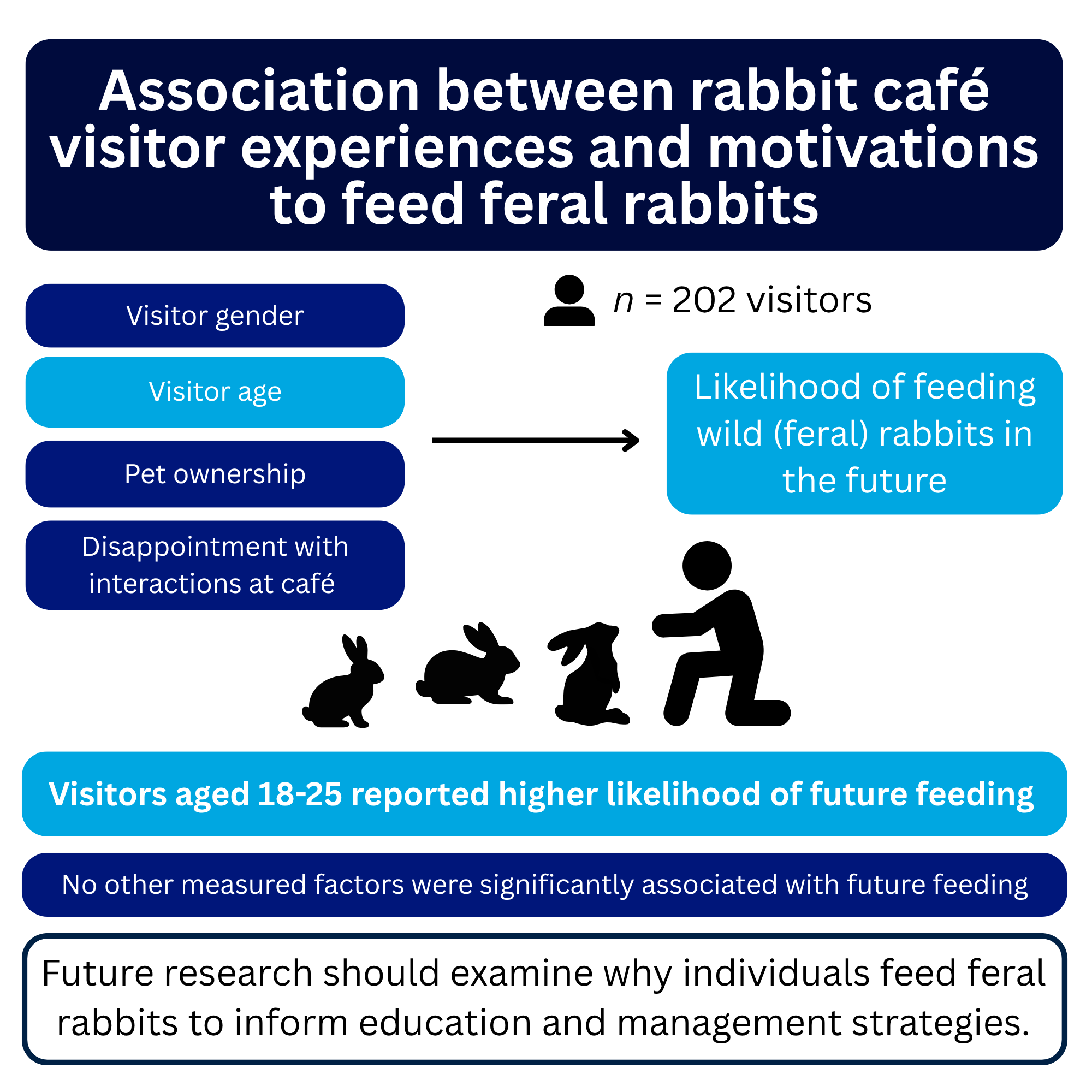
In Vancouver, British Columbia, feeding feral rabbits is prohibited due to risks to animal welfare and public health, yet feeding remains an ongoing issue in areas where populations of abandoned pet rabbits persist. One potential alternative to feeding animals in the wild is engaging in human–animal interaction opportunities in controlled settings such as rabbit cafés. This short report examined factors associated with visitors’ reported likelihood of feeding feral rabbits after visiting a rabbit café. Non-parametric analyses were used to examine differences in reported feeding likelihood across demographic and experiential variables. Younger visitors reported a higher likelihood of feeding feral rabbits in the future compared with older visitors, while no differences were observed by gender or pet ownership status. Patrons who reported disappointment with their café interactions also reported a higher likelihood of feeding feral rabbits in the future. This study is limited by reliance on self-reported future intentions; further research is needed to understand motivations of individuals who actively feed or are concerned about feral rabbit populations. Understanding how human–animal interaction opportunities shape attitudes and behaviors toward urban free-living animals may help inform visitor education and management strategies that support both public engagement and animal welfare.
Downloads
References
1.
Dubois S, Fraser D. A Framework to Evaluate Wildlife Feeding in Research, Wildlife Management, Tourism and Recreation. Animals. 2013;3(4):978–994. doi: 10.3390/ani3040978
2.
R Core Team. R: A Language and Environment for Statistical Computing. Vienna, Austria; 2024.
3.
Gunther I, Raz T, Zor YE, Bachowski Y, Klement E. Feeders of Free-Roaming Cats: Personal Characteristics, Feeding Practices, and Data on Cat Health and Welfare in an Urban Setting of Israel. Front Vet Sci. 2016;3(March):1–10. doi: 10.3389/fvets.2016.00021
4.
Neal SM, Wolf PJ. A cat is a cat: attachment to community cats transcends ownership status. J Shelter Med Community Anim Health. 2023;2(1). doi: 10.56771/jsmcah.v2.62
5.
Griffin LL, Ciuti S. Should we feed wildlife? A call for further research into this recreational activity. Conserv Sci Pract. 2023;5(10):e12958. doi: 10.1111/csp2.12958
6.
Bjerke T, Østdahl T, Kleiven J. Attitudes and activities related to urban wildlife: pet owners and non-owners. Anthrozoös. 2003;16(3):252–262. doi: 10.2752/089279303786992125
7.
Shuttlewood CZ, Greenwell PJ, Montrose VT. Pet ownership, attitude toward pets, and support for wildlife management strategies. Hum Dimens Wildl. 2016;21(2):180–188. doi: 10.1080/10871209.2016.1116029
8.
Grava S, Ly LH, Protopopova A. A descriptive survey of visitor experience and adoption interest among patrons of a rabbit café. J Shelter Med Community Anim Health. 2026;5(1). doi: 10.56771/jsmcah.v5.167
9.
Bradbury AG, Dickens GJE. Appropriate Handling of Pet Rabbits: A Literature Review. J Small Anim Pract. 2016;57(10):503–509. doi: 10.1111/jsap.12549
10.
Khor MM, Davey G, Zhao X. Why do People Feed Free-Roaming Cats? The role of Anticipated Regret in an Extended Theory of Planned Behavior in Malaysia. Anthrozoos. 2018;31(1):101–116. doi: 10.1080/08927936.2018.1406204
11.
Van Patter L, Flockhart T, Coe J, et al. Perceptions of Community Cats and Preferences for Their Management in Guelph, Ontario. Part I: A Quantitative Analysis. Can Vet J. 2019;60(1):41.
Additional Files
Published
Issue
Section
License
Copyright (c) 2026 Lexis H. Ly, Silvija Grava, Oceania C. Kreutzer, Alexandra Protopopova

This work is licensed under a Creative Commons Attribution 4.0 International License.
How to Cite