‘It’s Not as Cut-and-Dry as a Landlord Would Hope’ – BIPOC Pet Owners’ Experiences Navigating Housing Systems in Four U.S. Cities
DOI:
https://doi.org/10.56771/jsmcah.v5.173Keywords:
pet-inclusive housing, community-based participatory research, rapid qualitative analysisAbstract
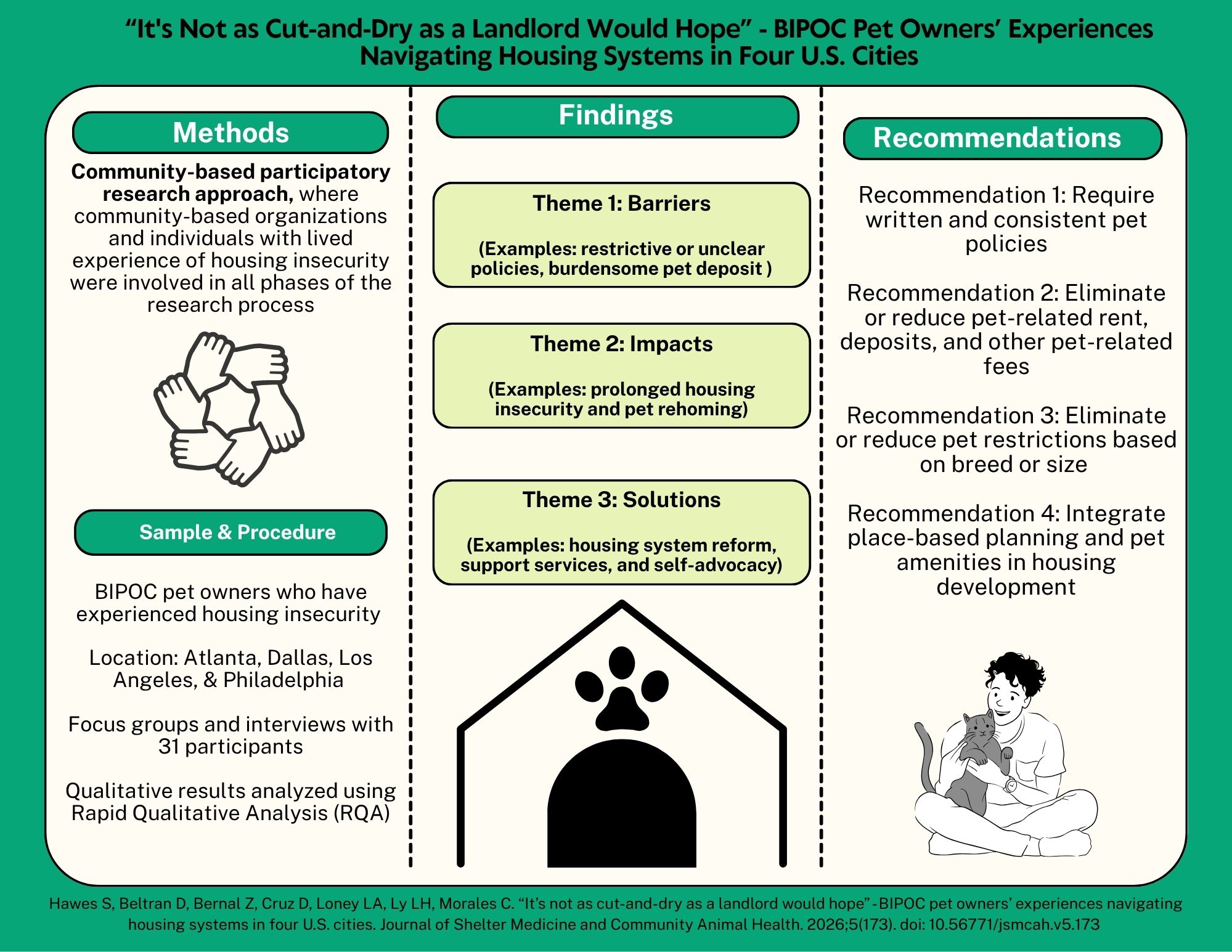
Introduction: The lack of pet-inclusive housing is one of the leading reasons for relinquishment to animal shelters in the U.S. However, few studies have focused specifically on Black, Indigenous, and People of Color (BIPOC) pet owners, despite their disproportionate exposure to housing insecurity. This study aimed to identify the barriers and solutions for navigating the lack of pet-inclusive housing in four U.S. cities (Atlanta, Dallas, Los Angeles, and Philadelphia).
Methods: A community-based participatory research approach was used and individuals with lived experience of housing insecurity co-created all aspects of the research. Nineteen virtual focus groups were conducted with 31 participants. The data were analyzed through rapid qualitative analysis.
Results: The results are organized by three themes: barriers, impacts, and solutions. The barriers to pet-inclusive housing included a general lack of pet-inclusive housing, restrictive and unclear pet policies, financial barriers, and challenges related to emotional support animal (ESA) accommodations. The impacts of these barriers included prolonged housing insecurity, noncompliance with pet policies, and pet rehoming. Suggested solutions included housing system reform, expanded supports and services, self-advocacy, and mutual aid.
Conclusion: These findings can be used to develop programs and policies that improve access to pet-inclusive housing and reduce one of the most common reasons for relinquishment to animal sheltering and rescue organizations.
Downloads
References
1.
National Low Income Housing Coalition. The GAP. National Low Income Housing Coalition; 2025. https://nlihc.org/gap. Accessed March 4, 2026.
2.
Fine A, Ng Z, Knight M, Griffin T, Braun L, Feldman S. A Commentary on Perspectives of the Pet Effect: Exploring Public Awareness, Community Impact, and Public Policy Implications. Pets. 2025;2(2):24. doi: 10.3390/pets2020024
3.
Pet-Inclusive Housing Initiative. Pets & Housing Data. 2025. https://www.petsandhousing.org/wp-content/uploads/2025/08/Pets-and-Housing-Data-2025-Edition.pdf. Accessed March 4, 2026.
4.
Mascitelli TM, Graham TM, Loney L, et al. Barriers to Finding and Maintaining Pet-Inclusive Affordable Housing: Tenant Experiences in Houston, Texas. Front Vet Sci. 2024;11:1465682. doi: 10.3389/fvets.2024.1465682
5.
McCarthy L, Simcock T. Pets and Private Renting: A Rapid Evidence Review of the Barriers, Benefits, and Challenges. Int J Housing Policy. 2025;25(1):119–146. doi: 10.1080/19491247.2024.2308711
6.
Power ER. Renting with Pets: A Pathway to Housing Insecurity? Housing Stud. 2017;32(3):336–360. doi: 10.1080/02673037.2016.1210095
7.
Applebaum JW, Loney L, Horecka K, Graham TM. Housing-Related Companion Animal Relinquishment across 21 Animal Shelters in the United States from 2019–2023. Front Vet Sci. 2024;11:1430388. doi: 10.3389/fvets.2024.1430388
8.
Friesinger JG, Birkeland B, Thorød AB. Human-Animal Relationships in Supported Housing: Animal Atmospheres for Mental Health Recovery. Front Psychol. 2021;12:712133. doi: 10.3389/fpsyg.2021.712133
9.
Jegatheesan B, Ormerod E, Graham TM, et al. Pets and Housing. In: Fine AH, Mueller MK, Ng ZY, Beck AM, Peralta JM, eds. The Routledge International Handbook of Human-Animal Interactions and Anthrozoology. Routledge; 2023:109–122. doi: 10.4324/9781032153346-8
10.
Morales C, Ruelas M, Daluz T, et al. Centering Community Voices: Advancing Health Equity for People and Pets in Los Angeles County through Community-Based Participatory Research. Front Vet Sci. 2025;12:1539811. doi: 10.3389/fvets.2025.1539811
11.
Vaughn LM, Jacquez F. Participatory Research Methods – Choice Points in the Research Process. J Participatory Res Methods. 2020;1(1):13244. doi: 10.35844/001c.13244
12.
Olmos-Vega FM, Stalmeijer RE, Varpio L, Kahlke R. A Practical Guide to Reflexivity in Qualitative Research: AMEE Guide No. 149. Med Teach. 2023;45(3):241–251. doi: 10.1080/0142159X.2022.2057287
13.
Wutich A, Beresford M, Bernard HR. Sample Sizes for 10 Types of Qualitative Data Analysis: An Integrative Review, Empirical Guidance, and Next Steps. Int J Qual Methods. 2024;23. doi: 10.1177/16094069241296206
14.
Gale RC, Wu J, Erhardt T, et al. Comparison of Rapid vs In-Depth Qualitative Analytic Methods from a Process Evaluation of Academic Detailing in the Veterans Health Administration. Implement Sci. 2019;14(1):11. doi: 10.1186/s13012-019-0853-y
15.
Kowalski CP, Nevedal AL, Finley EP, et al. Planning for and Assessing Rigor in Rapid Qualitative Analysis (PARRQA): A Consensus-Based Framework for Designing, Conducting, and Reporting. Implement Sci. 2024;19(1):71. doi: 10.1186/s13012-024-01397-1
16.
FIREPAW. Companion Animal Renters Study: The Market for Rental Housing for People with Pets Summary Report. 2003. https://firepaw.org/wp-content/uploads/2020/07/cars-website-version-exec-summary.pdf. Accessed March 4, 2026.
17.
Carlisle-Frank P, Frank JM, Nielsen L. Companion Animal Renters and Pet-Friendly Housing in the US. Anthrozoös. 2005;18(1):59–77. doi: 10.2752/089279305785594270
18.
Graham T, Milaney K, Adams C, Rock M. ‘Pets Negotiable’: How Do the Perspectives of Landlords and Property Managers Compare with Those of Younger Tenants with Dogs? Animals (Basel). 2018;8(3):32. doi: 10.3390/ani8030032
19.
Matsuoka A, Sorenson J, Graham TM, Ferreira J. No Pets Allowed: A Trans-Species Social Justice Perspective to Address Housing Issues for Older Adults and Companion Animals. Aotearoa N Z Soc Work. 2020;32(4):55–68. doi: 10.11157/anzswj-vol32iss4id793
20.
McCabe E, Brown CA, Tan MC, et al. Does Fido Have a Foot in the Door? Social Housing Companion Animal Policies and Policy Decision-Making in a Canadian City. Housing Soc. 2021;48(3):292–313. doi: 10.1080/08882746.2021.1881745
21.
Pearce HL, Spielman B, Weatherwax C, Pairis-Garcia M. A Novel Corporate-Community Partnership Model Provides Safe Housing for Pets of Domestic Violence Victims. J Am Vet Med Assoc. 2024;262(5):685–691. doi: 10.2460/javma.23.12.0716
22.
Barrett BJ, Gray A, Fitzgerald A, et al. Prevalence and Types of Pet-Inclusive Shelter Services for Unhoused Survivors of Intimate Partner Violence. Housing Stud. 2026;41(3):598–619. doi: 10.1080/02673037.2025.2479059
23.
Kerman N, Lem M, Witte M, Kim C, Rhoades H. A Multilevel Intervention Framework for Supporting People Experiencing Homelessness with Pets. Animals (Basel). 2020;10(10):1869. doi: 10.3390/ani10101869
24.
Kerman N, Gran-Ruaz S, Lem M. Pet Ownership and Homelessness: A Scoping Review. J Soc Distress Homeless. 2019;28(2):106–114. doi: 10.1080/10530789.2019.1650325
25.
Rose D, McMillian C, Carter O. Pet-Friendly Rental Housing: Racial and Spatial Inequalities. Space Culture. 2023;26(1):116–129. doi: 10.1177/1206331220956539
26.
Applebaum JW, Horecka K, Loney L, Graham TM. Pet-Friendly for Whom? An Analysis of Pet Fees in Texas Rental Housing. Front Vet Sci. 2021;8:767149. doi: 10.3389/fvets.2021.767149
27.
Pallotta NR. Emotional Support? Law, Social Control, and the Medicalization of the Human–Animal Bond. Pets. 2025;2(4):40. doi: 10.3390/pets2040040
28.
Bill Text – AB-468 Emotional Support Animals. Ca.gov; 2021. https://leginfo.legislature.ca.gov/faces/billTextClient.xhtml?bill_id=202120220AB468. Accessed February 11, 2026.
29.
U.S. Department of Housing & Urban Development. FHEO 2020-01: Assessing a Person’s Request to Have an Animal as a Reasonable Accommodation under the Fair Housing Act. 2020. https://www.dlcv.org/wp-content/uploads/2021/01/FHEO-2020-01.pdf. Accessed March 4, 2026.
30.
U.S. Department of Housing & Urban Development. Enforcement Guidance - Assessing Requests for the Use of an Animal as a Reasonable Accommodation Under the Fair Housing Act. https://www.hud.gov/sites/default/files/hudclips/documents/AS-Trainor-Enforcement-Guidance-Assessing-Requests-for-the-use-of-an-animal-as-a-reasonable-accommodation-under-the-fair-housing-act.pdf. Accessed October 7, 2026.
31.
HB26-1045 Disabilities Housing Protections | Colorado General Assembly. Colorado.gov; 2026. https://leg.colorado.gov/bills/HB26-1045. Accessed October 7, 2026.
32.
Dolan ED, Wyker B, Berliner EA, Goldweber M, Hernandez A. Don’t Forget Fido: A Call to Include Pets in Public Health Research and Policy to Support Families and Communities. Am J Public Health (1971). 2025;115(1):26–29. doi: 10.2105/AJPH.2024.307879
33.
Uhlig A, Bellamy W, Amos M, et al. Preventing Eviction and Housing Loss: Taking Advantage of a One Health Approach and the Human-Companion Animal Bond. Digital Commons@UM Carey Law; 2023;26(2):181–214. https://digitalcommons.law.umaryland.edu/jhclp/vol26/iss2/2. Accessed March 4, 2026.
34.
Eagan BH, Gordon E, Protopopova A. Reasons for Guardian-Relinquishment of Dogs to Shelters: Animal and Regional Predictors in British Columbia, Canada. Front Vet Sci. 2022;9:857634. doi: 10.3389/fvets.2022.857634
35.
Ly LH, Gordon E, Protopopova A. Inequitable Flow of Animals in and Out of Shelters: Comparison of Community-Level Vulnerability for Owner-Surrendered and Subsequently Adopted Animals. Front Vet Sci. 2021;8:784389. doi: 10.3389/fvets.2021.784389
36.
Montgomery J, Liang Z, Lloyd J. A Scoping Review of Forced Separation between People and Their Companion Animals. Anthrozoös. 2024;37(2):245–267. doi: 10.1080/08927936.2023.2287315
37.
Schmitz RM, Amjadi S, Tabler J, Ishoy J. Radical Healing in Precarity: LGBTQ+ Young People’s Approaches to Life Challenges and Aspirations through Pet Caregiving in the Context of Homelessness. Youth. 2023;3(1):50–69. doi: 10.3390/youth3010004
38.
Cleary M, West S, Visentin D, et al. The Unbreakable Bond: The Mental Health Benefits and Challenges of Pet Ownership for People Experiencing Homelessness. Issues Mental Health Nurs. 2021;42(8):741–746. doi: 10.1080/01612840.2020.1843096
39.
Bisgrove D, Wu S, Sheehan C. Social Determinants of Pet Needs among Young Adults Experiencing Homelessness in the Southwest United States. J Soc Distress Homeless. 2025;34(2):401–413. doi: 10.1080/10530789.2024.2417116
40.
Phillips GE, Gunter LM. Companion Animal Foster Caregiving: A Scoping Review Exploring Animal and Caregiver Welfare, Barriers to Caregiver Recruitment and Retention, and Best Practices for Foster Care Programs in Animal Shelters. PeerJ. 2024;12:e18623. doi: 10.7717/peerj.18623
41.
Doyle E, Dowling-Guyer S. Safety Net Programs. In: Collins KA, Reid PJ, Cussen VA, DiGangi BA, eds. Animal Behavior for Shelter Veterinarians and Staff. John Wiley & Sons, Inc; 2022:111–132. doi: 10.1002/9781119618515.ch5
42.
Von Geldern W. Evictions, Legal Counsel, and Population Health: A Mixed Methods Study. Soc Sci Med. 2025;377:118134. doi: 10.1016/j.socscimed.2025.118134
43.
Bernhardt F, Schwiertz H. Enacting Tenant Citizenship and Struggles for the Right to Home: Linking Activist, Active and Community Citizenship. Citizenship Stud. 2025;29(1–2):41–56. doi: 10.1080/13621025.2025.2470742
44.
Soaita AM. Everyday Activism: Private Tenants Demand Right to Home. Housing Stud. 2024;39(6):1422–1443. doi: 10.1080/02673037.2022.2036329
45.
Weissmann E. Mutual Aid in Low-Cost Housing. Ann Am Acad Polit Soc Sci. 1960;329(1):107–114. doi: 10.1177/000271626032900112
46.
Morales C, Cruz D, Daluz T, et al. Centering Community Voices Advancing Racial Equity for People & Pets in Los Angeles through Community-Based Participatory Research. 2024. https://careawo.org/wp-content/uploads/2025/06/CARE-LA-CPR-Report-FINAL.pdf. Accessed March 4, 2026.
47.
Morales C, Allen A, Anker J, et al. Centering Community Voices Advancing Racial Equity for People & Pets in Philadelphia through Community-Based Participatory Research. 2024. https://careawo.org/wp-content/uploads/2025/06/CARE-Philly-CPR-Report-FINAL.pdf. Accessed March 4, 2026.
48.
U.S. Department of Housing & Urban Development. Waiting List and Tenant Selection. In: Occupancy Requirements of Subsidized Multifamily Housing Programs (4350.3) Handbook. https://archives.hud.gov/offices/adm/hudclips/handbooks/hsgh/43503c4HSGH.PDF. Accessed March 4, 2026.
49.
Pet-Inclusive Housing Initiative. 2021 Pet-Inclusive Housing Report. Pet-Inclusive Housing Initiative; 2021. https://www.petsandhousing.org/2021-pet-inclusive-housing-report/. Accessed March 4, 2026.
50.
Simcock T, McCarthy L, Kara A, Brown P. The Financial Impact of Pet Ownership in Rental Properties. 2024. https://shura.shu.ac.uk/33664/1/financial-impact-pet-ownership-rental-properties.pdf. Accessed March 4, 2026.
51.
Aidoo EM. Social Determinants of Health: Examining Poverty, Housing, and Education in Widening U.S. Healthcare Access Disparities. World J Adv Res Rev. 2023;20(1):1370–1389. doi: 10.30574/wjarr.2023.20.1.2018
52.
Chum K, Fitzhenry G, Robinson K, et al. Examining Community-Based Housing Models to Support Aging in Place: A Scoping Review. Gerontologist. 2022;62(3):e178–e192. doi: 10.1093/geront/gnaa142
53.
Reid KW, Vittinghoff E, Kushel MB. Association between the Level of Housing Instability, Economic Standing and Health Care Access: A Meta-Regression. J Health Care Poor Underserv. 2008;19(4):1212–1228. doi: 10.1353/hpu.0.0068
54.
Eshetu HB, Blackford K, Lobo R, Alemu MB, Tessema GA, Crawford G. Housing Insecurity and Health Outcomes Among Migrants from Culturally and Linguistically Diverse Backgrounds in High-Income Countries: A Scoping Review. J Immigr Minor Health. 2026. doi: 10.1007/s10903-026-01849-4
55.
Golding E, Goodman L, Strochak S. Is Limited English Proficiency a Barrier to Homeownership. 2018. https://www.urban.org/sites/default/files/publication/97436/is_limited_english_proficiency_a_barrier_to_homeownership_0.pdf. Accessed March 4, 2026.
Additional Files
Published
Issue
Section
License
Copyright (c) 2026 Sloane M. Hawes M. Hawes, Diana R. Beltran, Zaira Bernal, Diana Cruz, Lauren A. Loney, Lexis H. Ly, Celeste Morales

This work is licensed under a Creative Commons Attribution 4.0 International License.
How to Cite