Cats in Space: Quantifying the Community Cat Caregiver Network
DOI:
https://doi.org/10.56771/jsmcah.v5.168Keywords:
community cats, free-roaming cats, geospatial, return-to-field, RTF, TNR, trap-neuter-return, welfareAbstract
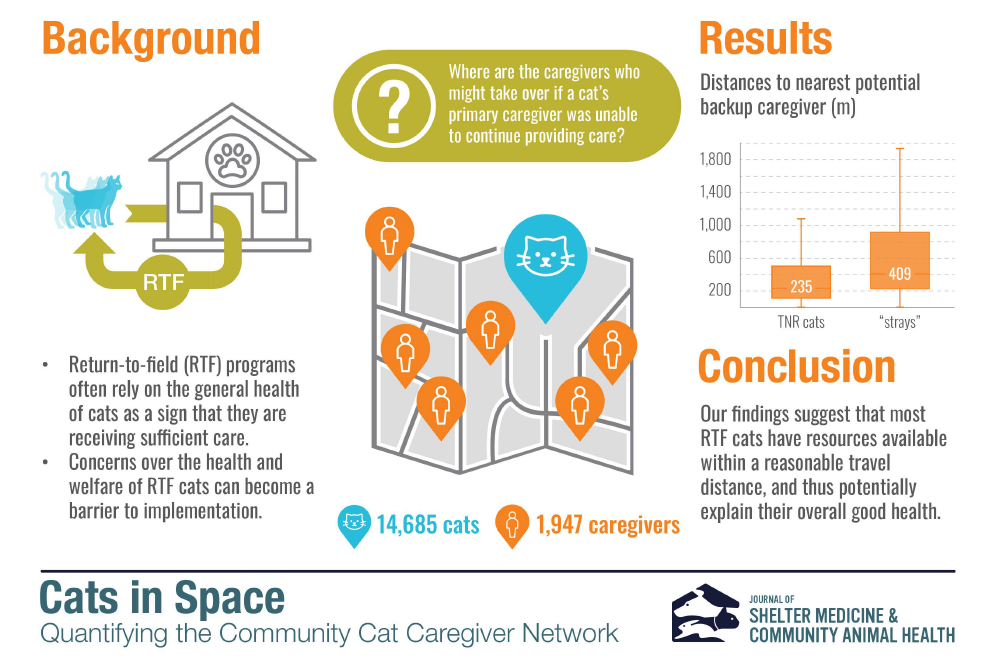
Introduction: For many US animal shelters, the majority of feline admissions are classified as ‘strays’. Historically, many of these cats were euthanatized despite being in generally good health. Return-to-field programs – shelter-based versions of the more traditional (i.e. community-based) trap-neuter-return (TNR) programs – offer an alternative, increasing a shelter’s live outcomes as eligible cats are sterilized, vaccinated, and returned to the location where they were found. It is not unusual for these programs to be conducted without any direct knowledge of caregivers associated with specific cats. Instead, they rely on the general health of the cats as a sign that they are receiving sufficient care. The objective of this study was to quantify the extent of the community cat ‘caregiver network’ by applying a geospatial analysis to a large set of cat and caregiver location data.
Methods: For this retrospective observational study, we used two sets of cat and caregiver location data (22,521 records in all). An empirical network was created using records for which both cat and caregiver location were known; a theoretical network was created using records for which no caregiver location was available (the cats having come through the local shelter system as ‘strays’). These two caregiver networks were then used to estimate the distances between community cats and potential caregivers nearby.
Results: Our results suggest that most cats in the study community are located within distances that are reasonably consistent with well-documented feline home ranges and foraging behavior in urban and suburban environments. For cats included in the area’s extensive TNR program, for example, the median distance to the second nearest caregiver was 235 m. For cats entering the shelter system as strays, the median distance to the nearest known caregiver was similar (246 m). Our theoretical network suggests that if 20% of households in the study are provided care for outdoor cats, 66.7% of cats would be within 126 meters of a theoretical caregiver, 20.7% would be within 80 meters.
Conclusion: The general availability of resources revealed by these findings might help explain the results of previous research (and considerable anecdotal evidence) documenting the good general health of community cats.
Downloads
References
1.
Houser SK. Prodigal Pets: A History of Animal Sheltering in America and the Origin of the No-Kill Movement. 2018. Accessed June 26, 2024. https://www.outthefrontdoor.com/prodigal-pets
2.
Gunther I, Hawlena H, Azriel L, Gibor D, Berke O, Klement E. Reduction of Free-Roaming Cat Population Requires High-Intensity Neutering in Spatial Contiguity to Mitigate Compensatory Effects. P Natl Acad Sci Biol. 2022;119(15):e2119000119. doi: 10.1073/pnas.2119000119
3.
Luzardo OP, Vara-Rascón M, Dufau A, Infante E, Travieso-Aja MDM. Four Years of Promising Trap–Neuter–Return (TNR) in Córdoba, Spain: A Scalable Model for Urban Feline Management. Animals. 2025;15(4):4. doi: 10.3390/ani15040482
4.
Natoli E, Maragliano L, Cariola G, et al. Management of Feral Domestic Cats in the Urban Environment of Rome (Italy). Prev Vet Med. 2006;77(3–4):180–185. doi: 10.1016/j.prevetmed.2006.06.005
5.
Nutter FB. Evaluation of a Trap-Neuter-Return Management Program for Feral Cat Colonies: Population Dynamics, Home Ranges, and Potentially Zoonotic Diseases. North Carolina State University; 2005. Accessed Oct 25, 2023. http://www.carnivoreconservation.org/files/thesis/nutter_2005_phd.pdf
6.
Spehar DD, Wolf PJ. An Examination of an Iconic Trap-Neuter-Return Program: The Newburyport, Massachusetts Case Study. Animals. 2017;7(11):81. doi: 10.3390/ani7110081
7.
Spehar DD, Wolf PJ. A Case Study in Citizen Science: The Effectiveness of a Trap-Neuter-Return Program in a Chicago Neighborhood. Animals. 2018;8(1):14. doi: 10.3390/ani7110081
8.
Spehar DD, Wolf PJ. Back to School: An Updated Evaluation of the Effectiveness of a Long-Term Trap-Neuter-Return Program on a University’s Free-Roaming Cat Population. Animals. 2019;9(10):768. doi: 10.3390/ani9100768
9.
Tan K, Rand J, Morton J. Trap-Neuter-Return Activities in Urban Stray Cat Colonies in Australia. Animals. 2017;7(6):46. doi: 10.3390/ani7060046
10.
Benka VA, Boone JD, Miller PS, et al. Guidance for Management of Free-Roaming Community Cats: A Bioeconomic Analysis. J Feline Med Surg. 2021;24(10):975–985. doi: 10.1177/1098612X211055685
11.
Wolf PJ, Weedon GR. An Inconvenient Truth: Targeted TNR Enjoys a Track Record Unmatched by Lethal Methods for Managing Free-Roaming Cats. J Shelter Med Community Anim Health. 2023;2:1. doi: 10.56771/jsmcah.v2.68
12.
Wolf PJ, Schaffner JE. The Road to TNR: Examining Trap-Neuter-Return Through the Lens of Our Evolving Ethics. Front Vet Sci. 2019;5:341. doi: 10.3389/fvets.2018.00341
13.
AAFP. 2023 AAFP Free-Roaming Cat Position Statement. J Feline Med Surg. 2023;25(5):1098612X231173791. doi: 10.1177/1098612X231173791
14.
Neal SM, Wolf PJ. A Cat Is a Cat: Attachment to Community Cats Transcends Ownership Status. J Shelter Med Community Anim Health. 2023;2:62. doi: 10.56771/jsmcah.v2.62
15.
Scotney R, Rand J, Rohlf V, Hayward A, Bennett P. The Impact of Lethal, Enforcement-Centred Cat Management on Human Wellbeing: Exploring Lived Experiences of Cat Carers Affected by Cat Culling at the Port of Newcastle. Animals. 2023;13(2):2. doi: 10.3390/ani13020271
16.
Mitchell T. Program Gives Feral Cats Shot at Freedom. The Florida Times-Union. November 19, 2008. Accessed June 2, 2024. https://www.jacksonville.com/story/entertainment/television/2008/11/20/stub-256/16005331007/
17.
Heath D. Reset: How to Change What’s Not Working. Avid Reader Press/Simon & Schuster; 2025. Accessed Aug 10, 2025. https://www.simonandschuster.com/books/Reset/Dan-Heath/9781668062098
18.
Johnson KL, Cicirelli J. Study of the Effect on Shelter Cat Intakes and Euthanasia from a Shelter Neuter Return Project of 10,080 Cats from March 2010 to June 2014. PeerJ. 2014;2:e646. doi: 10.7717/peerj.646
19.
Edinboro CH, Watson HN, Fairbrother A. Association between a Shelter-Neuter-Return Program and Cat Health at a Large Municipal Animal Shelter. J Am Vet Med Assoc. 2016;248(3):298–308. doi: 10.2460/javma.248.3.298
20.
Hamilton F. Implementing Nonlethal Solutions for Free-Roaming Cat Management in a County in the Southeastern United States. Front Vet Sci. 2019;6:259. doi: 10.3389/fvets.2019.00259
21.
Wolf PJ, Hamilton FE. Reforming Urban U.S. Animal Shelters: It’s (Not) Like Herding Cats. J Urban Affairs. 2019;44(2):221–242.
22.
Kreisler RE, Pugh AA, Pemberton K, Pizano S. The Impact of Incorporating Multiple Best Practices on Live Outcomes for a Municipal Animal Shelter in Memphis, TN. Front Vet Sci. 2022;9:786866. doi: 10.3389/fvets.2022.786866
23.
Levy JK, Isaza NM, Scott KC. Effect of High-Impact Targeted Trap-Neuter-Return and Adoption of Community Cats on Cat Intake to a Shelter. Vet J. 2014;201(3):269–274. doi: 10.1016/j.tvjl.2014.05.001
24.
Mauro K, Wolf PJ. Playing the Cards You’re Dealt: Implementing Feline Lifesaving Programs and Practices Despite Restrictive Ordinance Provisions. J Shelter Med Community Anim Health. 2024;3:49. doi: 10.56771/jsmcah.v3.49
25.
Spehar DD, Wolf PJ. The Impact of an Integrated Program of Return-to-Field and Targeted Trap-Neuter-Return on Feline Intake and Euthanasia at a Municipal Animal Shelter. Animals. 2018;8(4):55. doi: 10.3390/ani8040055
26.
Spehar DD, Wolf PJ. Integrated Return-to-Field and Targeted Trap-Neuter-Vaccinate-Return Programs Result in Reductions of Feline Intake and Euthanasia at Six Municipal Animal Shelters. Front Vet Sci. 2019;6:77. doi: 10.3389/fvets.2019.00077
27.
Hurley KF, Levy JK. Rethinking the Animal Shelter’s Role in Free-Roaming Cat Management. Front Vet Sci. 2022;9:847081. doi: 10.3389/fvets.2022.847081
28.
Dalrymple AM, Stively NE, Kreisler R. Tag! You’re Home! Reunification of Pet Cats with Their Owners Using a Community Engagement Approach: A Community Case Report. J Shelter Med Community Anim Health. 2025;3:113. doi: 10.56771/jsmcah.v3.113
29.
Schiefer CA, Spera K, Crawford PC, Levy JK. Trap–Neuter–Return and Return-to-Field Programs for Managing Community Cats at Florida Animal Shelters. J Shelter Med Community Anim Health. 2025;4:1. doi: 10.56771/jsmcah.v4.126
30.
Wallace JL, Levy JK. Population Characteristics of Feral Cats Admitted to Seven Trap-Neuter Programs in the United States. J Feline Med Surg. 2006;8:279–284. doi: 10.1016/j.jfms.2006.02.004
31.
Scott KC, Levy JK, Gorman SP, Neidhart SMN. Body Condition of Feral Cats and the Effect of Neutering. J Appl Anim Welf Sci. 2002;5(3):203–213. doi: 10.1207/S15327604JAWS0503_04
32.
Zito S, Walker J, Gates MC, Dale A. A Preliminary Description of Companion Cat, Managed Stray Cat, and Unmanaged Stray Cat Welfare in Auckland, New Zealand Using a 5-Component Assessment Scale. Front Vet Sci. 2019;6:40. doi: 10.3389/fvets.2019.00040
33.
August JW. Humane Society’s ‘Community Cat’ Plan Stirs Controversy Despite Scientific Support. Times of San Diego. August 18, 2022. Accessed July 9, 2023. https://timesofsandiego.com/life/2022/08/17/humane-societys-community-cat-plan-stirs-controversy-despite-scientific-support/
34.
Trageser C. San Diego Humane Society Releasing More Cats to Streets. KPBS Public Media. May 19, 2021. Accessed Dec 28, 2023. https://www.kpbs.org/news/midday-edition/2021/05/19/san-diego-humane-society-releasing-more-stray-cats
35.
Bacal KA. Pet Assistance Foundation v. San Diego Humane Society and SPCA. Superior Court of California; 2025.
36.
Times of San Diego. Judge Clears Way for Humane Society Cat Program after Legal Battle. Times of San Diego. June 11, 2025. Accessed Nov 9, 2025. https://timesofsandiego.com/life/2025/06/11/judge-clears-way-humane-societys-community-cat-program-legal-battle/
37.
U.S. Census Bureau. QuickFacts: Jefferson County, Kentucky. 2023. Accessed Jul 22, 2023. https://www.census.gov/quickfacts/fact/table/jeffersoncountykentucky/PST045222
38.
American Legal Publishing. Animal Ordinance–Louisville-Jefferson. Louisville, KY. 2024. Accessed Nov 30, 2024. https://codelibrary.amlegal.com/codes/louisvillemetro/latest/loukymetro/0-0-0-7177
39.
Spehar DD, Wolf PJ. The Impact of Return-to-Field and Targeted Trap-Neuter-Return on Feline Intake and Euthanasia at a Municipal Animal Shelter in Jefferson County, Kentucky. Animals. 2020;10(8):8. doi: 10.3390/ani10081395
40.
Neal SM, Wolf PJ, Anderson ME. Geospatial Model Suggests Sterilizing Free-Roaming Domestic Cats Reduces Potential Risk of Toxoplasma gondii Infection. Zoonotic Dis. 2025;5(3):24. doi: 10.3390/zoonoticdis5030024
41.
Neal SM, Kremer T. Who Cares? Exploring the Demographics and Proportion of People Providing Care for Community Cats in Seven Study Communities in the United States. J Shelter Med Community Animal Health. 2024;3(1):71. doi: 10.56771/jsmcah.v3.71
42.
Levy JK, Woods JE, Turick SL, Etheridge DL. Number of Unowned Free-Roaming Cats in a College Community in the Southern United States and Characteristics of Community Residents Who Feed Them. J Am Vet Med Assoc. 2003;223(2):202–205. doi: 10.2460/javma.2003.223.202
43.
Kass PH, Johnson KL, Weng HY. Evaluation of Animal Control Measures on Pet Demographics in Santa Clara County, California, 1993–2006. PeerJ. 2013;1:e18. doi: 10.7717/peerj.18
44.
APPA. 2017–2018 APPA National Pet Owners Survey. American Pet Products Association; 2018.
45.
APPA. 2019–2020 APPA National Pet Owners Survey. American Pet Products Association; 2020.
46.
Horn JA, Mateus-Pinilla N, Warner RE, Heske EJ. Home Range, Habitat Use, and Activity Patterns of Free-Roaming Domestic Cats. J Wildl Manage. 2011;75(5):1177–1185. doi: 10.1002/jwmg.145
47.
Kays R, Dunn RR, Parsons AW, et al. The Small Home Ranges and Large Local Ecological Impacts of Pet Cats. Animal Conservation. 2020;23(5):12563. doi: 10.1111/acv.12563
48.
Barratt DG. Home Range Size, Habitat Utilisation and Movement Patterns of Suburban and Farm Cats Felis Catus. Ecography. 1997;20(3):271–280. doi: 10.1111/j.1600-0587.1997.tb00371.x
49.
Liberg O, Sandell M, Pontier D, Natoli E. Density, Spatial Organisation and Reproductive Tactics in the Domestic Cat and Other Felids. In: Turner DC, Bateson PPG, eds. The Domestic Cat: The Biology of Its Behaviour. Cambridge University Press; 2000:119–147.
50.
Wong D. The Modifiable Areal Unit Problem (MAUP). In: Fotheringham AS, Rogerson PA, eds. The SAGE Handbook of Spatial Analysis. SAGE Publications; 2008:105–124. Accessed Nov. 20, 2025. https://books.google.com/books?id=phEgXfbCU_YC
51.
Bissonnette V, Lussier B, Doizé B, Arsenault J. Impact of a Trap-Neuter-Return Event on the Size of Free-Roaming Cat Colonies around Barns and Stables in Quebec: A Randomized Controlled Trial. Can J Vet Res. 2018;82(3):192–197.
52.
Castillo D, Clarke AL. Trap/Neuter/Release Methods Ineffective in Controlling Domestic Cat ‘Colonies’ on Public Lands. Nat Areas J. 2003;23(3):247–253.
53.
Gunther I, Raz T, Klement E. Association of Neutering with Health and Welfare of Urban Free-Roaming Cat Population in Israel, during 2012–2014. Prev Vet Med. 2018;157:26–33. doi: 10.1016/j.prevetmed.2018.05.018
54.
Ferreira GA, Machado JC, Nakano-Oliveira E, Andriolo A, Genaro G. The Effect of Castration on Home Range Size and Activity Patterns of Domestic Cats Living in a Natural Area in a Protected Area on a Brazilian Island. Appl Anim Behav Sci. 2020;230:105049. doi: 10.1016/j.applanim.2020.105049
55.
Schmidt PM, Lopez RR, Pierce BL. Estimating Free-Roaming Cat Densities in Urban Areas: Comparison of Mark-Resight and Distance Sampling. Wildlife Biol Pract. 2007;3(1):18–27. doi: 10.2461/wbp.2007.3.3
56.
Horn JA. Home Range, Habitat Use, and Activity Patterns of Free-Ranging Domestic Cats. Master of Science in Natural Resources and Environmental Sciences, University of Illinois at Urbana-Champaign; 2009.
57.
Lord LK. Attitudes toward and Perceptions of Free-Roaming Cats among Individuals Living in Ohio. J Am Vet Med Assoc. 2008;232(8):1159–1167. doi: 10.2460/javma.232.8.1159
58.
Cove MV, Gardner B, Simons TR, Kays R, O’Connell AF. Free-Ranging Domestic Cats (Felis catus) on Public Lands: Estimating Density, Activity, and Diet in the Florida Keys. Biol Invasions. 2018;20(2):333–344. doi: 10.1007/s10530-017-1534-x
59.
Silva-Rodríguez EA, Sieving KE. Influence of Care of Domestic Carnivores on Their Predation on Vertebrates. Conserv Biol. 2011;25(4):808–815. doi: 10.1111/j.1523-1739.2011.01690.x
60.
Zasloff LR, Hart LA. Attitudes and Care Practices of Cat Caretakers in Hawaii. Anthrozoös. 1998;11(4):242–248. doi: 10.2752/089279398787000599
Published
Issue
Section
License
Copyright (c) 2026 Sue M. Neal, Peter J. Wolf

This work is licensed under a Creative Commons Attribution 4.0 International License.
How to Cite