Linked Administrative Records, Adoption Throughput, and Early Return of Dogs after Adoption in a Rural Animal Shelter: A Single-Shelter Retrospective Study
DOI:
https://doi.org/10.56771/jsmcah.v5.177Keywords:
animal sheltering, adoption return, population management, data quality, retrospective studies, companion animal welfareAbstract
Introduction: Rural, volunteer-intensive dog shelters commonly maintain linked administrative records, yet the utility of those records for daily adoption activity and early post-adoption returns remain unclear. Using records from one rural Kentucky dog shelter, this study characterizes adoption activity and early returns while assessing record completeness and limitations.
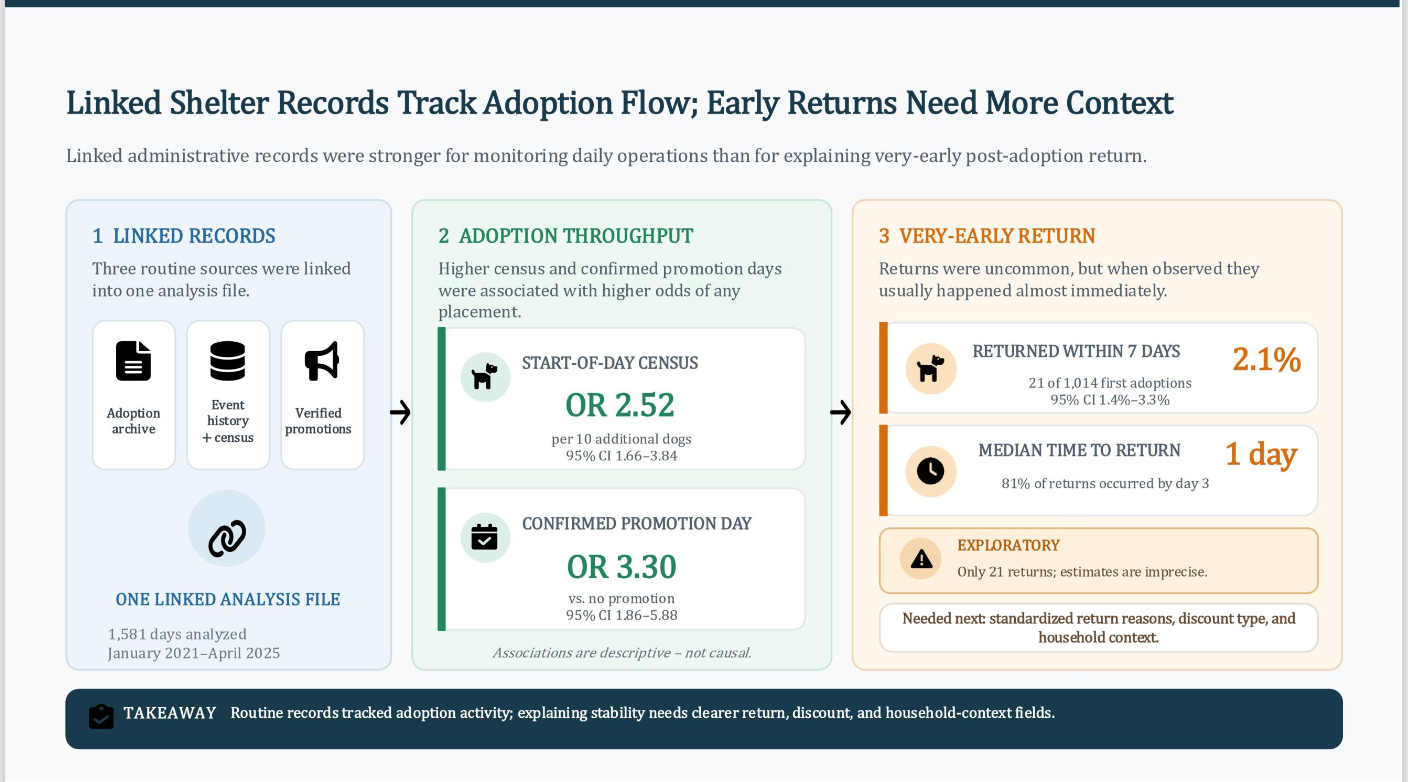
Methods: We used linked, de-identified dog records from one rural Kentucky shelter. ‘Placement’ is defined as coded adoption outcome in the event-history file; transfers, foster movements, and return-to-owner events are not counted as placements. The adoption archive covers June 2019 through April 2025 and includes 1,098 adoptions involving 1,017 dogs. For the operations analysis, we reconstructed a daily on-site dog census from the event-history file using a piecewise anchored series with the residual correction distributed linearly across days within each of 10 anchor-defined intervals (11 anchor reports). For the early-return analysis, we restricted the sample to first adoptions with a complete 7-day observation window. Given only 21 observed 7-day return events, we treat all return models as exploratory.
Results: Across 1,581 days in the operations window (490 placement days, 31.0%), higher start-of-day census was associated with greater odds of any placement (odds ratio [OR]: 2.52 per 10 additional dogs, 95% confidence interval [CI]: 1.66–3.84). Confirmed shelter-wide promotion days were associated with higher odds of any placement (OR: 3.30, 95% CI: 1.86–5.88). In the secondary Poisson rate model for placement counts, the point estimate on promotion days exceeded one (incidence rate ratio [IRR]: 1.14, 95% CI: 0.96–1.36), but the CI included 1, indicating no clear effect. In the return sample, 21 of 1,014 first adoptions ended in an observed return within 7 days (2.1%); the median time to observed return was 1 day (interquartile range [IQR]: 1–3), so the 7-day window predominantly captures acute placement breakdown. Discount-coded first adoptions had a higher 7-day return rate than non-discount-coded first adoptions (3.3% vs. 1.8%; adjusted OR: 1.98, 95% CI: 0.76–5.13). We interpret all associations descriptively and do not treat them as causal effects.
Conclusion: For this rural Kentucky shelter, the linked records are useful for tracking crowding-related adoption activity, but they support only limited descriptive conclusions about very-early return after adoption. Distinguishing shelter-wide promotions from adoption-level discounts is conceptually important. These two measures overlap partially, and the available records cannot distinguish selective fee waivers from blanket shelter-wide events. Stronger conclusions about placement stability would require clearer fee coding, more detailed return-reason fields, and basic adopter-context measures.
Downloads
References
1.
Karsten CL, Wagner DC, Kass PH, Hurley KF. An Observational Study of the Relationship between Capacity for Care as an Animal Shelter Management Model and Cat Health, Adoption and Death in Three Animal Shelters. Vet J. 2017;227:15–22. doi: 10.1016/j.tvjl.2017.08.003
2.
Newbury S, Blinn MK, Bushby PA, et al. Guidelines for Standards of Care in Animal Shelters. 1st ed. Apex, NC: Association of Shelter Veterinarians; 2010.
3.
Association of Shelter Veterinarians. Guidelines for Standards of Care in Animal Shelters: Second Edition. J Shelter Med Community Anim Health. 2022;1(suppl 1):1–76.
4.
University of Wisconsin Shelter Medicine Program. Length of stay (LOS). Published 2025. Accessed Mar 30, 2026. https://sheltermedicine.wisc.edu/library/resources/length-of-stay-los
5.
Shore ER. Returning a Recently Adopted Companion Animal: Adopters’ Reasons for and Reactions to the Failed Adoption Experience. J Appl Anim Welf Sci. 2005;8(3):187–198. https://doi.org/10.1207/s15327604jaws0803_3
6.
Hawes SM, Kerrigan JM, Hupe T, Morris KN. Factors Informing the Return of Adopted Dogs and Cats to an Animal Shelter. Animals. 2020;10(9):1573. doi: 10.3390/ani10091573
7.
Powell L, Lee B, Reinhard CL, et al. Returning a Shelter Dog: The Role of Owner Expectations and Dog Behavior. Animals. 2022;12(9):1053. doi: 10.3390/ani12091053
8.
Scott S, Jong E, McArthur M, Hazel SJ. Follow-Up Surveys of People Who Have Adopted Dogs and Cats from an Australian Shelter. Appl Anim Behav Sci. 2018;201:40–45. doi: 10.1016/j.applanim.2017.12.021
9.
Bohland KR, Lilly ML, Herron ME, Arruda AG, O’Quin JM. Shelter Dog Behavior after Adoption: Using the C-BARQ to Track Dog Behavior Changes through the First Six Months after Adoption. PLoS One. 2023;18(8):e0289356. doi: 10.1371/journal.pone.0289356
10.
Reese LA. Make Me A Match: Prevalence and Outcomes Associated with Matching Programs in Dog Adoptions. J Appl Anim Welf Sci. 2021;24(1):16–28. doi: 10.1080/10888705.2020.1867985
11.
Connelly R, Playford CJ, Gayle V, Dibben C. The Role of Administrative Data in the Big Data Revolution in Social Science Research. Soc Sci Res. 2016;59:1–12. doi: 10.1016/j.ssresearch.2016.04.015
12.
Kremer T. A New Web-Based Tool for RTO-Focused Animal Shelter Data Analysis. Front Vet Sci. 2021;8:669428. doi: 10.3389/fvets.2021.669428
13.
Ly LH, Protopopova A. A Mixed-Method Analysis of the Consistency of Intake Information Reported by Shelter Staff upon Owner Surrender of Dogs. J Appl Anim Welf Sci. 2023;28(2):259–280. doi: 10.1080/10888705.2023.2250254
14.
ASPCApro. What Animal Data Do You Need? Accessed Mar 30, 2026. https://www.aspcapro.org/resource/what-animal-data-do-you-need
15.
Protopopova A, Mehrkam LR, Boggess MM, Wynne CDL. In-Kennel Behavior Predicts Length of Stay in Shelter Dogs. PLoS One. 2014;9(12):e114319. doi: 10.1371/journal.pone.0114319
16.
Applebaum JW, Peek CW, Zsembik BA. Trends in Intake and Outcome Data from U.S. Animal Shelters from 2016 to 2020. Front Vet Sci. 2022;9:863990. doi: 10.3389/fvets.2022.863990
17.
Powell L, Houlihan C, Stone M, et al. Animal Shelters’ Response to the COVID-19 Pandemic: A Pilot Survey of 14 Shelters in the Northeastern United States. Animals. 2021;11(9):2669. doi: 10.3390/ani11092669
18.
Cameron AC, Trivedi PK. Regression Analysis of Count Data. 2nd ed. Cambridge: Cambridge University Press; 2013.
19.
Mullahy J. Specification and Testing of Some Modified Count Data Models. J Econom. 1986;33(3):341–365. doi: 10.1016/0304-4076(86)90002-3
20.
Zorn CJW. An Analytic and Experimental Examination of Zero-Inflated and Hurdle Poisson Specifications. Sociol Methods Res. 1998;26(3):368–400. doi: 10.1177/0049124198026003004
21.
Peduzzi P, Concato J, Kemper E, Holford TR, Feinstein AR. A Simulation Study of the Number of Events Per Variable in Logistic Regression Analysis. J Clin Epidemiol. 1996;49(12):1373–1379. doi: 10.1016/S0895-4356(96)00236-3.
22.
Heinze G, Schemper M. A Solution to the Problem of Separation in Logistic Regression. Stat Med. 2002;21(16):2409–2419. doi: 10.1002/sim.1047
23.
Weiss E, Gramann S. A Comparison of Attachment Levels of Adopters of Cats: Fee-Based Adoptions Versus Free Adoptions. J Appl Anim Welf Sci. 2009;12(4):360–370. doi: 10.1080/10888700903163674
24.
MacArthur SL, Levy JK, Dingman PA, Tucker SJ. Outcome of Pets Adopted During a Waived-Fee Adoption Event: Maddie’s Matchmaker Adoptathon. In Maddie’s Shelter Medicine Conference proceedings, 2012. Gainesville, FL: Maddie’s Shelter Medicine Program, College of Veterinary Medicine, University of Florida; 2012.
25.
ASPCApro. Research Shows Why Shelters Should Offer Free Cat Adoptions. ASPCApro. https://www.aspcapro.org/resource/research-shows-why-shelters-should-offer-free-cat-adoptions. Accessed May 17, 2026.
Additional Files
Published
Issue
Section
License
Copyright (c) 2026 Prayat Poudel

This work is licensed under a Creative Commons Attribution 4.0 International License.
How to Cite