Feasibility of Recruiting and Retaining Adopters From Animal Shelters for a Longitudinal Study of Mental Health
DOI:
https://doi.org/10.56771/jsmcah.v5.175Keywords:
animal shelter, cats, dogs, pets, community engagement, psychological health, mental well-being, human–animal interactions, human–animal bond, stressAbstract
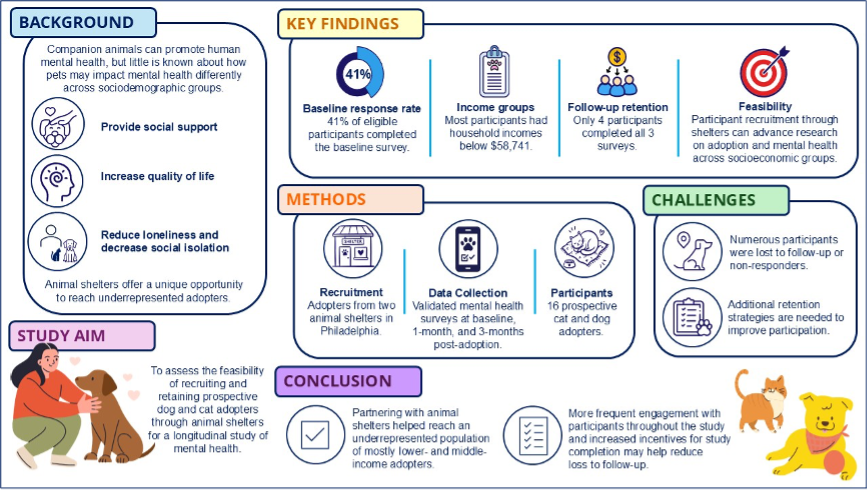
Companion animals offer an underutilized pathway that may improve public mental health. A critical evidence gap persists regarding the role of companion animals in mental health outcomes among lower-income pet owners. While animal shelters provide a unique avenue to reach this under-represented population, longitudinal data remain scarce. This pilot study used a prospective observational design to assess the feasibility of recruiting and retaining a sample of prospective dog and cat adopters across socioeconomic groups for a longitudinal study about animal adoption and mental health through animal shelters. Participants completed a series of validated mental well-being scales prior to adoption and at 1- and 3-month post-adoption intervals.
Between August and December 2024, 16 participants were recruited from two animal shelters in Philadelphia. The baseline response rate was 41%. Non-response to follow-up measures was common, with only four participants providing complete responses at both the 1- and 3-month survey time points. The majority of participants reported household incomes within the first (≤ $30,623, n = 3, 19%) and second income quintiles ($30,624 – $58,741, n = 7, 44%) based on the U.S. Census. The results affirm the potential of shelter-based recruitment to advance research about the impacts of companion animal adoption on mental health for adopters spanning socioeconomic groups. However, researchers must be aware of the significant potential for participant non-response and implement additional strategies to promote retention.
Downloads
References
1.
Lewis A, Krägeloh CU, Shepherd D. Pet Ownership, Attachment and Health-Rated Quality of Life in New Zealand. Electronic Journal of Applied Psychology. 2009;5(1):96–101. doi: 10.7790/ejap.v5i1.138
2.
Li J, Wong NML. The Mediating Role of Loneliness in the Relationship between Pet Ownership and Human Well-Being. Sci Rep. 2025;15(1):35899. doi: 10.1038/s41598-025-19692-2
3.
Ikeuchi T, Taniguchi Y, Abe T, et al. Association between Experience of Pet Ownership and Psychological Health among Socially Isolated and Non-Isolated Older Adults. Animals. 2021;11(3):595. doi: 10.3390/ani11030595
4.
Christian H, Bauman A, Epping JN, et al. Encouraging Dog Walking for Health Promotion and Disease Prevention. Am J Lifestyle Med. 2018;12(3):233–243. doi: 10.1177/1559827616643686
5.
Higgins JW, Temple V, Murray H, Kumm E, Rhodes R. Walking Sole Mates: Dogs Motivating, Enabling and Supporting Guardians’ Physical Activity. Anthrozoös. 2013;26(2):237–252. doi: 10.2752/175303713X13636846944286
6.
Moshfeghinia R, Rostamipourfard S, Kamran M, et al. Pet Ownership and Risk of Depression: A Systematic Review and Meta-Analysis. Ann Gen Psychiatry. 2025;24(1):66. doi: 10.1186/s12991-025-00600-x
7.
Scoresby KJ, Strand EB, Ng Z, et al. Pet Ownership and Quality of Life: A Systematic Review of the Literature. Vet Sci. 2021;8(12):332. doi: 10.3390/vetsci8120332
8.
Martins CF, Soares JP, Cortinhas A, et al. Pet’s Influence on Humans’ Daily Physical Activity and Mental Health: A Meta-Analysis. Front Public Health. 2023;11:1196199. doi: 10.3389/fpubh.2023.1196199
9.
Gilbey A, McNicholas J, Collis GM. A Longitudinal Test of the Belief that Companion Animal Ownership Can Help Reduce Loneliness. Anthrozoös. 2007;20(4):345–353. doi: 10.2752/089279307X245473
10.
Serpell J. Beneficial Effects of Pet Ownership on Some Aspects of Human Health and Behaviour. J R Soc Med. 1991;84(12):717–720. doi: 10.1177/014107689108401208
11.
Mokos J, Kubinyi E, Ujfalussy DJ, et al. Short-Term Effects of Pet Acquisition and Loss on Well-Being in an Unbiased Sample during the COVID-19 Pandemic. Sci Rep. 2025;15(1):20267. doi: 10.1038/s41598-025-06987-7
12.
Powell L, Edwards KM, McGreevy P, et al. Companion Dog Acquisition and Mental Well-Being: A Community-Based Three-Arm Controlled Study. BMC Public Health. 2019;19(1):1428. doi: 10.1186/s12889-019-7770-5
13.
Singh GK, Daus GP, Allender M, et al. Social Determinants of Health in the United States: Addressing Major Health Inequality Trends for the Nation, 1935–2016. Int J MCH AIDS. 2017;6(2):139–164. doi: 10.21106/ijma.236
14.
Chetty R, Stepner M, Abraham S, et al. The Association between Income and Life Expectancy in the United States, 2001–2014. JAMA. 2016;315(16):1750–1766. doi: 10.1001/jama.2016.4226
15.
Allen J, Balfour R, Bell R, Marmot M. Social Determinants of Mental Health. Int Rev Psychiatry. 2014;26(4):392–407. doi: 10.3109/09540261.2014.928270
16.
LaVallee E, Mueller MK, McCobb E. A Systematic Review of the Literature Addressing Veterinary Care for Underserved Communities. J Appl Anim Welf Sci. 2017;20(4):381–394. doi: 10.1080/10888705.2017.1337515
17.
Sehatzadeh B, Noland RB, Weiner MD. Walking Frequency, Cars, Dogs, and the Built Environment. Transp Res Part A Policy Pract. 2011;45(8):741–754. doi: 10.1016/j.tra.2011.06.001
18.
Collins D, Lee H, Dunbar MD, Crowder K, Consortium DAP. Associations between Neighborhood Disadvantage and Dog Walking among Participants in the Dog Aging Project. Int J Environ Res Public Health. 2022;19(18):11179. doi: 10.3390/ijerph191811179
19.
Turrell G, Haynes M, Wilson L-A, Giles-Corti B. Can the Built Environment Reduce Health Inequalities? A Study of Neighbourhood Socioeconomic Disadvantage and Walking for Transport. Health Place. 2013;19:89–98. doi: 10.1016/j.healthplace.2012.10.008
20.
Ownby KK. Use of the Distress Thermometer in Clinical Practice. J Adv Pract Oncol. 2019;10(2):175–179. doi: 10.6004/jadpro.2019.10.2.7
21.
Spitzer RL, Kroenke K, Williams JBW, Löwe B. A Brief Measure for Assessing Generalized Anxiety Disorder. Arch Intern Med. 2006;166(10):1092–1097. doi: 10.1001/archinte.166.10.1092
22.
Kroenke K, Spitzer RL, Williams JBW. The PHQ-9. J Gen Intern Med. 2001;16(9):606–613. doi: 10.1046/j.1525-1497.2001.016009606.x
23.
Cohen S, Kamarck T, Mermelstein R. A Global Measure of Perceived Stress. J Health Soc Behav. 1983;24(4):385–396. doi: 10.2307/2136404
24.
Thompson ER. Development and Validation of an Internationally Reliable Short-Form of the Positive and Negative Affect Schedule (PANAS). J Cross Cult Psychol. 2007;38(2):227–242. doi: 10.1177/0022022106297301
25.
Hughes ME, Waite LJ, Hawkley LC, Cacioppo JT. A Short Scale for Measuring Loneliness in Large Surveys. Res Aging. 2004;26(6):655–672. doi: 10.1177/0164027504268574
26.
Slater MR, Weiss E, Levy JK, Greenberg M. Shelter to Home: Surveys of Early Post-Adoption Experiences with More Than 22,000 Dog and Cat Adopters. JSMCAH. 2026;5(1):158. doi: 10.56771/jsmcah.v5.158
Additional Files
Published
Issue
Section
License
Copyright (c) 2026 Jessie L. Dyer, Brittany Watson, Chelsea L. Reinhard, Heather Klusaritz, James A. Serpell, Lauren Powell

This work is licensed under a Creative Commons Attribution 4.0 International License.
How to Cite