A Case Report of Generalized Tetanus in a Shelter-Housed Puppy
DOI:
https://doi.org/10.56771/jsmcah.v5.174Keywords:
tetanus, Clostridium tetani, shelter medicine, canine neurology, wound infection, equine tetanus antitoxin, case reportAbstract
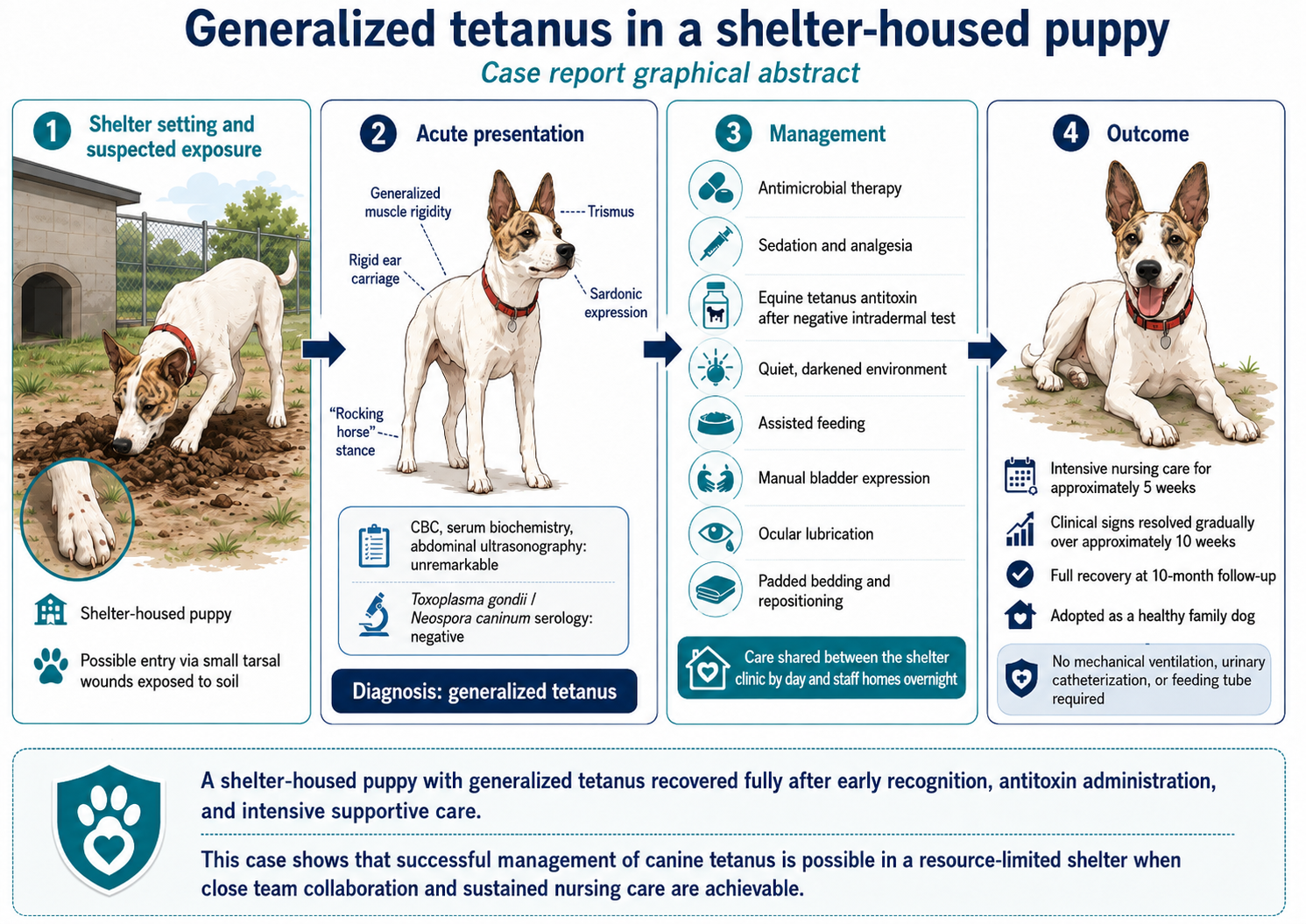
On April 7, 2025, Arvin, a 5-month-old male mixed-breed dog housed in a animal shelter in Israel, presented with acute generalized muscle rigidity, trismus, a sardonic facial expression, rigid ear carriage, and a ‘rocking horse’ stance. Hematology, serum biochemistry, abdominal ultrasonography, and serology for Toxoplasma gondii and Neospora caninum were unremarkable. Generalized tetanus was diagnosed based on the characteristic clinical presentation and exclusion of relevant differential diagnoses. Treatment included antimicrobial therapy, sedation, analgesia, equine tetanus antitoxin administered after a negative intradermal sensitivity test, and intensive nursing care, including assisted feeding, manual bladder expression, ocular lubrication, and a quiet, darkened environment to minimize stimulation. Care was shared between the shelter clinic during the day and shelter staff homes overnight, allowing continuous observation during the critical period. Clinical signs resolved gradually over approximately 10 weeks. At 10-month follow-up, before adoption, the dog had recovered fully with no observable deficits. This case illustrates that generalized canine tetanus can be managed successfully within the resource constraints of an animal shelter when early recognition, sustained supportive care, and close team collaboration are achievable.
Downloads
References
1.
Lalli G, Bohnert S, Deinhardt K, Verastegui C, Schiavo G. The Journey of Tetanus and Botulinum Neurotoxins in Neurons. Trends Microbiol. 2003;11(9):431–437. doi: 10.1016/S0966-842X(03)00210-5
2.
Rossetto O, Scorzeto M, Megighian A, Montecucco C. Tetanus Neurotoxin. Toxicon. 2013;66:59–63. doi: 10.1016/j.toxicon.2012.12.027
3.
Burkitt JM, Sturges BK, Jandrey KE, Kass PH. Risk Factors Associated with Outcome in Dogs with Tetanus: 38 Cases (1987–2005). J Am Vet Med Assoc. 2007;230(1):76–83. doi: 10.2460/javma.230.1.76
4.
Shea A, Hatch A, De Risio L, Beltran E. Association between Clinically Probable REM Sleep Behavior Disorder and Tetanus in Dogs. J Vet Intern Med. 2018;32(6):2029–2036. doi: 10.1111/jvim.15320
5.
Zitzl J, Dyckers J, Güssow A, Lehmann H, Hazuchová K. Survival in Canine Tetanus: Retrospective Analysis of 42 Cases (2006–2020). Front Vet Sci. 2022;9:1015569. doi: 10.3389/fvets.2022.1015569
6.
Tetaniserum 150. Résumé des caractéristiques du produit (RCP). French Agency for Food, Environmental and Occupational Health & Safety (ANSES), Index des Médicaments vétérinaires autorisés en France. Accessed July 1, 2026. https://www.ircp.anmv.anses.fr/rcp.aspx?NomMedicament=TETANISERUM+150
7.
Fawcett A, Irwin P. Diagnosis and Treatment of Generalised Tetanus in Dogs. In Pract. 2014;36(10):482–493. doi: 10.1136/inp.g6312
8.
Dörfelt S, Mayer C, Wolf G, Straubinger RK, Fischer A, Hartmann K. Retrospective Study of Tetanus in 18 Dogs: Causes, Management, Complications, and Immunological Status. Front Vet Sci. 2023;10:1249833. doi: 10.3389/fvets.2023.1249833
9.
Bandt C, Rozanski EA, Steinberg T, Shaw SP. Retrospective Study of Tetanus in 20 Dogs: 1988–2004. J Am Anim Hosp Assoc. 2007;43(3):143–148. doi: 10.5326/0430143
10.
Wong B. Evaluating the Effect of Equine Tetanus Antitoxin on Mortality Rates of Dogs Affected by Tetanus. Vet Evid. 2024;9(1):1–8. doi: 10.18849/ve.v9i1.676
11.
Tauro A, Beltran E, Cherubini GB, et al. Metronidazole-Induced Neurotoxicity in 26 Dogs. Aust Vet J. 2018;96(12):495–501. doi: 10.1111/avj.12772
Additional Files
Published
Issue
Section
License
Copyright (c) 2026 Marganit Bashan, Lenna Algrably, Hila Martonovich Bengar, Yifat Goldshmidt

This work is licensed under a Creative Commons Attribution 4.0 International License.
How to Cite