A Limited, Lower-Cost Dental Procedure Can Improve Owner-Reported Canine Health and Welfare for Dogs With Severe Dental Disease
DOI:
https://doi.org/10.56771/jsmcah.v5.170Keywords:
dogs, dental disease, quality of life, spectrum of care, accessible veterinary care, general practitionerAbstract
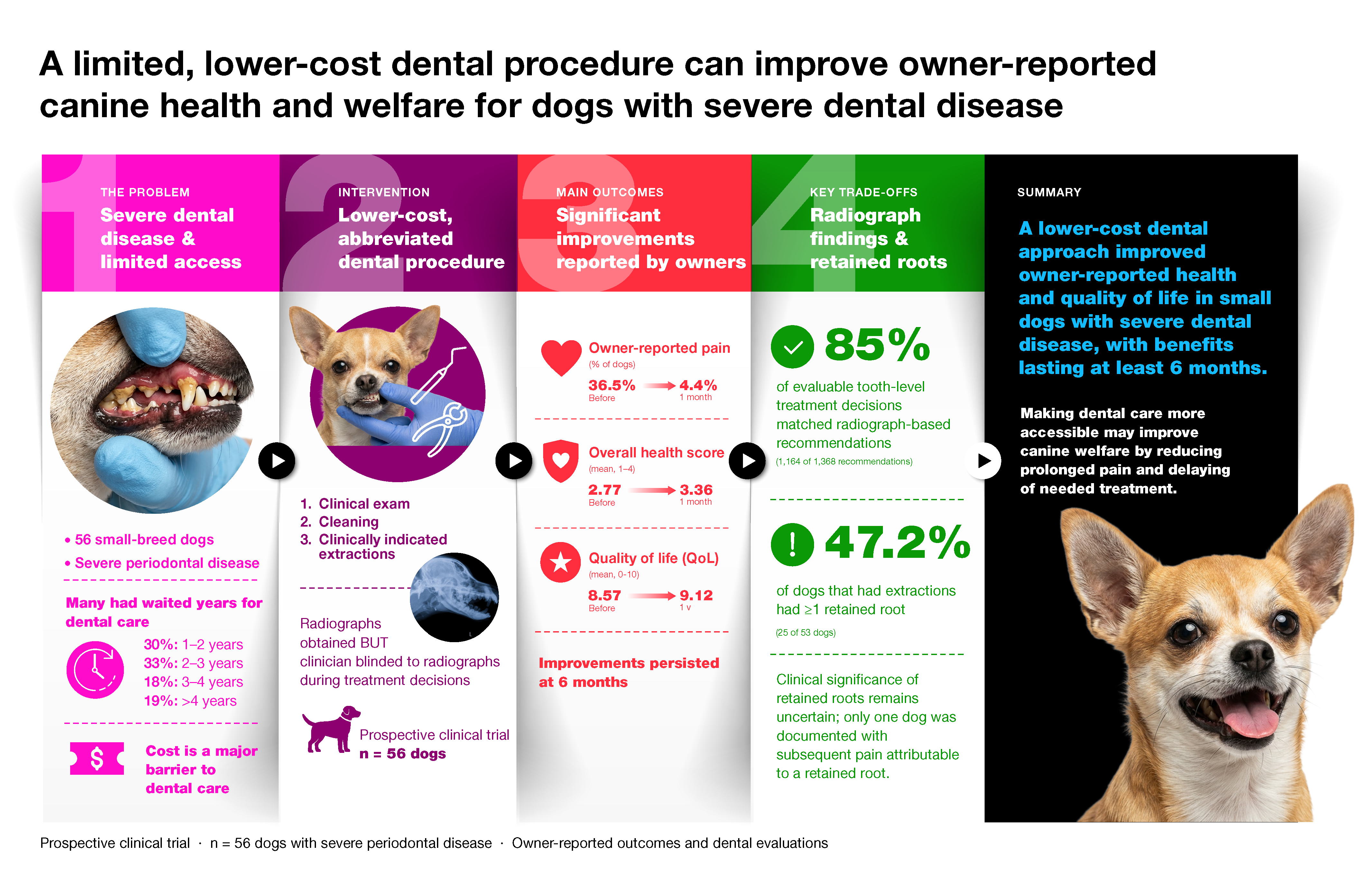
Introduction: Dental disease is nearly ubiquitous in dogs, with small breeds being particularly afflicted. Dogs with any degree of dental disease require evaluation and treatment under general anesthesia, which is financially out of reach for many pet owners. The objective of this study was to document the impact of a lower-cost dental procedure on dog health and quality of life (QoL) among a population of small breed dogs with severe dental disease who lacked access to dental care.
Methods: Client-owned small breed dogs received a dental examination and cleaning under anesthesia. Full-mouth radiographs were taken and repeated after extractions. The veterinarian performing the procedure was blinded to the radiographs, which were reviewed by a general practitioner with a special interest in dentistry. The actions of the procedure veterinarian were compared with the recommendations from the radiographs. Owners completed questionnaires measuring dog health and QoL before the procedure, 1 month, 3 months and 6 months post-dental procedure. Dental exams and radiographs were repeated for each dog after at least 6 months.
Results: 56 dogs were enrolled, and 40 completed all parts of the study. Most owners had been waiting more than 1 year for the dental procedure to be scheduled due to cost concerns. Owner-reported health and QoL were higher 1 month and 6 months post-procedure. The procedure veterinarian performed the recommended action (as suggested by dental radiograph review) 85% of the time.
Conclusions: In small breed dogs with severe dental disease, radiographs were minimally helpful in determining treatment decisions. An abbreviated dental procedure improved dog health and QoL as assessed by the owner. Given that many owners delay or never schedule dental procedures due to the cost, making them more affordable is essential to improve access.
Downloads
References
1.
Wallis C, Saito EK, Salt C, Holcombe LJ, Desforges NG. Association of Periodontal Disease with Breed Size, Breed, Weight, and Age in Pure-Bred Client-Owned Dogs in the United States. Vet J. 2021;275:105717. doi: 10.1016/j.tvjl.2021.105717
2.
Riggio MP, Lennon A, Taylor DJ, Bennett D. Molecular Identification of Bacteria Associated with Canine Periodontal Disease. Vet Microbiol. 2011;150(3–4):394–400. doi: 10.1016/j.vetmic.2011.03.001
3.
Banfield Pet Hospital. State of Pet Health Report. 2024. https://www.banfield.com/state-of-pet-health. Accessed May 28, 2025.
4.
Niemiec B, Gawor J, Nemec A, et al. World Small Animal Veterinary Association Global Dental Guidelines. J Small Anim Pract. 2020;61:E36–E161. doi: 10.1111/jsap.13132
5.
Enlund KB, Pettersson A, Eldh AC. Dog Owners’ Ideas and Strategies Regarding Dental Health in Their Dogs-Thematic Analysis of Free-Text Survey Responses. Front Vet Sci. 2022;9:878162. doi: 10.3389/fvets.2022.878162
6.
PetSmart Charities–Gallup. State of Pet Care Study: Pet Parents’ Assessment of American Veterinary Care. 2025. https://www.gallup.com/analytics/659123/gallup-petsmart-charities.aspx. Accessed May 29, 2025.
7.
King E, Mueller MK, Wolfus G, McCobb E. Assessing Service-Learning in Community-Based Veterinary Medicine as a Pedagogical Approach to Promoting Student Confidence in Addressing Access to Veterinary Care. Front Vet Sci. 2021;8:644556. doi: 10.3389/fvets.2021.644556
8.
Access to Veterinary Care Coalition. Access to Veterinary Care: Barriers, Current Practices, and Public Policy. 2018. https://www.avcc.org/. Accessed May 28, 2025.
9.
Pasteur K, Diana A, Yatcilla JK, Barnard S, Croney CC. Access to Veterinary Care: Evaluating Working Definitions, Barriers, and Implications for Animal Welfare. Front Vet Sci. 2024;11:1335410. doi: 10.3389/fvets.2024.1335410
10.
American Animal Hospital Association. 2011 AAHA/AVMA preventive healthcare guidelines. 2011. https://www.aaha.org/resources/2011-aaha-avma-preventive-healthcare-guidelines/. Accessed August 20, 2026.
11.
Volk JO, Felsted KE, Thomas JG, Siren CW. Executive Summary of the Bayer Veterinary Care Usage Report. J Am Vet Med Assoc. 2011;238(10):1275–1282. doi: 10.2460/javma.238.10.1275
12.
Blackwell MJ, O’Reilly A. Access to Veterinary Care – A National Family Crisis and Case for One Health. Adv Small Anim Care. 2023;4(1):145–157. doi: 10.1016/j.yasa.2023.05.003
13.
Kvitka D, Jankauskas M, Klupšas M, Gradeckienė A, Juodžentė D, Rudenkovaitė G. Clinical Evaluation of Autologous PRP (Platelet-Rich Plasma) in the Treatment of Periodontitis in Small-Breed Dogs. Animals. 2025;15(24):3581. doi: 10.3390/ani15243581
14.
Slater MR, Pailler S, Gayle JM, et al. Welfare of Cats 5–29 Months after Perineal Urethrostomy: 74 Cases (2015–2017). J Feline Med Surg. 2020;22(6):582–588. doi: 10.1177/1098612X19867777
15.
Wilcox Z, McCobb E, Dowling-Guyer S, Rozanski EA. Emergency Clinicians Need More Information about Offering Spectrum of Care and Solutions for Clients with Financial Limitations. J Am Vet Med Assoc. 2025;263(S3):S43–S48. doi: 10.2460/javma.25.01.0034
16.
Kogan LR, Rishniw M. Veterinarians and Moral Distress. J Am Vet Med Assoc. 2023;261(5):1–7. doi: 10.2460/javma.22.12.0598
17.
Stull JW, Shelby JA, Bonnett BN, et al. Barriers and Next Steps to Providing a Spectrum of Effective Health Care to Companion Animals. J Am Vet Med Assoc. 2018;253(11):1386–1389. doi: 10.2460/javma.253.11.1386
18.
Greenberg M, McCants D, Alvarez E, et al. 2024 AAHA Community Care Guidelines for Small Animal Practice. J Am Anim Hosp Assoc. 2024;60(6):227–246. doi: 10.5326/JAAHA-MS-7464
Additional Files
Published
Issue
Section
License
Copyright (c) 2026 Emily McCobb, Erin K. King, Lynn F. Knight, Elizabeth Clifton , Elizabeth Rozanski

This work is licensed under a Creative Commons Attribution 4.0 International License.
How to Cite