An Interview-Based Retrospective Study on Long-Term Outcomes of Shelter Cats with Feline Lower Urinary Tract Disease (FLUTD) and a History of Urethral Obstruction (UO)
DOI:
https://doi.org/10.56771/jsmcah.v5.169Keywords:
shelter cats, adoption, FLUTD, UO, recurrence, prognosesAbstract
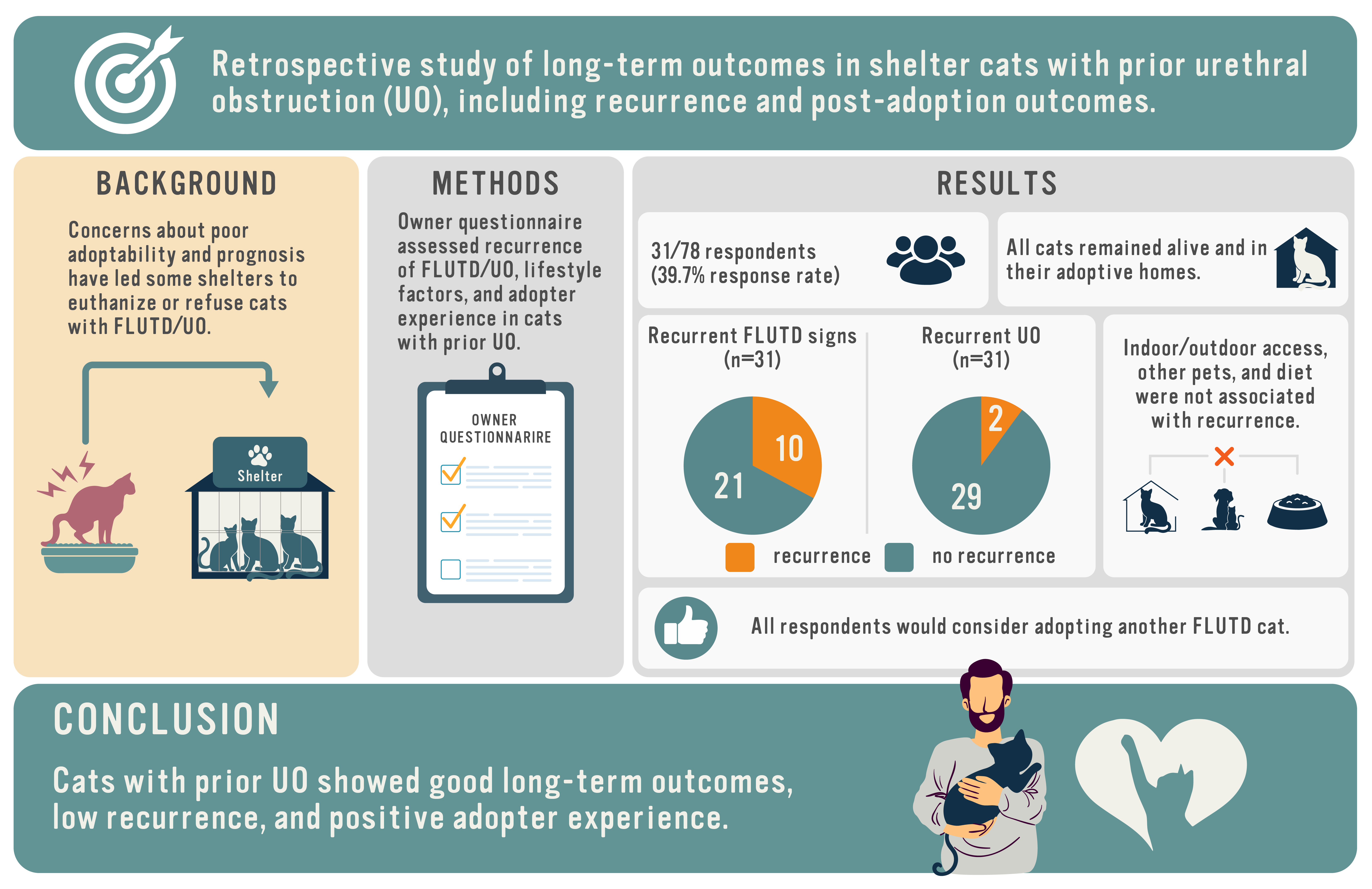
Introduction: Concerns regarding poor adoptability and guarded long-term prognoses have historically influenced some shelters to elect euthanasia or decline intake of cats with feline lower urinary tract disease (FLUTD) and urethral obstruction (UO). Specifically, UO remains an acute life-threatening condition, and mortality can occur despite treatment. Recurrence of FLUTD signs has been reported in up to 51% and recurrent UO in 15–47% of cats that have previously experienced obstruction. This retrospective study evaluated long-term prognoses of shelter cats with a history of UO, including recurrence of urinary signs and UO and overall post-adoption outcomes, to assess adoptability and identify how shelters can prepare adopters.
Methods: A standardized owner questionnaire evaluated recurrence of FLUTD signs and UO, lifestyle factors, and adopter experience in cats with prior UO adopted from a limited-admissions shelter between 2018 and 2023. Inclusion criteria required one diagnosed UO event in which a urinary catheter was maintained for at least 24 h, absence of comorbidities, successful adoption, and residence in the home for at least 3 months following the UO event.
Results: Of the 78 eligible cats, 31 owners responded to the questionnaire (39.7% response rate). All cats were alive and remained in their adopted homes; 10 (32.3%) showed recurrent FLUTD signs, and two (6.5%) experienced recurrent obstruction. Lifestyle factors related to housing environment, household composition, or diet were not statistically associated with recurrence of urinary signs post-adoption. All respondents indicated that they would consider adopting another FLUTD cat.
Conclusion: Adoption of cats with a history of UO in this shelter was associated with positive overall adopter experience and good long-term outcomes; low recurrence of FLUTD signs or UO, minimal need for hospitalization or surgery, and remained in their adoptive homes. These outcomes, however, should be interpreted with caution due to several study limitations.
Downloads
References
1.
Gunn-Moore D. Feline Lower Urinary Tract Disease. J Feline Med Surg. 2016;5(2):133–138. doi: 10.1016/S1098-612X(02)00129-8
2.
Taylor S, Boysen S, Buffington T, et al. 2025 iCatCare Consensus Guidelines on the Diagnosis and Management of Lower Urinary Tract Diseases in Cats. J Feline Med Surg. 2025;27(2):1098612X241309176. doi: 10.1177/1098612X241309176
3.
Kaul E, Hartmann K, Reese S, Dorsch R. Recurrence Rate and Long-Term Course of Cats with Feline Lower Urinary Tract Disease. J Feline Med Surg. 2019;22(6):544–556. doi: 10.1177/1098612x19862887
4.
Cooper ES, Owens TJ, Chew DJ, Buffington CAT. A Protocol for Managing Urethral Obstruction in Male Cats without Urethral Catheterization. J Am Vet Med Assoc. 2010;237(11):1261–1266. doi: 10.2460/javma.237.11.1261
5.
Gerber B, Eichenberger S, Reusch C. Guarded Long-Term Prognosis in Male Cats with Urethral Obstruction. J Feline Med Surg. 2008;10(1):16–23. doi: 10.1016/j.jfms.2007.06.007
6.
Williams J. Surgical Management of Blocked Cats: Which Approach and When? J Feline Med Surg. 2009;11(1):14–22. doi: 10.1016/j.jfms.2008.11.009
7.
Slater MR, Pailler S, Gayle JM, et al. Welfare of Cats 5–29 Months after Perineal Urethrostomy: 74 Cases (2015–2017). J Fel Med Surg. 2019;22(6):582–588. doi: 10.1177/1098612X19867777
8.
Boveé KC, Reif JS, Maguire TG, Gaskell CJ, Batt RM. Recurrence of Feline Urethral Obstruction. JAVMA. 1979;174(1):93–96. doi: 10.2460/javma.1979.174.01.93
9.
Segev G, Livne H, Ranen E, Lavy E. Urethral Obstruction in Cats: Predisposing Factors, Clinical, Clinicopathological Characteristics and Prognosis. J Fel Med Surg. 2011;13(2):101–108. doi: 10.1016/j.jfms.2010.10.006
10.
Eisenberg BW, Waldrop JE, Allen SE, Brisson JO, Aloisio KM, Horton NJ. Evaluation of Risk Factors Associated with Recurrent Obstruction in Cats Treated Medically for Urethral Obstruction. JAVMA. 2013;243(8):1140–1146. doi: 10.2460/javma.243.8.1140
11.
Patronek GJ, Glickman LT, Beck AM, McCabe GP, Ecker C. Risk Factors for Relinquishment of Cats to an Animal Shelter. J Am Vet Med Assoc. 1996;209(3):582–588. doi: 10.2460/javma.1996.209.03.582
12.
Kisley MA, Chung EJ, Levitt H. Investigating the Reasons behind Companion Animal Relinquishment: A Systemic Content Analysis of Shelter Records for Cats and Dogs, 2018–2023. Animals. 2024;12(17):2606. doi: 10.3390/ani14172606
13.
Liu S, Sung W, Welsh S, Berger JM. A Six-Year Retrospective Study of Outcomes of Surrendered Cats (Felis cactus) with Periuria in a No-Kill Shelter. J Vet Behav. 2021;42:75–80. doi: 10.1016/j.jveb.2020.12.002
Additional Files
Published
Issue
Section
License
Copyright (c) 2026 Krystal Mendoza, Emmy Ferrell, Wendi Rekers

This work is licensed under a Creative Commons Attribution 4.0 International License.
How to Cite