Who Let the Dogs Out? A Cross-Sectional Knowledge, Attitudes, and Practices Survey Reveals Caregiver Behavior and a Value-Action Gap in Ownership Practices as Potential Contributors to Free-Roaming Dog Populations in Fiji
DOI:
https://doi.org/10.56771/jsmcah.v5.166Keywords:
dog , population management, Fiji, demographics, KAP analysis, ownership practicesAbstract
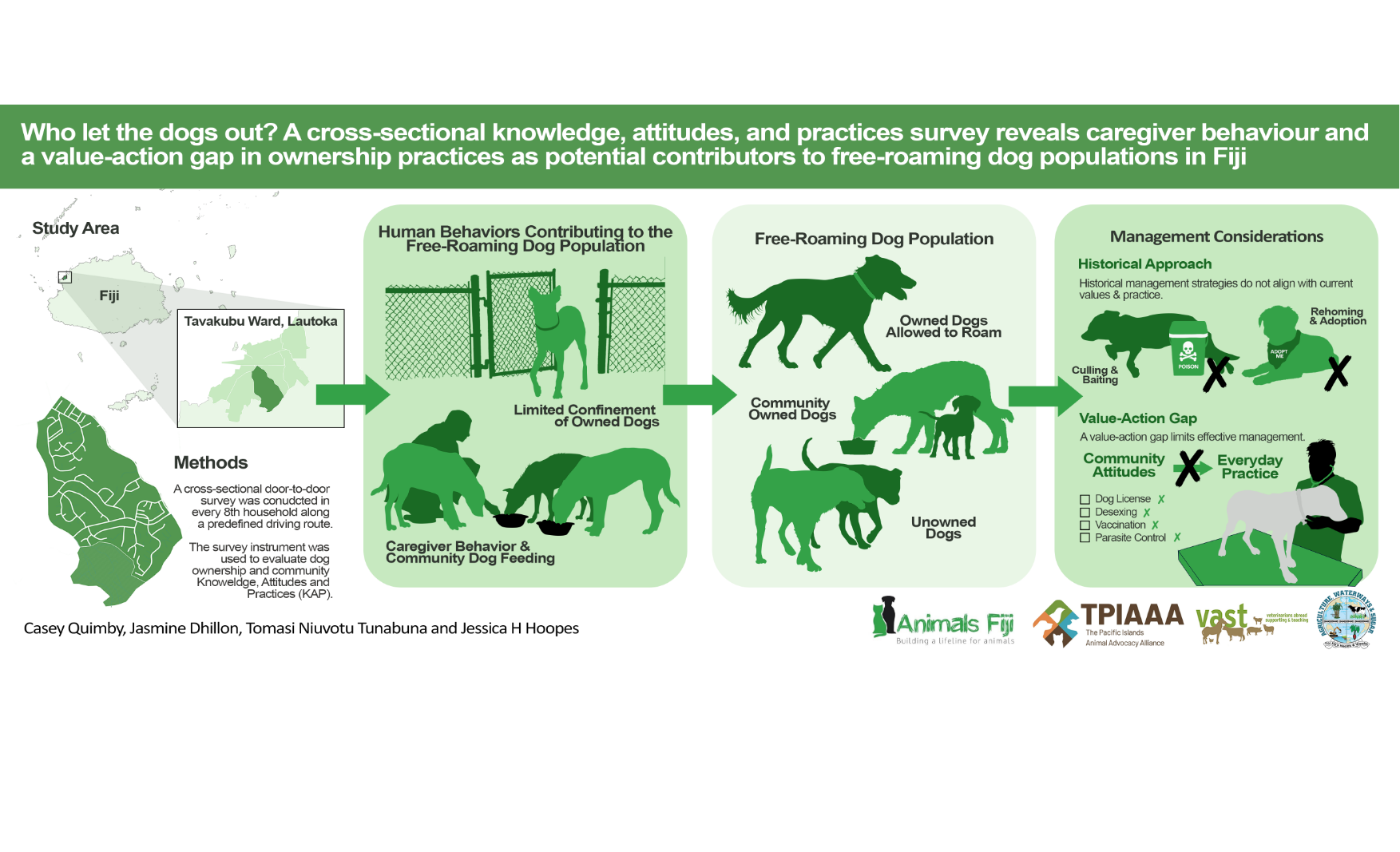
Introduction: Free-roaming dogs (FRD) are common in villages and urban areas across Fiji, and managing these populations presents significant challenges. Developing sustainable dog population management (DPM) programs requires an in-depth understanding of how ownership practices and human behaviors influence dog population dynamics. This study aimed to establish a framework for understanding dog demographics, dog bite incidence and the socio-behavioral factors contributing to dog overpopulation and the maintenance of FRD populations in Fiji.
Methods: A cross-sectional, door-to-door household knowledge, attitudes, and practices (KAP) survey was conducted to evaluate the size and dynamics of the owned dog population, dog ownership practices, public knowledge and attitudes toward dogs, and the incidence of dog bites in households in Tavakubu Ward, Lautoka, Fiji.
Results: More than one-third of households (37%) owned a dog for companionship or protection, with over half of households (54%) reporting feeding dogs they did not own. Few respondents supported the use of control measures involving confinement or culling, and owner uptake of rehoming services was low. Despite positive attitudes toward preventive care, desexing (sterilization), and licensing, adoption of these practices remained low. A lack of awareness of the importance of desexing and licensing was reported as a key barrier to uptake.
Conclusion: Historical methods of dog population control in Fiji, such as indiscriminate culling and rehoming, may not align with contemporary community attitudes and ownership practices. Results suggest high levels of caregiver behavior and community dog feeding, compounded by low desexing rates, and limited confinement of owned dogs, likely contribute to Fiji’s FRD population. Participants’ responses also reveal a clear value-action gap in responsible pet ownership, where community attitudes do not consistently translate into everyday practice. Therefore, identifying and addressing barriers to evidence-based responsible dog ownership practices and incorporating sustainable, community-led strategies for dog management will be an important step in improving the effectiveness of DPM programs in Fiji.
Downloads
References
1.
Anderson A. The rat and the octopus: initial human colonization and the prehistoric introduction of domestic animals to Remote Oceania. Biol Invasions. 2009;11:1503–1519. doi: 10.1007/s10530-008-9403-2
2.
Borrelli C, Granai G, Di Iacovo FP, et al. The benefits of dog ownership on people as an undervalued resource in urban environments. Dog Behav. 2022;8(3):163.
3.
Smith LM, Quinnell RJ, Goold C, Munteanu AM, Hartmann S, Collins LM. Assessing the impact of free-roaming dog population management through systems modelling. Sci Rep. 2022;12(1):11452. doi: 10.1038/s41598-022-15049-1
4.
Repeka N. Dog attacks on tourists and locals a concern. The Fiji Times. 2016. https://www.fijitimes.com.fj/dog-attacks-on-tourists-and-locals-a-concern/. Accessed November 13, 2024.
5.
Graue C. Fiji Authorities Crack Down on Stray Dog Problem after Attack. Pacific Beat. Australian Broadcasting Corporation (ABC) Pacific; 2019. https://www.abc.net.au/pacific/programs/pacificbeat/fiji-authorities-to-crack-down-on-stray-dog-problem-after-attack/11219230. Accessed November 16, 2024.
6.
Epineri V. Wild dogs bite off girl’s ear. Fiji Sun. 2019. https://www.pressreader.com/fiji/fiji-sun/20190615/282269551912353. Accessed November 16, 2024.
7.
Nacei, L. Dog attacks boy, 7, at sea wall. The Fiji Times. 2020. https://www.fijitimes.com.fj/dog-attacks-boy-7-at-sea-wall/. Accessed November 16, 2024.
8.
Silaitoga S. Dog attacks girl, 7. The Fiji Times. 2021. https://www.fijitimes.com.fj/dog-attacks-girl-7/. Accessed November 16, 2024.
9.
Silaitoga S. Dog attacks cause loss of livestock. The Fiji Times. 2020. https://www.pressreader.com/fiji/the-fiji-times/20201030/281981790092069. Accessed November 16, 2024.
10.
Reddy N. Farmer pleads for help as wild dogs kill goats. The Fiji Times. 2023. https://www.fijitimes.com.fj/farmer-pleads-for-help-as-wild-dogs-kill-goats/. Accessed November 16, 2024.
11.
Tuilevuka N. Farmers lose livestock to wild dogs. The Fiji Times. 2024. https://www.fijitimes.com.fj/farmers-lose-livestock-to-wild-dogs/. Accessed November 16, 2024.
12.
Ministry of Primary Industries. Department of Agriculture Annual Report 2009. 2009:148 pp. https://www.agriculture.gov.fj/documents/annualreport/AR2009.pdf. Accessed November 17, 2024.
13.
Ministry of Primary Industries. Department of Agriculture Annual Report 2011. 2011:66 pp. https://www.agriculture.gov.fj/documents/annualreport/AR2011.pdf. Accessed November 17, 2024.
14.
Ministry of Agriculture. Ministry of Agriculture Annual Report 2012. 2012:82 pp. https://www.agriculture.gov.fj/documents/annualreport/AR2012.pdf. Accessed November 17, 2024.
15.
Ministry of Primary Industries. Department of Agriculture Annual Report 2008. 2008:118 pp. https://www.agriculture.gov.fj/documents/annualreport/AR2008.pdf. Accessed November 16, 2024.
16.
Ministry of Agriculture. Ministry of Agriculture Annual Report 2013. 2013:69 pp. https://www.agriculture.gov.fj/documents/annualreport/AR2013.pdf. Accessed November 17, 2024.
17.
Ministry of Agriculture. Ministry of Agriculture Annual Report 2015. 2015:72 pp. https://www.agriculture.gov.fj/documents/annualreport/AR2015.pdf. Accessed November 17, 2024.
18.
Ministry of Agriculture. Ministry of Agriculture Annual Report 2014. 2014:64 pp. https://www.agriculture.gov.fj/documents/annualreport/AR2014.pdf. Accessed November 15, 2024.
19.
Australian Veterinary Association. Surgical Sterilisation of Dogs and Cats. 2022. https://www.ava.com.au/policy-advocacy/policies/companion-animals-health/desexing-surgical-sterilisation-of-companion-animals/. Accessed October 1, 2025.
20.
Moreira ED, Jr, de Souza VMM, Sreenivasan M, Nascimento EG, de Carvalho LP. Assessment of an optimized dog-culling program in the dynamics of canine Leishmania transmission. Vet Parasitol. 2004;122(4):245–252. doi: 10.1016/j.vetpar.2004.05.019
21.
Nunes CM, de Lima VMF, de Paula HB, et al. Dog culling and replacement in an area endemic for visceral leishmaniasis in Brazil. Vet Parasitol. 2008;153(1–2):19–23. doi: 10.1016/j.vetpar.2008.01.005
22.
Taylor LH, Wallace RM, Balaram D, et al. The role of dog population management in rabies elimination – a review of current approaches and future opportunities. Front Vet Sci. 2017;4:109. doi: 10.3389/fvets.2017.00109
23.
Yoak A, Calinger K, Hiby E. Assessing multiple free-roaming dog control strategies in a flexible agent-based model. Sci Rep. 2023;13(1):19826. doi: 10.1038/s41598-023-47076-x
24.
Belo VS, Struchiner CJ, Werneck GL, et al. Abundance, survival, recruitment and effectiveness of sterilization of free-roaming dogs: a capture and recapture study in Brazil. PLoS One. 2017;12(11):e0187233. doi: 10.1371/journal.pone.0187233
25.
Hiby E, Rungpatana T, Izydorczyk A, Rooney C, Harfoot M, Christley R. Impact assessment of free-roaming dog population management by CNVR in Greater Bangkok. Animals. 2023;13(11): 1726. doi: 10.3390/ani13111726
26.
Wandeler AI, Matter HC, Kappeler A, Budde A. The ecology of dogs and canine rabies: a selective review. Rev Sci Tech Int Off Epizoot. 1993;12(1):51–71. doi: 10.20506/rst.12.1.663
27.
Fournier AK, Geller ES. Behavior analysis of companion-animal overpopulation: a conceptualization of the problem and suggestions for intervention. Behav Soc Issues. 2004;13(1):51–69. doi: 10.5210/bsi.v13i1.35
28.
Morters MK, McKinley TJ, Restif O, et al. The demography of free-roaming dog populations and applications to disease and population control. J Appl Ecol. 2014;51(4):1096–1106. doi: 10.1111/1365-2664.12279
29.
Pacific Community (SPC), Fiji Bureau of Statistics. Enumeration Areas – Fiji 2017 Population and Housing Census. 2017. https://pacificdata.org/data/dataset/2017_fji_phc_admin_boundaries. Accessed November 5, 2022.
30.
Schedule Lautoka Wards. 56,495. 2011. https://laws.gov.fj/Acts/ViewSection/127926. Accessed March 7, 2024.
31.
OpenStreetMap Contributors. OpenStreetMap – Fiji Region Dataset. 2020. https://download.geofabrik.de/australia-oceania/fiji-latest-free.shp.zip. Accessed November 9, 2020.
32.
Fiji Bureau of Statistics. Household & Population Summary – Lautoka City by Ward. Fiji Bureau of Statistics, Suva, Fiji, 2017.
33.
International Companion Animal Management Coalition. Humane Dog Population Management Guidance. 2019. https://www.icam-coalition.org/wp-content/uploads/2019/09/2019-ICAM-DPM-guidance-Interactive-updated-15-Oct-2019.pdf. Accessed November 10, 2021.
34.
Dhillon JM. Dog Population Management and Dog Bite Prevention in Rural and Remote Northern Saskatchewan Aboriginal Communities. Doctor of Philosophy. University of Saskatchewan; 2017. https://harvest.usask.ca/items/e5a51917-e498-4ce8-8eae-abfa14a4e75a. Accessed November 10, 2021.
35.
World Organisation for Animal Health. Terrestrial Animal Health Code. 2024. https://www.woah.org/fileadmin/Home/eng/Health_standards/tahc/2024/en_preface.htm. Accessed February 16, 2026.
36.
Stevenson MA. Sample size estimation in veterinary epidemiologic research. Front Vet Sci. 2021;7:539573. doi: 10.3389/fvets.2020.539573
37.
Cronbach LJ. Coefficient alpha and the internal structure of tests. Psychometrika. 1951;16(3):297–334. doi: 10.1007/BF02310555
38.
Tavakol M, Dennick R. Making sense of Cronbach’s alpha. Int J Med Educ. 2011;2:53. doi: 10.5116/ijme.4dfb.8dfd
39.
Fiji Bureau of Statistics. 2017 Fiji Population & Housing Census – Release 3. 2017:89–90. https://www.statsfiji.gov.fj/census-surveys/census-of-population-and-housing/#2017. Accessed May 22, 2025.
40.
Fiji Bureau of Statstics. Fiji Bureau of Statistics Population 2017 Census – Population by Major Religion. 2017. https://experience.arcgis.com/experience/fd6bb849099f46869125089fd13579ec/page/Population--by-Major-Religious-Groups. Accessed March 9, 2026.
41.
Basco AN, McCormack ER, Basco WT, Jr. Age-and sex-related differences in nonfatal dog bite injuries among persons aged 0–19 treated in hospital emergency departments, United States, 2001–2017. Public Health Rep. 2020;135(2):238–244. doi: 10.1177/0033354920904072
42.
Patterson KN, Horvath KZ, Minneci PC, et al. Pediatric dog bite injuries in the USA: a systematic review. World J Pediatr Surg. 2022;5(2):e000281. doi: 10.1136/wjps-2021-000281
43.
Companion Animal Parasite Council. General Guidelines for Dogs and Cats. 2025. https://capcvet.org/guidelines/general-guidelines/. Accessed June 25, 2025.
44.
Dantas-Torres F, Ketzis J, Mihalca AD, et al. TroCCAP recommendations for the diagnosis, prevention and treatment of parasitic infections in dogs and cats in the tropics. Vet Parasitol. 2020;283:109167. doi: 10.1016/j.vetpar.2020.109167
45.
Squires RA, Crawford C, Marcondes M, Whitley N. 2024 guidelines for the vaccination of dogs and cats – compiled by the Vaccination Guidelines Group (VGG) of the World Small Animal Veterinary Association (WSAVA). J Small Anim Pract. 2024;65(5):277–316. doi: 10.1111/jsap.13718
46.
Laws of Fiji. Dogs Act. 1968. https://www.laws.gov.fj/Acts/DisplayAct/678. Accessed September 27, 2025.
47.
Laws of Fiji. Dogs Regulations. 1969. https://www.laws.gov.fj/Acts/DisplayAct/678. Accessed September 27, 2025.
48.
Animal Medicines Australia. Pets in Australia: a national survey of pets and people. Animal Medicines Australia, Barton, ACT, 2025. https://animalmedicinesaustralia.org.au/wp-content/uploads/2025/09/SNR-2403006-Pet-Ownership-Study-2025-Designed_F3.pdf. Accessed October 02, 2025.
49.
Applebaum JW, Peek CW, Zsembik BA. Examining US pet ownership using the General Social Survey. Soc Sci J. 2023;60(1):110–119. doi: 10.1080/03623319.2020.1728507
50.
American Veterinary Medical Association. 2022 AVMA Pet Ownership and Demographics Sourcebook. 2022. https://ebusiness.avma.org/files/ProductDownloads/eco-pet-demographic-report-22-low-res.pdf?utm_source=chatgpt.com. Accessed October 2, 2025.
51.
Carvelli A, Scaramozzino P, Iacoponi F, Condoleo R, Della Marta U. Size, demography, ownership profiles, and identification rate of the owned dog population in central Italy. PLoS One. 2020;15(10):e0240551. doi: 10.1371/journal.pone.0240551
52.
Corfmat J, Gibson AD, Mellanby RJ, et al. Community attitudes and perceptions towards free-roaming dogs in Goa, India. J Appl Anim Welf Sci. 2023;26(4):565–581. doi: 10.1080/10888705.2021.2014839
53.
de Melo SN, Da Silva ES, Ribeiro RAN, et al. The influence of community feeders and commercial food outlets on the spatial distribution of free-roaming dogs – a photographic capture and recapture study. Animals. 2023;13(5):824. doi: 10.3390/ani13050824
54.
Bhalla SJ, Kemmers R, Vasques A, Vanak AT. ‘Stray appetites’: a socio-ecological analysis of free-ranging dogs living alongside human communities in Bangalore, India. Urban Ecosyst. 2021;24(6):1245–1258. doi: 10.1007/s11252-021-01097-4
55.
Silva-Rodríguez EA, Cortés EI, Zambrano B, Naughton-Treves L, Farías AA. On the causes and consequences of the free-roaming dog problem in southern Chile. Sci Total Environ. 2023;891:164324. doi: 10.1016/j.scitotenv.2023.164324
56.
Westgarth C, Brooke M, Christley RM. How many people have been bitten by dogs? A cross-sectional survey of prevalence, incidence and factors associated with dog bites in a UK community. J Epidemiol Community Health. 2018;72(4):331–336. doi: 10.1136/jech-2017-209330
57.
Grove G, Lovell M, Best M. Perspectives of major world religions regarding euthanasia and assisted suicide: a comparative analysis. J Relig Health. 2022;61(6):4758–4782. doi: 10.1007/s10943-022-01498-5
58.
Avci E. A comparative analysis on the perspective of Sunni theology and Hindu tradition regarding euthanasia: the impact of belief in resurrection and reincarnation. J Relig Health. 2019;58(5):1770–1791. doi: 10.1007/s10943-019-00836-4
59.
Amaku M, Dias RA, Ferreira F. Dynamics and control of stray dog populations. Math Popul Stud. 2010;17(2):69–78. doi: 10.1080/08898481003689452
60.
Spatola GJ, Feuerborn TR, Betz JA, et al. Genomic reconstruction reveals impact of population management strategies on modern Galápagos dogs. Curr Biol. 2025;35(1):208–216.e5. doi: 10.1016/j.cub.2024.10.079
61.
Smith LM, Hartmann S, Munteanu AM, Dalla Villa P, Quinnell RJ, Collins LM. The effectiveness of dog population management: a systematic review. Animals. 2019;9(12): 1020. doi: 10.3390/ani9121020
62.
Pedrinelli V, Zafalon RVA, Rodrigues RBA, et al. Influence of number of ingredients, use of supplement and vegetarian or vegan preparation on the composition of homemade diets for dogs and cats. BMC Vet Res. 2021;17(1):358. doi: 10.1186/s12917-021-03068-5
63.
Remillard RL. Homemade diets: attributes, pitfalls, and a call for action. Controv Small Anim Nutr. 2008;23(3):137–142. doi: 10.1053/j.tcam.2008.04.006
64.
Ionică CN, Daina S, Pop R, Macri A. Home-prepared dog food: benefits and downsides. Front Anim Sci. 2025;6:1506003. doi: 10.3389/fanim.2025.1506003
65.
Please PM, Hine DW, Skoien P, Phillips KL, Jamieson I. Prioritizing community behaviors to improve wild dog management in peri-urban areas. Hum Dimens Wildl. 2018;23(1):39–53. doi: 10.1080/10871209.2017.1385877
Additional Files
Published
Issue
Section
License
Copyright (c) 2026 Casey Quimby, Jasmine Dhillon, Tomasi Niuvotu Tunabuna, Jessica H. Hoopes

This work is licensed under a Creative Commons Attribution 4.0 International License.
How to Cite