Model Selection for Examining the Association Between Dog Intake Quantity and Socioeconomic and Geographic Conditions
DOI:
https://doi.org/10.56771/jsmcah.v5.164Keywords:
Animal Shelters, Animal Welfare, Companion Animals, Stray Animals, Animal Abandonment, Animal Rescue, Animal Control, Animal Relinquishment, Canine, ModelsAbstract
Introduction: Dog intake to government shelters reflects both community conditions and local animal management practices, yet predictors of intake in Japan have not been evaluated at a national scale. The objective of this study was to identify community-level socioeconomic and geographic predictors of dog intake to government shelters in Japan, stratified by intake type (owner-unknown vs. owner-relinquished) and administrative setting (urban vs. non-urban).
Methods: Publicly available municipal and prefectural data were used to model dog intake counts for 2022. Separate generalised linear models were developed for owner-unknown and owner-relinquished intake in urban areas (designated and core cities; n = 82) and non-urban areas (n = 47). Socioeconomic-related explanatory variables tested included the proportions of low-income households, older adults’ households, owner-occupied households, and individuals with higher education levels. Geographically related explanatory variables included the proportion of vacant houses, cultivated land area, the highest temperature, and the lowest temperature.
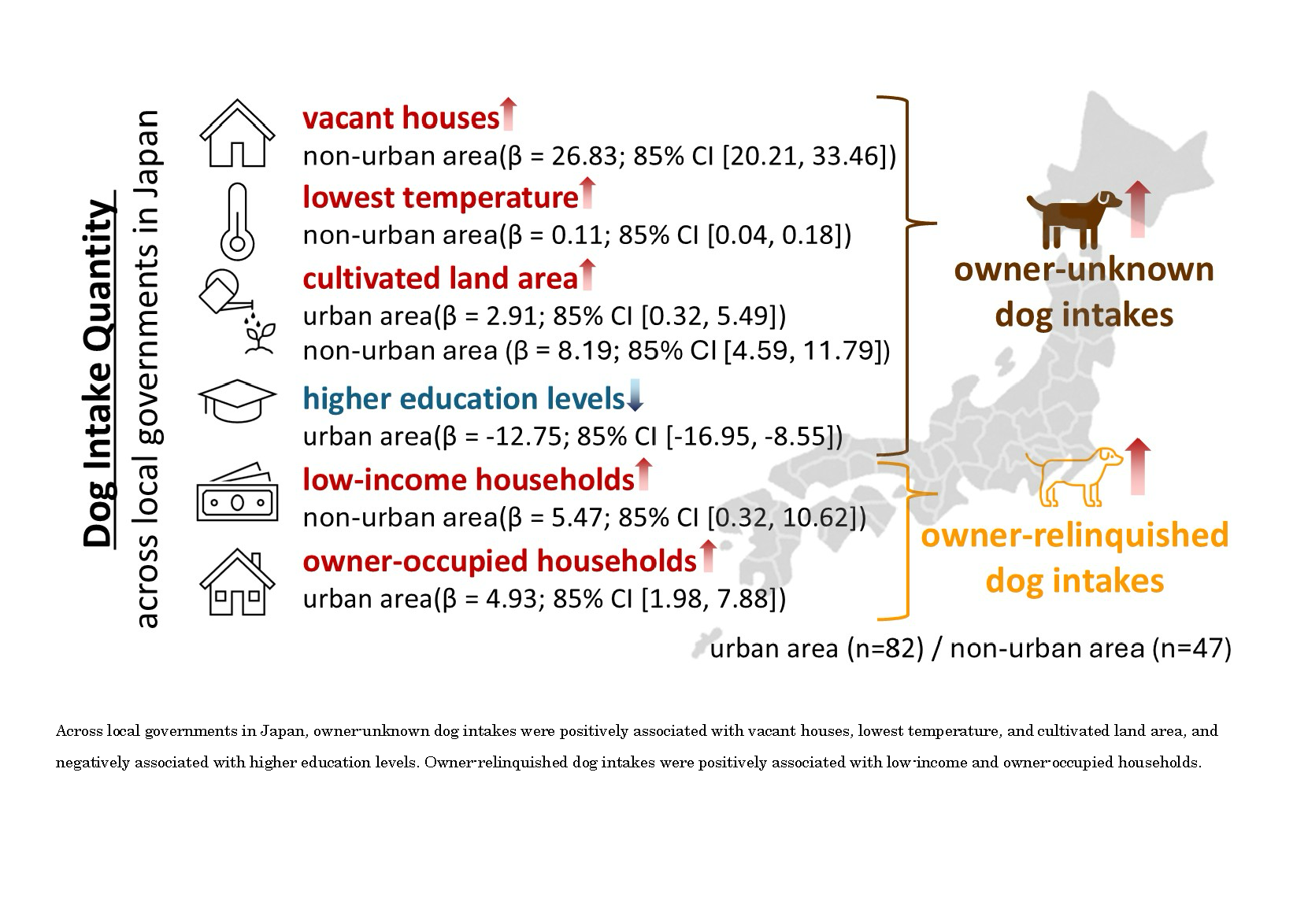
Results: Intake rates varied widely across regions. In urban areas, higher owner-unknown intake was associated with lower education level (incidence rate ratio [IRR] = 0.28, 85% confidence interval [CI]: 0.18–0.43) and higher cultivated land area (IRR = 1.34, 85% CI: 1.03–1.73). In non-urban areas, owner-unknown intake was higher in areas with more vacant housing (IRR = 14.64, 85% CI: 7.54–28.40), more cultivated land (IRR = 2.27, 85% CI: 1.58–3.25), and higher lowest temperature (IRR = 1.12, 85% CI: 1.04–1.20). Urban owner-relinquished intake was associated with owner-occupied housing (IRR = 1.64, 85% CI: 1.22–2.20). Non-urban owner-relinquished intake was higher in areas with a greater proportion of low-income households (IRR = 1.73, 85% CI: 1.03–2.89).
Conclusion: Supported predictors differed by intake type and administrative setting, suggesting that intake prevention strategies may be more effective when tailored to local context and dominant intake pathway. The associations observed in this study can serve as a basis for informing future policy development and further research.
Downloads
References
1.
Act on Welfare and Management of Animals (Act No. 105 of Oct 1, 1973). e-Gov Law Search. 1973. Last amended June 7, 2023. https://laws.e-gov.go.jp/law/348AC1000000105. Accessed June 17, 2025. [in Japanese]
2.
Act on Rabies Prevention (Act No. 247 of Aug 26, 1950). e-Gov Law Search. 1950. Last amended June 13, 2014. https://laws.e-gov.go.jp/law/325AC1000000247. Accessed November 5, 2025. [in Japanese]
3.
Act on Local Autonomy (Act No. 67 of Apr 17, 1947). e-Gov Law Search. Published Apr 17, 1947. Last amended Jun 1, 2022. https://laws.e-gov.go.jp/law/322AC0000000067/20230901_505AC0000000014 Accessed November 5, 2025. [in Japanese]
4.
Dănilă G, Simioniuc V, Duduman ML. Research on the ethology and diet of the stray dog population in the areas bordering the Municipality of Suceava, Romania. Vet Sci. 2023;10(3):188. doi: 10.3390/vetsci10030188
5.
Gill GS, Singh BB, Dhand NK, Aulakh RS, Ward MP, Brookes VJ. Stray dogs and public health: population estimation in Punjab, India. Vet Sci. 2022;9(2):75. doi: 10.3390/vetsci9020075
6.
Calvo P, Duarte C, Bowen J, Bulbena A, Fatjó J. Characteristics of 24 cases of animal hoarding in Spain. Anim Welf. 2014;23(2):199–208. doi: 10.7120/09627286.23.2.199
7.
Patronek GJ. Hoarding of animals: an under-recognized public health problem in a difficult-to-study population. Public Health Rep. 1999;114(1):81–87. doi: 10.1093/phr/114.1.81
8.
Hoarding of Animals Research Consortium (HARC). Health implications of animal hoarding. Health Soc Work. 2002;27(2):125–136. doi: 10.1093/hsw/27.2.125
9.
New JC, Salman MD, King M, Scarlett JM, Kass PH, Hutchison JM. Characteristics of shelter-relinquished animals and their owners compared with animals and their owners in U.S. pet-owning households. J Appl Anim Welf Sci. 2000;3(3):179–201. doi: 10.1207/S15327604JAWS0303_1
10.
New JC, Jr, Salman MD, Scarlett JM, et al. Moving: owners relinquishing dogs/cats to shelters. J Appl Anim Welf Sci. 1999;2(2):83–96. doi: 10.1207/S15327604JAWS0202_1
11.
Woodruff K, Smith DR, Cain C, Loftin C. The number of dogs entering shelters in five states, and factors that affect their outcomes: a study of the sheltering system. J Appl Anim Welf Sci. 2021;24(1):1–15. doi: 10.1080/10888705.2020.1852407
12.
Salman MD, New JG, Jr, Scarlett JM, Kass PH, Ruch-Gallie R, Hetts S. Human and animal factors related to relinquishment of dogs and cats in 12 selected animal shelters in the United States. J Appl Anim Welf Sci. 1998;1(3):207–226. doi: 10.1207/s15327604jaws0103_2
13.
Dolan E, Scotto J, Slater M, Weiss E. Risk factors for dog relinquishment to a Los Angeles Municipal Animal Shelter. Animals. 2015;5(4):1311–1328. doi: 10.3390/ani5040413
14.
McDowall S, Hazel SJ, Hamilton-Bruce MA, Stuckey R, Howell TJ. Association of socioeconomic status and reasons for companion animal relinquishment. Animals. 2024;14(17): 2549. doi: 10.3390/ani14172549
15.
Weiss E, Gramann S, Victor Spain C, Slater M. Goodbye to a good friend: an exploration of the re-homing of cats and dogs in the U.S. Open J Anim Sci. 2015;5(4):435–456. doi: 10.4236/ojas.2015.54046
16.
Graham T, Milaney K, Adams C, Rock M. ‘Pets negotiable’: how do the perspectives of landlords and property managers compare with those of younger tenants with dogs? Animals. 2018;8(3):32. doi: 10.3390/ani8030032
17.
Applebaum JW, Loney L, Horecka K, Graham TM. Housing-related companion animal relinquishment across 21 animal shelters in the United States from 2019–2023. Front Vet Sci. 2024;11:1430388. doi: 10.3389/fvets.2024.1430388
18.
Jensen JBH, Sandøe P, Nielsen SS. Owner-related reasons matter more than behavioural problems – a study of why owners relinquished dogs and cats to a Danish animal shelter from 1996 to 2017. Animals. 2020;10(6): 1064. doi: 10.3390/ani10061064
19.
Nishino A, Shimada M. Model selection for examining the association between cat intake quantity and socioeconomic conditions. Discov Anim. 2025;2(1):97. doi: 10.1007/s44338-025-00149-9
20.
Ministry of the Environment, Government of Japan. Statistics of Relinquished and Injured Dogs and Cats. 2023. https://www.env.go.jp/nature/dobutsu/aigo/2_data/statistics/files/r05/2_4_3a.pdf. Accessed November 13, 2024. [in Japanese]
21.
Statistics Bureau of Japan. e-Stat (Portal Site of Official Statistics of Japan). 2023. https://www.e-stat.go.jp/. Accessed January 22, 2026. [In Japanese]
22.
R Core Team. R: A Language and Environment for Statistical Computing. R Foundation for Statistical Computing; Vienna, Austria, 2025.
23.
Bartoń K. MuMIn: Multi-Model Inference. 2010:1.48.11. doi: 10.32614/CRAN.package.MuMIn
24.
Venables WN, Ripley BD. Modern Applied Statistics with S. 4th ed. Springer; dern Applied Statistics with S. 4th ed. New York, Springe, 2002.
25.
Burnham KP, Anderson DR. Model Selection and Multimodel Inference: A Practical Information-Theoretic Approach. 2nd ed. Springer-Verlag; 2002. https://link.springer.com/book/10.1007/b97636. Accessed January 22, 2026.
26.
Sutherland C, Hare D, Johnson PJ, Linden DW, Montgomery RA, Droge E. Practical advice on variable selection and reporting using Akaike information criterion. Proc R Soc B Biol Sci. 2023;290(2007):20231261. doi: 10.1098/rspb.2023.1261
27.
Arnold TW. Uninformative parameters and model selection using Akaike’s information criterion. J Wildl Manag. 2010;74(6):1175–1178. doi: 10.1111/j.1937-2817.2010.tb01236.x
28.
Ministry of Health, Labour and Welfare. Overview of the 2022 Comprehensive Survey of Living Conditions. https://www.mhlw.go.jp/toukei/list/20-21kekka.html. Accessed June 17, 2025. [in Japanese]
29.
Statistics Bureau of Japan. 2020 Population Census, Table 22–3: Number of Private Households by Family Type and Dwelling Tenure. e-Stat (Portal Site of Official Statistics of Japan). https://www.e-stat.go.jp/index.php/stat-search/database?page=1&layout=datalist&cycle=0&toukei=00200521&tstat=000001136464&tclass1=000001136466&statdisp_id=0003445169. Accessed January 22, 2026. [In Japanese]
30.
Ministry of Health, Labour and Welfare. White Paper on Health and Welfare 2000. https://www.mhlw.go.jp/www1/wp/wp00_4/chapt-a1.html. Accessed June 18, 2025. [in Japanese]
31.
Statistics Bureau of Japan. 2020 Population Census: Basic Tabulation. https://www.stat.go.jp/data/kokusei/2020/kekka.html. Accessed January 22, 2026. [In Japanese]
32.
Ministry of the Environment, Government of Japan. Guidelines for Proper Keeping of Dogs and Cats in Dense Residential Areas. 2010. https://www.env.go.jp/nature/dobutsu/aigo/2_data/pamph/h2202.pdf. Accessed November 13, 2024. [in Japanese]
33.
Statistics Bureau of Japan. 2018 Housing and Land Survey. https://www.stat.go.jp/data/jyutaku/2018/tyousake.html. Accessed June 17, 2025. [in Japanese]
34.
Ministry of Education, Culture, Sports, Science and Technology. School Basic Survey FY2020. https://www.mext.go.jp/b_menu/toukei/chousa01/kihon/kekka/k_detail/1419591_00003.htm. Accessed June 18, 2025. [in Japanese]
35.
Statistics Bureau of Japan. 2020 Population Census: Employment Status (Basic Tabulation). e-Stat (Portal Site of Official Statistics of Japan). https://www.e-stat.go.jp/stat-search/files?page=1&layout=datalist&toukei=00200521&tstat=000001136464&cycle=0&tclass1=000001136467. Accessed January 22, 2026. [In Japanese]
36.
Ministry of Agriculture, Forestry and Fisheries. Crop Statistics Survey: Municipal Data, 2021 Production. https://www.e-stat.go.jp/stat-search/files?page=1&layout=datalist&toukei=00500215&tstat=000001013427. Accessed June 17, 2025. [in Japanese]
37.
Statistics Bureau of Japan. Social and Population Statistics System. https://www.stat.go.jp/data/ssds/index.html. Accessed January 22, 2026. [In Japanese]
38.
Galarde-López M, Rosales-Moreno EDR, Hernández-Méndez SE, et al. Spatiotemporal analysis of a population management intervention for dogs and cats in a municipality in central Mexico. Vet World. 2024;17:1693–1701. doi: 10.14202/vetworld.2024.1693-1701
39.
Ministry of the Environment, Government of Japan. Animal Welfare and Management Administrative Outline (FY2024 Edition): <III> Reference Material 3: Fees for Acceptance of Dogs and Cats and Subsidies for Neutering/Spaying. https://www.env.go.jp/nature/dobutsu/aigo/2_data/statistics/gyosei-jimu_r06.html. Accessed December 5, 2025.
40.
Uchikoshi A. Public administration in the age of the pet boom. Seijo Law Rev. 2015;84:39–98.
41.
Pal SK. Population ecology of free-ranging urban dogs in West Bengal, India. Acta Theriol (Warsz). 2001;46(1):69–78. doi: 10.1007/BF03192418
42.
De Santi CE, Chiba De Castro WA, Sibim AC, et al. Spatial distribution and population dynamics of free-roaming (stray and semi-domiciled) dogs in a major Brazilian city. Front Vet Sci. 2024;11:1417458. doi: 10.3389/fvets.2024.1417458
43.
Ministry of the Environment, Government of Japan. Basic Guidelines under the Act on Welfare and Management of Animals (Notification No. 53 of Apr 30, 2020). 2020. https://www.env.go.jp/nature/dobutsu/aigo/1_law/guideline.html. Accessed November 5, 2025. [in Japanese]
44.
Saunders J, Parast L, Babey SH, Miles JV. Exploring the differences between pet and non-pet owners: implications for human-animal interaction research and policy. PLoS One. 2017;12(6):e0179494. doi: 10.1371/journal.pone.0179494
45.
Crespo P, Faytong-Haro M. Impact of the 2007–2008 United States economic crisis on pet ownership. Animals. 2022;12(21): 3010. doi: 10.3390/ani12213010
46.
Rodriguez JR, Davis J, Hill S, Wolf PJ, Hawes SM, Morris KN. Trends in intake and outcome data from U.S. animal shelters from 2016 to 2020. Front Vet Sci. 2022;9:863990. doi: 10.3389/fvets.2022.863990
47.
Ly LH, Gordon E, Protopopova A. Exploring the relationship between human social deprivation and animal surrender to shelters in British Columbia, Canada. Front Vet Sci. 2021;8:656597. doi: 10.3389/fvets.2021.656597
48.
Dyer JL, Milot L. Social vulnerability assessment of dog intake location data as a planning tool for community health program development: a case study in Athens-Clarke County, GA, 2014–2016. PLoS One. 2019;14(12):e0225282. doi: 10.1371/journal.pone.0225282
49.
Woodruff K, Smith DR. An estimate of the number of dogs in US shelters in 2015 and the factors affecting their fate. J Appl Anim Welf Sci. 2020;23(3):302–314. doi: 10.1080/10888705.2019.1663735
50.
Neal SM, Kremer T. Examining the relationship between social vulnerability and animal shelter intakes and outcomes: patterns and implications. Animals. 2024;14(22): 3166. doi: 10.3390/ani14223166
Additional Files
Published
Issue
Section
License
Copyright (c) 2026 Arisa Nishino, Masaki Shimada

This work is licensed under a Creative Commons Attribution 4.0 International License.
How to Cite