Shelter to Home: Surveys of Early Post-Adoption Experiences with More Than 22,000 Dog and Cat Adopters
DOI:
https://doi.org/10.56771/jsmcah.v5.158Keywords:
Pet adoption, cat behavior, dog behavior, animal shelter, human-animal bond, post-adoption, adoption satisfactionAbstract
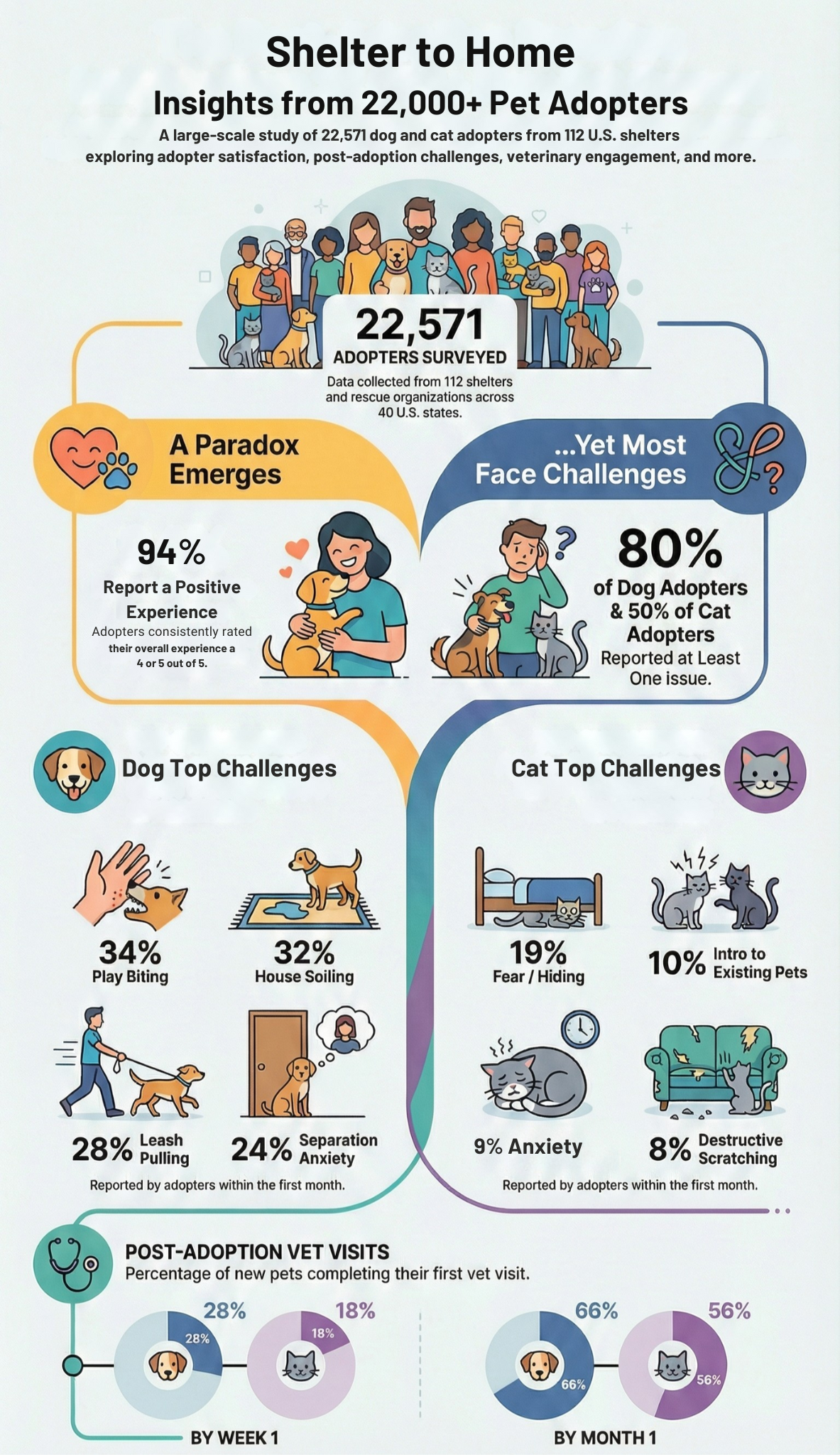
Introduction: Understanding the early post-adoption experience is critical to supporting animal welfare, strengthening the human–animal bond, and improving shelter practices. While most adopters report high satisfaction, behavioural and care-related challenges are common. This study used the Petszel platform to evaluate early post-adoption outcomes across more than 22,000 dog and cat adopters from 112 shelters and rescue organisations in 40 United States (U.S.) states.
Methods: Surveys were distributed automatically on Day 1, Week 1, and Month 1 post-adoption. Adopters were asked about general satisfaction, specific behaviours, veterinary care, and microchip registration. Responses were included only if the pet was in the home at time of survey. Data were summarised by species and time point using descriptive statistics.
Results: Over 94% rated their experience positively (score of 4 or 5 out of 5) at all time points. However, more than 78% of dog adopters and 50% of cat adopters also reported at least one challenge. Among dogs, common issues included house soiling (32%), play biting (34%), leash pulling (28%), and separation distress/anxiety (24%). Among cats, the most frequent challenges were fear or hiding (19%), introduction to existing pets (10%), anxiety in specific situations (9%); destructive chewing/scratching (8%) and urinating and/or defecating outside the litter box (5%) were both reported slightly less commonly. By Month 1, 56% of cat adopters and 66% of dog adopters reported completing their pet’s first veterinary visit. Microchip registration was reported by 61% of cat and 62% of dog adopters by Week 1. Nearly half of dog adopters reported no plans for formal training by Month 1.
Conclusion: Despite high satisfaction ratings, many adopters faced behavioural or care challenges. These findings suggest that general satisfaction measures may obscure important challenges as animals settle into their new homes. Species-specific counselling, proactive veterinary engagement, and further microchip registration guidance may better support post-adoption success.
Downloads
References
1.
Kent M. 2024 AVMA Pet Ownership and Demographics Sourcebook. American Veterinary Medical Association; 2024:1–42.
2.
Amat M, Camps T, Manteca X. Stress in owned cats: behavioural changes and welfare implications. J Feline Med Surg. 2016;18(8):577–586. doi: 10.1177/1098612X15590867
3.
Bradley J, Rajendran S. Increasing adoption rates at animal shelters: a two-phase approach to predict length of stay and optimal shelter allocation. BMC Vet Res. 2021;17(1):70. doi: 10.1186/s12917-020-02728-2
4.
Buckland EL, Giragosian K, Jordan EJ, Da Costa REP, Woodward JL, Casey RA. New strategies of canine post-adoption support: methods for a prospective longitudinal cohort study. Animals. 2025;15(9): 1232. doi: 10.3390/ani15091232
5.
Powell L, Reinhard C, Satriale D, Morris M, Serpell J, Watson B. Characterizing unsuccessful animal adoptions: age and breed predict the likelihood of return, reasons for return and post-return outcomes. Sci Rep. 2021;11(1): 8018. doi: 10.1038/s41598-021-87649-2
6.
Ellis JJ, Janke KJ, Furgala NM, Bridge T. Post-adoption behavior and adopter satisfaction of cats across socialization likelihoods. J Shelter Med Community Anim Health. 2025;4(1):116. doi: 10.56771/jsmcah.v4.116
7.
Gates MC, Zito S, Thomas J, Dale A. Post-adoption problem behaviours in adolescent and adult dogs rehomed through a New Zealand animal shelter. Animals. 2018;8(6):93. doi: 10.3390/ani8060093
8.
Lord LK, Reider L, Herron ME, Graszak K. Health and behavior problems in dogs and cats one week and one month after adoption from animal shelters. J Am Vet Med Assoc. 2008;233(11):1715–1722. doi: 10.2460/javma.233.11.1715
9.
Scott S, Jong E, McArthur M, Hazel SJ. Follow-up surveys of people who have adopted dogs and cats from an Australian shelter. Appl Anim Behav Sci. 2018;201:40–45. doi: 10.1016/j.applanim.2017.12.021
10.
Beaver BV. The prevalence of behavior problems in dogs in the United States. J Vet Behav. 2024;76:34–39. doi: 10.1016/j.jveb.2024.11.001
11.
Bohland KR, Lilly ML, Herron ME, Arruda AG, O’Quin JM. Shelter dog behavior after adoption: using the C-BARQ to track dog behavior changes through the first six months after adoption. PLoS One. 2023;18(8):e0289356. doi: 10.1371/journal.pone.0289356
12.
Marston LC, Bennett PC, Coleman GJ. Adopting shelter dogs: owner experiences of the first month post-adoption. Anthrozoös. 2005;18(4):358–378. doi: 10.2752/089279305785593965
13.
Ramos D, Reche-Junior A, Luzia Fragoso P, et al. A case-controlled comparison of behavioural arousal levels in urine spraying and latrining cats. Anim Open Access J MDPI. 2020;10(1):117. doi: 10.3390/ani10010117
14.
Lord LK, Ingwersen W, Gray JL, Wintz DJ. Characterization of animals with microchips entering animal shelters. J Am Vet Med Assoc. 2009;235(2):160–167. doi: 10.2460/javma.235.2.160
15.
Kremer T. Post: Lost Pet Reunification. HASS Data Is Clear – Microchips Work, and They Could Work Even Better. 2023. https://www.humananimalsupportservices.org/uncategorized/new-analysis-pets-with-microchips-are-three-times-more-likely-to-get-home/. Accessed July 24, 2025.
16.
American Association for Public Opinion Research. Standard Definitions: Final Dispositions of Case Codes and Outcome Rates for Surveys. AAPOR; 2023:1–90.
17.
Townsend L, Dixon L, Buckley L. Lead pulling as a welfare concern in pet dogs: what can veterinary professionals learn from current research? Vet Rec. 2022;191(10):e1627. doi: 10.1002/vetr.1627
18.
Harvey ND, Christley RM, Giragosian K, et al. Impact of changes in time left alone on separation-related behaviour in UK pet dogs. Anim Open Access J MDPI. 2022;12(4):482. doi: 10.3390/ani12040482
19.
Quinn R, Masters S, Starling M, et al. Functional significance and welfare implications of chewing in dogs (Canis familiaris). Front Vet Sci. 2025;12:1499933. doi: 10.3389/fvets.2025.1499933
20.
Serpell JA, Powell L. Prevalence and Severity of Behavior Problems in Dogs in the United States: A Re-Assessment. Social Science Research Network. Preprint posted online July 31, 2025. doi: 10.2139/ssrn.5374383
21.
Tiira K, Sulkama S, Lohi H. Prevalence, comorbidity, and behavioral variation in canine anxiety. J Vet Behav. 2016;16:36–44. doi: 10.1016/j.jveb.2016.06.008
22.
Yamada R, Kuze-Arata S, Kiyokawa Y, Takeuchi Y. Prevalence of 25 canine behavioral problems and relevant factors of each behavior in Japan. J Vet Med Sci. 2019;81(8):1090–1096. doi: 10.1292/jvms.18-0705
23.
Salman MD, Hutchison J, Ruch-Gallie R, et al. Behavioral reasons for relinquishment of dogs and cats to 12 shelters. J Appl Anim Welf Sci. 2000;3(2):93–106. doi: 10.1207/S15327604JAWS0302_2
24.
Herron ME, Lord LK, Hill LN, Reisner IR. Effects of preadoption counseling for owners on house-training success among dogs acquired from shelters. J Am Vet Med Assoc. 2007;231(4):558–562. doi: 10.2460/javma.231.4.558
25.
Lawson GT, Langford FM, Harvey AM. The environmental needs of many Australian pet cats are not being met. J Feline Med Surg. 2020;22(10):898–906. doi: 10.1177/1098612X19890189
26.
Tateo A, Ricci-Bonot C, Felici M, et al. Litter management practices and house-soiling in Italian cats. Anim Open Access J MDPI. 2023;13(14): 2382. doi: 10.3390/ani13142382
27.
New JC, Salman MD, King M, Scarlett JM, Kass PH, Hutchison JM. Characteristics of shelter-relinquished animals and their owners compared with animals and their owners in U.S. pet-owning households. J Appl Anim Welf Sci. 2000;3(3):179–201. doi: 10.1207/S15327604JAWS0303_1
28.
Liu S, Sung W, Welsh S, Berger JM. A six-year retrospective study of outcomes of surrendered cats (Felis catus) with periuria in a no-kill shelter. J Vet Behav. 2021;42:75–80. doi: 10.1016/j.jveb.2020.12.002
29.
Halls V, Dowgray N, Ellis SLH, Taylor S, Bessant C. Cat friendly principles for those working with unowned cats. J Shelter Med Community Anim Health. 2023;2(S1):63. doi: 10.56771/jsmcah.v2.63
30.
American Humane Association. Keeping Pets (Dogs and Cats) in Homes: A Three-Phase Retention Study. Phase I: Reasons for Not Owning a Dog or Cat. American Humane Association; 2012:1–53. https://www.americanhumane.org/app/uploads/2016/08/aha-petsmart-retention-study-phase-1.pdf. Accessed July 24, 2025.
31.
American Humane Association. Keeping Pets (Dogs and Cats) in Homes: A Three-Phase Retention Study. Phase II: Descriptive Study of Post-Adoption Retention in Six Shelters in Three U.S. Cities. American Humane Association; 2013:1–53. https://www.americanhumane.org/app/uploads/2016/08/petsmart-keeping-pets-phase-ii.pdf. Accessed July 24, 2025.
32.
Miller TR, Bergen G, Ballesteros MF, Bhattacharya S, Gielen AC, Sheppard MS. Increasing smoke alarm operability through theory-based health education: a randomised trial. J Epidemiol Community Health. 2014;68(12): 1168. doi: 10.1136/jech-2014-204182
33.
Weiss E, Slater MR, Lord LK. Retention of provided identification for dogs and cats seen in veterinary clinics and adopted from shelters in Oklahoma City, OK, USA. Prev Vet Med. 2011;101(3):265–269. doi: 10.1016/j.prevetmed.2011.05.008
34.
Rybak A. Survey mode and nonresponse bias: a meta-analysis based on the data from the international social survey programme waves 1996–2018 and the European social survey rounds 1 to 9. PLoS One. 2023;18(3):e0283092. doi: 10.1371/journal.pone.0283092
35.
Barriball KL, While AE. Non-response in survey research: a methodological discussion and development of an explanatory model. J Adv Nurs. 1999;30(3):677–686. doi: 10.1046/j.1365-2648.1999.01117.x
36.
Groves RM, Fowler FJ, Jr, Couper MP, Singer E, Tourangeau R. Survey Methodology. 2nd ed. John Wiley & Sons, Inc.; 2009.
37.
Groves RM, Peytcheva E. The impact of nonresponse rates on nonresponse bias: a meta-analysis. Public Opin Q. 2008;72(2):167–189. doi: 10.1093/poq/nfn011
38.
Morton SMB, Bandara DK, Robinson EM, Carr PEA. In the 21st century, what is an acceptable response rate? Aust N Z J Public Health. 2012;36(2):106–108. doi: 10.1111/j.1753-6405.2012.00854.x
39.
Dillman DA, Smyth JD, Christian LM. Internet, Phone, Mail, and Mixed-Mode Surveys: The Tailored Design Method. 4th ed. John Wiley & Sons, Inc.; 2014.
40.
Tourangeau R, Rips LJ, Rasinski K. The Psychology of Survey Response. Cambridge University Press; 2000.
Additional Files
Published
Issue
Section
License
Copyright (c) 2026 Margaret R. Slater, Emily Weiss, Julie K. Levy, Michael Greenberg

This work is licensed under a Creative Commons Attribution 4.0 International License.
How to Cite