Sheltering Domestic Rabbits (Oryctolagus cuniculus) in Canada and the USA during the COVID-19 Pandemic and RHDV2 Emergence: A Cross-Sectional Mixed-Methods Survey of Intake, Care, and Management (2017–2022)
DOI:
https://doi.org/10.56771/jsmcah.v5.153Keywords:
animal abandonment, animal fostering, animal sheltering, animal relinquishment, companion animal welfare, companion rabbit, RHD, pandemics, pet rabbit, stray animalsAbstract
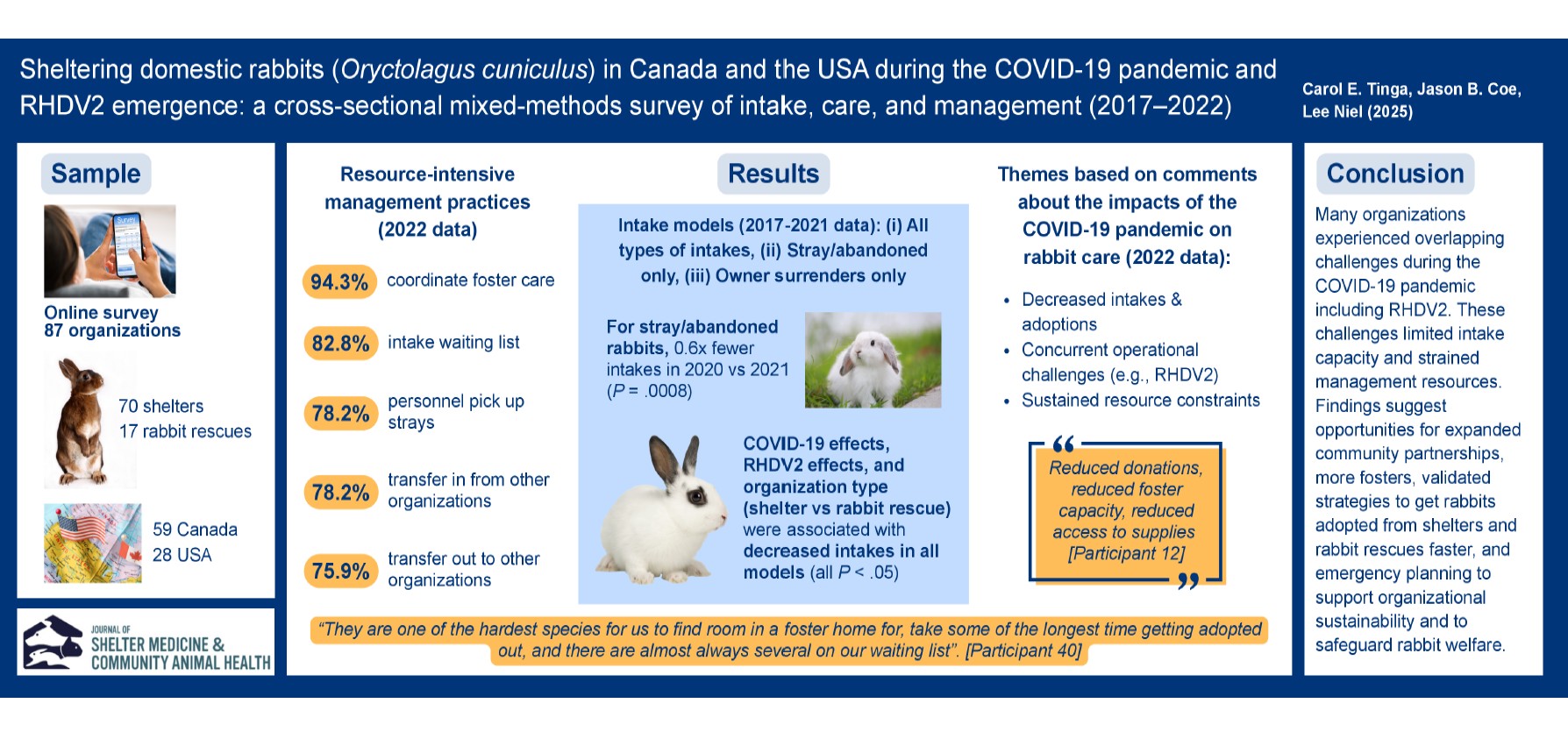
Introduction: During the COVID-19 pandemic, news reports indicated increased numbers of stray rabbits and surrender requests at shelters and rabbit rescues. This study examined the impacts of the COVID-19 and Rabbit Hemorrhagic Disease Virus 2 (RHDV2) pandemics on rabbit intake, care, and management.
Methods: An online survey gathered a convenience sample of Canadian and American shelters and rabbit rescues. Retrospective data (2017–2022) were collected on rabbit intake numbers per year (all types, stray/abandoned only, and owner surrenders only). Nine categorical questions addressed practices related to capacity challenges, species-specific tracking, and whether RHDV2 affected intakes. Additional questions asked whether surrenders were declined, waiting lists were used, and if RHDV2 impacted intakes annually for each of 2017–2022. Participants also reported whether the COVID-19 pandemic affected their ability to care for domestic rabbits. Open-ended comments explored pandemic-related impacts; changes in stray, abandoned, or relinquished rabbits in 2022 vs. before; and any additional information about organizational roles in rabbit care. Analyses included descriptive statistics, multivariable regressions of intakes (point estimates, 95% confidence intervals, and exact P values), and thematic analysis.
Results: Organizations (N = 87) frequently used resource-intensive practices: foster care (94.3%), waiting lists (82.8%), and transfers in/out (78.2%, 75.9%) to other organizations. The proportion of organizations declining surrenders rose from 67.1% (55/82) in 2017 to 88.5% (77/87) in 2022; waiting lists rose from 59.0 (46/78) to 80.0% (68/85). COVID-19, RHDV2, and organization type were each associated with decreased intake across intake categories (all P < 0.05). A year-over-year decrease was observed only for stray/abandoned intakes in 2020 vs. 2021 (P = 0.0008). Thematic analysis revealed three COVID-19 effects: decreased intakes/adoptions, concurrent operational challenges including RHDV2, and sustained resource constraints.
Conclusion: Some organizations faced complex, simultaneous challenges during the COVID-19 pandemic and RHDV2 emergence, significantly limiting intakes and straining resources. Recommendations include emergency planning, expanded fostering, and community partnerships to support sustainability and to safeguard rabbit welfare.
Downloads
References
1.
Crowell-Davis S. Rabbit Behavior. Vet Clin North Am Exot Anim Pract. 2021;24(1):53–62. doi: 10.1016/j.cvex.2020.09.002
2.
McMahon SA, Wigham E. ‘All Ears’: A Questionnaire of 1516 Owner Perceptions of the Mental Abilities of Pet Rabbits, Subsequent Resource Provision, and the Effect on Welfare. Animals. 2020;10(10):1730. doi: 10.3390/ani10101730
3.
Ledger RA. The Relinquishment of Rabbits to Rescue Shelters in Canada [Abstract Only]. J Vet Behav. 2010;5(1):36–37. doi: 10.1016/j.jveb.2009.10.016
4.
Cook AJ, McCobb E. Quantifying the Shelter Rabbit Population: An Analysis of Massachusetts and Rhode Island Animal Shelters. J Appl Anim Welf Sci. 2012;15(4):297–312. doi: 10.1080/10888705.2012.709084
5.
Davis SE, DeMello M. Stories Rabbits Tell: A Natural and Cultural History of a Misunderstood Creature. Lantern Books, 2003.
6.
Díaz-Berciano C, Gallego-Agundez M. Abandonment and Rehoming of Rabbits and Rodents in Madrid (Spain): A Retrospective Study (2008–2021). J Appl Anim Welf Sci. 2022;27(4):712–722. doi: 10.1080/10888705.2022.2162342
7.
Ulfsdotter L. Rehoming of Pet Rabbits in Sweden. Student Report #478. Swedish University of Agriculture, 2013. Accessed Dec 17, 2025. https://stud.epsilon.slu.se/5998/1/Ulfsdotter_L_130829.pdf
8.
Ulfsdotter L, Lundberg A, Andersson M. Rehoming of Pet Rabbits (Oryctolagus cuniculus) in Sweden: An Investigation of National Advertisement. Anim Welf. 2016;25(3):303–308. doi: 10.7120/09627286.25.3.303
9.
Falconer J. Humans of Animal Advocacy: Michelle Kelly | The Founder and CEO of the Los Angeles Rabbit Foundation Has Transformed Rabbit Care at LA Shelters. HumanePro – Humane Society of the United States. Accessed Nov 8, 2023. https://humanepro.org/magazine/articles/humans-animal-advocacy-michelle-kelly
10.
Neville V, Hinde K, Line E, Todd R, Saunders RA. Rabbit Relinquishment through Online Classified Advertisements in the United Kingdom: When, Why, and How Many? J Appl Anim Welf Sci. 2018;22(2):105–115. doi: 10.1080/10888705.2018.1438287
11.
Ellis CF, McCormick W, Tinarwo A. Analysis of Factors Relating to Companion Rabbits Relinquished to Two United Kingdom Rehoming Centers. J Appl Anim Welf Sci. 2017;20(3):230–239. doi: 10.1080/10888705.2017.1303381
12.
U ASY, Hou CY, Protopopova A. Rabbit Intakes and Predictors of Their Length of Stay in Animal Shelters in British Columbia, Canada. PLoS One. 2024;19(4):e0300633. doi: 10.1371/journal.pone.0300633
13.
World Health Organization. Opening Remarks at the Media Briefing on COVID-19 – 11 March 2020. 2020. Accessed Nov 14, 2023. https://www.who.int/director-general/speeches/detail/who-director-general-s-opening-remarks-at-the-media-briefing-on-covid-19---11-march-2020
14.
Canadian Institute for Health Information (CIHI). Canadian COVID-19 Intervention Timeline. 2022. Accessed Jul 10, 2024. https://www.cihi.ca/en/canadian-covid-19-intervention-timeline
15.
Dasgupta S, Kassem AM, Sunshine G, et al. Differences in Rapid Increases in County-Level COVID-19 Incidence by Implementation of Statewide Closures and Mask Mandates – United States, June 1–September 30, 2020. Ann Epidemiol. 2021;57:46–53. doi: 10.1016/j.annepidem.2021.02.006
16.
Combden S, Forward A, Sarkar A. COVID-19 Pandemic Responses of Canada and United States in First 6 Months: A Comparative Analysis. Int J Health Plann Mgmt. 2022;37:50–65. doi: 10.1002/hpm.3323
17.
National Animal Care & Control Association. NACA Statement on Animal Control Functions During the COVID-19 Pandemic. Accessed Jul 10, 2024. https://www.nacanet.org/wp-content/uploads/2020/03/1.General-Statement-on-Animal-Control-Functions-During-the-COVID-19-Pandemic.r.pdf
18.
Humane Canada. Community-Supported Animal Sheltering Policy Platform. 2023. Accessed Oct 29, 2025. https://humane-canada.ca/en/your-humane-canada/news-and-reports/reports/community-supported-animal-sheltering-policy-platform
19.
Anon. Guelph Humane Society Has Too Many Rabbits, and Not Enough Adopters. CBC Kitchener-Waterloo. September 8, 2021. Accessed Jan 4, 2022. https://www.cbc.ca/news/canada/kitchener-waterloo/guelph-humane-society-surge-in-rabbits-1.6166509
20.
Anon. From a Bunny Surge to a Need for Food: Animal Groups Reflect on Another Pandemic Year for Pets. CBC News Windsor. January 2, 2022. Accessed Jan 3, 2022. https://www.cbc.ca/news/canada/windsor/windsor-essex-pandemic-year-pets-1.6300809
21.
Anon. Quebec Animal Shelters Overwhelmed by Rabbits as Advocates Call for Stricter Regulations. CBC News Montreal. January 3, 2022. Accessed Jan 4, 2022. https://www.cbc.ca/news/canada/montreal/pandemic-rabbits-abandoned-montreal-quebec-shelters-1.6303026?fbclid=IwAR1IAD5tJMrXK_yQHmb4XYC8a4yQakrQ6No_cQK7G89uNl8KxPhY6GeWxwo
22.
Campbell T. Bay Area Shelters Make Plea to Pet Owners as Facilities Overflow with Abandoned Animals. ABC7 San Francisco. October 27, 2022. Accessed Apr 27, 2024. https://abc7news.com/bay-area-animal-shelters-pet-adoption-abandoned-animals-pandemic-pets/12387327/
23.
Larson A. Bay Area Shelters Overloaded with Rabbits. KRON4. August 18, 2022. Accessed Apr 27, 2024. https://www.kron4.com/news/bay-area/bay-area-shelters-overloaded-with-rabbits/
24.
Le Gall-Reculé G, Zwingelstein F, Boucher S, et al. Detection of a New Variant of Rabbit Haemorrhagic Disease Virus in France. Vet Rec. 2011;168(5):137–138. doi: 10.1136/vr.d697
25.
Le Gall-Reculé G, Lavazza A, Marchandeau S, et al. Emergence of a New Lagovirus Related to Rabbit Haemorrhagic Disease Virus. Vet Res. 2013;44:81. doi: 10.1186/1297-9716-44-81
26.
Rouco C, Aguayo-Adán JA, Santoro S, Abrantes J, Delibes-Mateos M. Worldwide Rapid Spread of the Novel Rabbit Haemorrhagic Disease Virus (GI.2/RHDV2/b). Transbound Emerg Dis. 2019;66(4):1762–1764. doi: 10.1111/tbed.13189
27.
Asin J, Calvete C, Uzal FA, et al. Rabbit Hemorrhagic Disease Virus 2, 2010–2023: A Review of Global Detections and Affected Species. J Vet Diagnostic Investig. 2024;36(5):617–637. doi: 10.1177/10406387241260281
28.
Hawai`i Department of Agriculture. Rabbit Hemorrhagic Disease Confirmed on Maui – Quarantine Order Issued. 2022. Accessed Jul 4, 2022. https://hdoa.hawaii.gov/blog/main/nr-rabbitdisease/
29.
Government of Canada. Rabbit Haemorrhagic Disease (RHD) Fact Sheet. Canadian Food Inspection Agency, 2023. Accessed Nov 21, 2023. https://inspection.canada.ca/en/animal-health/terrestrial-animals/diseases/immediately-notifiable/rhd/fact-sheet
30.
Braun V, Clarke V. Using Thematic Analysis in Psychology. Qual Res Psychol. 2006;3(2):77–101. doi: 10.1191/1478088706qp063oa
31.
Braun V, Clarke V. Can I Use TA? Should I Use TA? Should I Not Use TA? Comparing Reflexive Thematic Analysis and Other Pattern-Based Qualitative Analytic Approaches. Couns Psychother Res. 2021;21:37–47. doi: 10.1002/capr.12360
32.
Green J, Thorogood N. Qualitative Methods for Health Research. 4th ed. (Seaman J, ed.). SAGE, 2018.
33.
Powdrill-Wells N, Bennett C, Cooke F, Rogers S, White J. A Novel Approach to Engaging Communities Through the Use of Human Behaviour Change Models to Improve Companion Animal Welfare and Reduce Relinquishment. Animals. 2025;15(7):1036. doi: 10.3390/ani15071036
34.
Carroll GA, Reeve C, Torjussen A. Companion Animal Adoption and Relinquishment during the COVID-19 Pandemic: The Experiences of Animal Rescue Staff and Volunteers. Anim Welf. 2024;33:e12. doi: 10.1017/awf.2024.15
35.
Karsten CL, Wagner DC, Kass PH, Hurley KF. An Observational Study of the Relationship between Capacity for Care as an Animal Shelter Management Model and Cat Health, Adoption and Death in Three Animal Shelters. Vet J. 2017;227:15–22. doi: 10.1016/j.tvjl.2017.08.003
36.
UC Davis – Koret Shelter Medicine Program. October 9, 2025 Update. Accessed Oct 28, 2025. https://www.sheltermedicine.com/programs/maddies-million-pet-challenge/
37.
Koret Shelter Medicine Program. Four Rights. n.d. Accessed Aug 5, 2025. https://www.shelterlearniverse.com/visitor_class_catalog/category/126596
38.
CASCAR: California Animal Shelter COVID Action Response | Koret Shelter Medicine Program. June 1, 2021. Accessed Nov 7, 2023. https://www.sheltermedicine.com/services/cascar/
39.
Guerios SD, Porcher TR, Clemmer G, Denagamage T, Levy JK. COVID-19 Associated Reduction in Elective Spay-Neuter Surgeries for Dogs and Cats. Front Vet Sci. 2022;9:912893. doi: 10.3389/fvets.2022.912893
40.
Muzzatti SL, Grieve KL. Covid Cats and Pandemic Puppies: The Altered Realm of Veterinary Care for Companion Animals during a Global Pandemic. J Appl Anim Welf Sci. 2022;25(2):153–166. doi: 10.1080/10888705.2022.2038168
41.
Jacobson LS, Janke KJ, Probyn-Smith K, Stiefelmeyer K. Barriers and Lack of Access to Veterinary Care in Canada 2022. J Shelter Med Community Anim Health. 2024;3(1):1–12. doi: 10.56771/jsmcah.v3.72
42.
House Rabbit Society. Veterinary Training Initiative. n.d. Accessed Oct 15, 2025. https://houserabbit.org/veterinaryinitiative
43.
United States Department of Agriculture – Animal and Plant Health Inspection Service. Rabbit Hemorrhagic Disease Map Application. 2020–24 Rabbit Hemorrhagic Disease Virus 2. 2025. Accessed Jul 29, 2025. https://www.aphis.usda.gov/livestock-poultry-disease/rabbit-hemorrhagic-disease-map
44.
Lederhouse C. Rabbit Hemorrhagic Disease’s Spread Appears to be Slowing. AVMA News. 2023. Accessed Aug 25, 2023. https://www.avma.org/news/rabbit-hemorrhagic-diseases-spread-appears-be-slowing
45.
Capucci L, Cavadini P, Schiavitto M, Lombardi G, Lavazza A. Increased Pathogenicity in Rabbit Haemorrhagic Disease Virus Type 2 (RHDV2). Vet Rec. 2017;180(17):426. doi: 10.1136/vr.104132
46.
Le Minor O, Boucher S, Joudou L, et al. Rabbit Haemorrhagic Disease: Experimental Study of a Recent Highly Pathogenic GI.2/RHDV2/b Strain and Evaluation of Vaccine Efficacy. World Rabbit Sci. 2019;27(3):143–156. doi: 10.4995/wrs.2019.11082
47.
Mohamed F, Gidlewski T, Berninger ML, et al. Comparative Susceptibility of Eastern Cottontails and New Zealand White Rabbits to Classical Rabbit Haemorrhagic Disease Virus (RHDV) and RHDV2. Transbound Emerg Dis. 2022;69(4):e968–e978. doi: 10.1111/tbed.14381
48.
Hall RN, King T, O’Connor T, et al. Age and Infectious Dose Significantly Affect Disease Progression after RHDV2 Infection in Naïve Domestic Rabbits. Viruses. 2021;13:1184. doi: 10.3390/v13061184
49.
Hu B, Fan Z, Qiu R, et al. Novel Recombinant Rabbit Hemorrhagic Disease Virus 2 (RHDV2) Is Circulating in China within 12 Months after Original RHDV2 Arrival. Transbound Emerg Dis. 2023;2023:4787785. doi: 10.1155/2023/4787785
50.
Hu B, Dong W, Song Y, Fan Z, Cavadini P, Wang F. Detection of a New Recombinant Rabbit Hemorrhagic Disease Virus 2 in China and Development of Virus-Like Particle-Based Vaccine. Viruses. 2025;17(5):710. doi: 10.3390/v17050710
51.
Schumacher E, Berliner E, Hicks S, et al. The Association of Shelter Veterinarians’ Guidelines for Humane Rabbit Housing in Animal Shelters. J Shelter Med Community Anim Health. 2025;4(S2):149. doi: 10.56771/jsmcah.v4.149
52.
Ellis C, McCormick W, Tinarwo A. Rabbit Relinquishment to Two UK Rescue Centres and Beyond. Poster presented at: Universities Federation for Animal Welfare Conference. June 23, 2016, York, UK. ResearchGate; 2016:1. doi: 10.13140/RG.2.1.2212.3124
53.
House Rabbit Society – San Francisco Bay Area Center (HRS – SFBAC). Adopting a Rabbit. n.d. Accessed Mar 27, 2025. https://houserabbit.org/how-to-adopt
54.
Gunter LM, Gilchrist RJ, Blade EM, et al. Emergency Fostering of Dogs from Animal Shelters During the COVID-19 Pandemic: Shelter Practices, Foster Caregiver Engagement, and Dog Outcomes. Front Vet Sci. 2022;9:862590. doi: 10.3389/fvets.2022.862590
55.
Reese L, Jacobs J, Pratt G, Vanslembrouck H, Werner G. Dog Foster Volunteer Retention. J Appl Anim Welf Sci. 2025;28(3):419–434. doi: 10.1080/10888705.2024.2355523
56.
McBride EA. Small Prey Species’ Behaviour and Welfare: Implications for Veterinary Professionals. J Small Anim Pract. 2017;58(8):423–436. doi: 10.1111/jsap.12681
57.
University of Florida Shelter Medicine Program. The Community Cat Superhighway – The Right Outcome for Every Cat. 2024. Accessed Jun 11, 2024. https://sheltermedicine.vetmed.ufl.edu/shelter-services/the-right-outcome/the-community-cat-superhighway/
58.
Tinga CE. Bunny Bonds and Shelter Stories: Understanding Human-Rabbit Relationships and Recent Trends in Managing Unwanted Companion Rabbits. PhD Thesis, University of Guelph, 2025. https://hdl.handle.net/10214/28788
Additional Files
Published
Issue
Section
License
Copyright (c) 2026 Carol E. Tinga, Jason B. Coe, Lee Niel

This work is licensed under a Creative Commons Attribution 4.0 International License.
How to Cite