Pets in Lower Socioeconomic Communities Have a Higher Exposure to Second-Hand Smoke
DOI:
https://doi.org/10.56771/jsmcah.v5.151Keywords:
cotinine, second-hand smoke, environmental risk, education, povertyAbstract
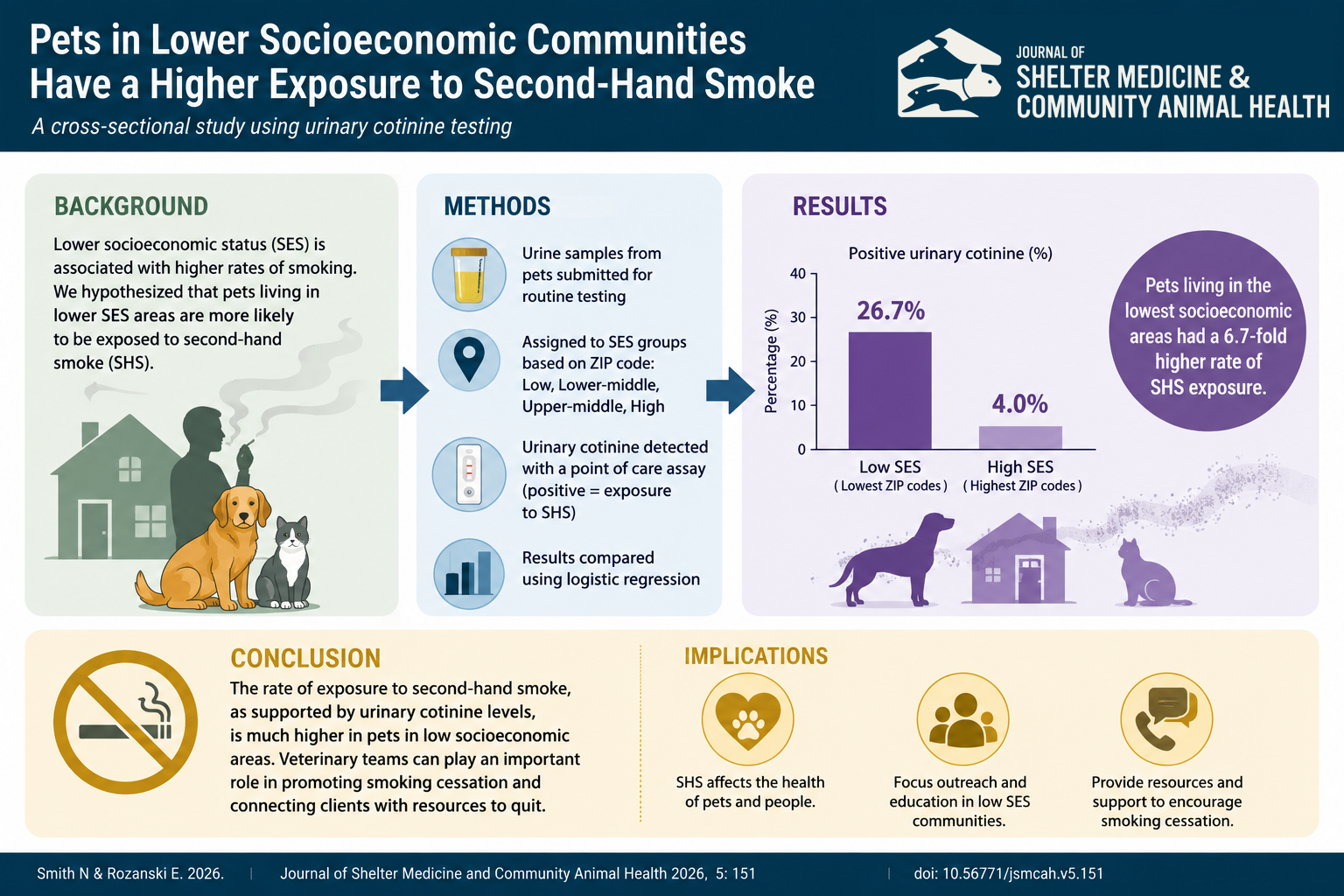
Introduction: Second-hand smoke (SHS) represents a significant public health issue. Lower socioeconomic status has been associated with a higher baseline rate of smoking. The hypothesis was that animals living in lower socioeconomic areas are more likely to be exposed to SHS.
Methods: Urine samples submitted for routine testing from pets living low-, lower-middle-, upper-middle-, and high-income areas based upon ZIP code were collected from a reference laboratory, and the presence or absence of urinary cotinine, as a marker of smoke exposure, was determined using a point of care assay. Results were compared using logistic regression.
Results: A total of 168 samples were evaluated. Animals living in the lowest socioeconomic Postal (ZIP) codes had a higher rate (26.7%) of positive urine cotinine compared to animals living in a higher income Postal (ZIP) code (4%).
Conclusion: The rate of exposure to SHS, as supported by urine cotinine levels, is much higher in animals in low socioeconomic areas. Consideration should be given to promoting smoking cessation and providing resources to encourage quitting.
Downloads
References
1.
Flor LS, Anderson JA, Ahmad N, et al. Health Effects Associated with Exposure to Secondhand Smoke: A Burden of Proof Study. Nat Med. 2024;30(1):149–167. doi: 10.1038/s41591-023-02743-4
2.
Kaur J, Upendra S, Barde S. Inhaling Hazards, Exhaling Insights: A Systematic Review Unveiling The Silent Health Impacts of Secondhand Smoke Pollution on Children And Adolescents. Int J Environ Health Res. 2024;34(12):4059–4073. doi: 10.1080/09603123.2024.2337837
3.
Garrett BE, Martell BN, Caraballo RS, King BA. Socioeconomic Differences in Cigarette Smoking Among Sociodemographic Groups. Prev Chronic Dis. 2019;16:180553. doi: 10.5888/pcd16.180553
4.
Hitchman SC, Fong GT, Zanna MP, Thrasher JF, Chung-Hall J, Siahpush M. Socioeconomic Status and Smokers’ Number of Smoking Friends: Findings from the International Tobacco Control (ITC) Four Country Survey. Drug Alcohol Depend. 2014;143:158–166. doi: 10.1016/j.drugalcdep.2014.07.019
5.
Berkowitz SA, Traore CY, Singer DE, Atlas SJ. Evaluating Area-Based Socioeconomic Status Indicators for Monitoring Disparities within Health Care Systems: Results from a Primary Care Network. Health Serv Res. 2015;50(2):398–417. doi: 10.1111/1475-6773.12229
6.
Ciaccio CE, DiDonna A, Kennedy K, Barnes CS, Portnoy JM, Rosenwasser LJ. Secondhand Tobacco Smoke Exposure in Low-Income Children and Its Association with Asthma. Allergy Asthma Proc. 2014;35(6):462–466. doi: 10.2500/aap.2014.35.3788
7.
Mahabee-Gittens EM, Merianos AL, Lopez-Galvez N, Quintana PJE, Hoh E, Dodder NG, et al. Thirdhand Smoke Exposes Children Living with Smokers and Nonsmokers to Tobacco Smoke Toxicants: Racial, Income, and Housing Disparities in Hand Nicotine and Saliva Cotinine Levels. Environ Health Perspect. 2025. doi:10.1021/EHP.6c00329.
8.
Reif JS, Bruns C, Lower KS. Cancer of the Nasal Cavity and Paranasal Sinuses and Exposure to Environmental Tobacco Smoke in Pet Dogs. Am J Epidemiol. 1998;147(5):488–492. doi: 10.1093/oxfordjournals.aje.a009475
9.
Zierenberg-Ripoll A, Pollard RE, Stewart SL, et al. Association Between Environmental Factors Including Second-Hand Smoke and Primary Lung Cancer in Dogs. J Small Anim Pract. 2018;59(6):343–349. doi: 10.1111/jsap.12778
10.
Hawkins EC, Clay LD, Bradley JM, Davidian M. Demographic and Historical Findings, Including Exposure to Environmental Tobacco Smoke, in Dogs with Chronic Cough. J Vet Intern Med. 2010;24:825–831. doi: 10.1111/j.1939-1676.2010.0530.x
11.
Lin CH, Lo PY, Wu HD, Chang C, Wang LC. Association Between Indoor Air Pollution and Respiratory Disease in Companion Dogs and Cats. J Vet Intern Med. 2018;32(3):1259–1267. doi: 10.1111/jvim.15143
12.
Zaccone R, Renzi A, Chalfon C, et al. Environmental Risk Factors for the Development of Oral Squamous Cell Carcinoma in Cats. J Vet Intern Med. 2022;36(4):1398–1408. doi: 10.1111/jvim.16372
13.
Bertone-Johnson ER, Procter-Gray E, Gollenberg AL, Ryan MB, Barber LG. Environmental Tobacco Smoke and Canine Urinary Cotinine Level. Environ Res. 2008;106(3):361–364. doi: 10.1016/j.envres.2007.09.007
14.
Milberger SM, Davis RM, Holm AL. Pet Owners’ Attitudes and Behaviours Related to Smoking and Second-Hand Smoke: A Pilot Study. Tob Control. 2009;18(2):156–158. doi: 10.1136/tc.2008.028282
15.
Roza MR, Viegas CA. The Dog as a Passive Smoker: Effects of Exposure to Environmental Cigarette Smoke On Domestic Dogs. Nicotine Tob Res. 2007;9:1171–1176. doi: 10.1080/14622200701648391
16.
Groppetti D, Pizzi G, Pecile A, Bronzo V, Mazzola SM. Cotinine as a Sentinel of Canine Exposure to Tobacco Smoke. Animals (Basel). 2023;13(4):693. doi: 10.3390/ani13040693
17.
Sipe RV, 3rd, Buck DC, Hollinger JO. Nicotine Administration in Rabbits Using Habitrol Nicotine Patches and Nicotine Nasal Spray. Clin Exp Pharmacol Physiol. 2000;27(7):480–482. doi: 10.1046/j.1440-1681.2000.03285.x
18.
Daniel E, Lu L, Nunez-Davis R, et al. Quality Improvement Increases Pediatric Community Hospital Smoking Cessation Interventions. Hosp Pediatr. 2023;13(6):553–562. doi: 10.1542/hpeds.2022-006838
19.
He Z, Wu H, Zhang S, et al. The Association Between Secondhand Smoke and Childhood Asthma: A Systematic Review and Meta-Analysis. Pediatr Pulmonol. 2020;55:2518–2531. doi: 10.1002/ppul.24961
20.
Lepore SJ, Collins BN, Egleston BL. Babies Living Safe and Smokefree (BLiSS) Intervention Reduces Children’s Tobacco Smoke Exposure Directly and Indirectly by Improving Maternal Smokers’ Urge Management Skills and Exposure Protection Behaviors. Int J Environ Res Public Health. 2025;22(2):254. doi: 10.3390/ijerph22020254
21.
Østbye T, Taylor DH. The Effect of Smoking on Years of Healthy Life (YHL) Lost among Middle-Aged and Older Americans. Health Serv Res. 2004;39(3):531–552. doi: 10.1111/j.1475-6773.2004.00243.x
22.
Lepore SJ, Collins BN, Coffman DL, et al. Kids Safe and Smokefree (KiSS) Multilevel Intervention to Reduce Child Tobacco Smoke Exposure: Long-Term Results of a Randomized Controlled Trial. Int J Environ Res Public Health. 2018;15(6):1239. doi: 10.3390/ijerph15061239
23.
Gruzdys V, Signorelli H, Johnson-Davis KL. NicAlert™ Test Strip Performance Comparison with LC-MS/MS and Immunoassay Methods for Nicotine and Cotinine. Arch Clin Toxicol. 2020;2(2):19–24. doi: 10.46439/toxicology.2.010
Additional Files
Published
Issue
Section
License
Copyright (c) 2026 Nichole Smith , Elizabeth Rozanski

This work is licensed under a Creative Commons Attribution 4.0 International License.
How to Cite