Post-Adoption Behavior and Adopter Satisfaction of Shelter Kittens Identified as Undersocialized Prior to Adoption
DOI:
https://doi.org/10.56771/jsmcah.v5.150Keywords:
feline, socialization period, human-animal bond, adoptability, welfare, feral, behavior, approach, traits, shelterAbstract
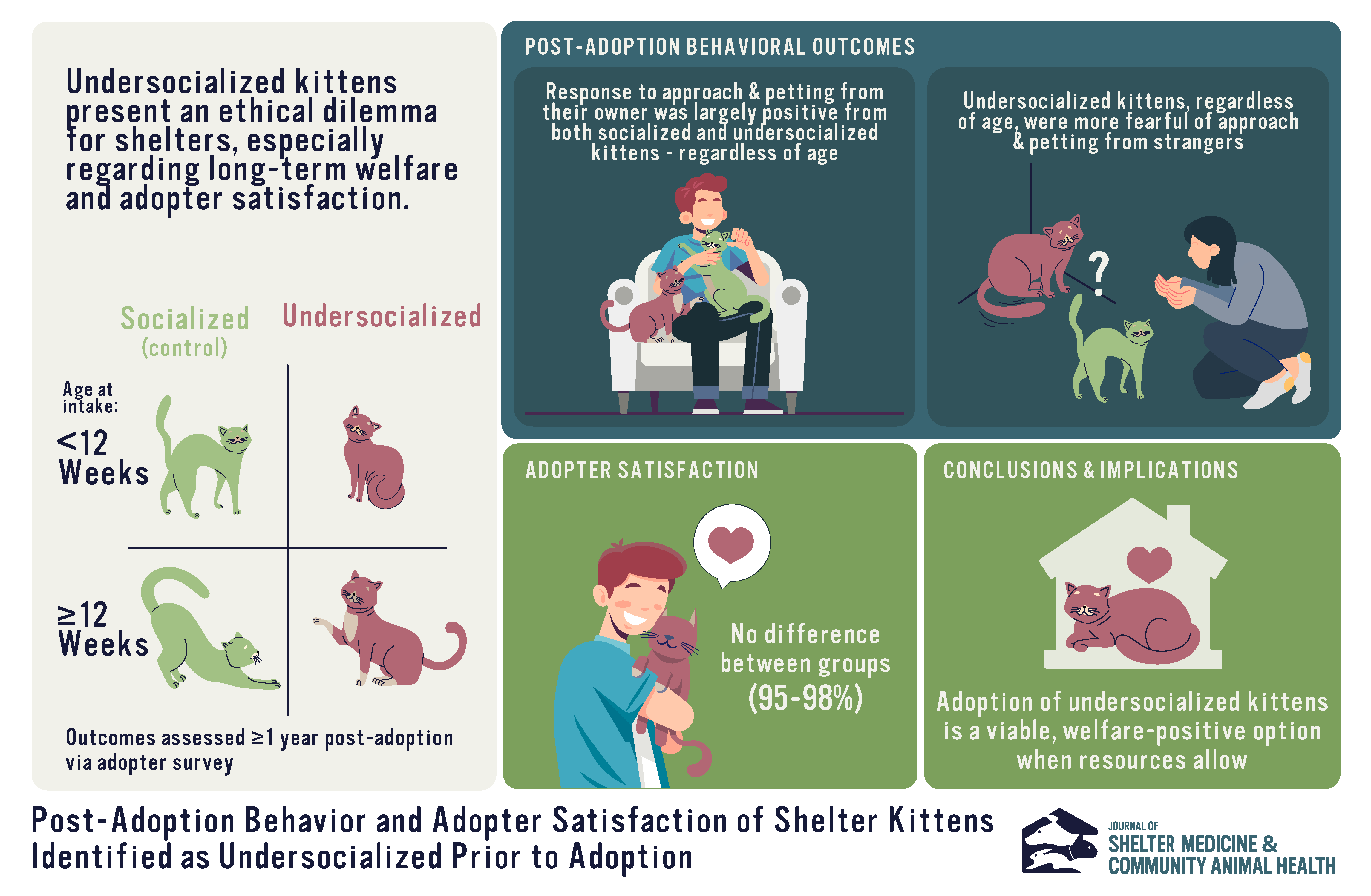
Introduction: Undersocialized kittens pose an ethical challenge for shelters. Although undersocialized kittens (especially those under 12 weeks) are thought to adapt better than undersocialized adults, data on their long-term welfare and adopter satisfaction are limited. This study examines behavioral outcomes and adopter experiences for Undersocial and Control kittens, above and below 12 weeks of age.
Methods: At least 1 year after placement, a survey was administered to adopters of kittens who were >1 and <7 months old at intake. Multinomial logistic regressions and Fisher’s exact tests were conducted to identify significant differences between groups (Undersocial<12 weeks, Undersocial>12 weeks, Control<12 weeks, and Control>12 weeks) in reported behavioral traits (8 traits, 1–5 Likert scale), responses to situational social interactions (approach and petting, from owner and stranger), and adopter experience (satisfaction 1–5 Likert scale, categorical classification of feelings toward the cats, and categorical classification of what type of environment would make the cat happiest).
Results: Of the 724 adopters surveyed, overall differences between groups were minimal. Fearfulness was the only trait significantly associated with group: Control<12 weeks kittens were 71% less likely and Control>12 weeks kittens were 65% less likely to be rated as fearful compared to Undersocial<12 weeks kittens. Responses to stranger approach and petting also differed: Undersocial<12 weeks kittens were more likely to react negatively than Control<12 weeks kittens. Owner-directed behaviors (approach and petting) showed no meaningful differences between groups. Adopter satisfaction was high across all groups (95–98%), most adopters described loving their kittens (96–99%) and thought their kitten would be happiest in a traditional home environment (89–93%).
Conclusion: Both age groups of Undersocial kittens were more fearful and wary of strangers, but all groups formed strong bonds with adopters. There was no notable difference between Undersocial kitten age groups, suggesting adoption is a viable, welfare-positive option when intake sources and resources allow.
Downloads
References
1.
Karsh EB, Turner DC. The Human-Cat Relationship. In: Turner DC, & Patrick B (Edtior). The Domestic Cat: The Biology of Its Behaviour. Cambridge University Press; 1988:159–177.
2.
Slater MR, Miller KA, Weiss E, Makolinski KV, Weisbrot LAM. A Survey of the Methods Used in Shelter and Rescue Programs to Identify Feral and Frightened Pet Cats. J Feline Med Surg. 2010;12(8):592–600. doi: 10.1016/j.jfms.2010.02.001
3.
Gosling L, Stavisky J, Dean R. What Is a Feral Cat?: Variation in Definitions May Be Associated with Different Management Strategies. J Feline Med Surg. 2013;15(9):759–764. doi: 10.1177/1098612X13481034
4.
Halls V, Ellis SLH, Bessant C. Outcomes for Kittens Born to Free-Roaming Unowned Cats. J Shelter Med Community Animal Health. 2023;2(S1):57. doi: 10.56771/jsmcah.v2.57
5.
Ellis JJ, Janke KJ, Furgala NM, Bridge T. Post-Adoption Behavior and Adopter Satisfaction of Cats Across Socialization Likelihoods. J Shelter Med Community Animal Health. 2025;4(1):116. doi: 10.56771/jsmcah.v4.116
6.
Yammarino FJ, Skinner SJ, Childers TL. Understanding Mail Survey Response Behavior: A Meta-Analysis. Public Opin Q. 1991;55(4):613. doi: 10.1086/269284
7.
van Gelder MMHJ, Vlenterie R, IntHout J, Engelen LJLPG, Vrieling A, van de Belt TH. Most Response-Inducing Strategies Do Not Increase Participation in Observational Studies: A Systematic Review and Meta-Analysis. J Clin Epidemiol. 2018;99:1–13. doi: 10.1016/j.jclinepi.2018.02.019
8.
Brennan M, Benson S, Kearns Z. The Effect of Introductions on Telephone Survey Participation Rates. Int J Market Res. 2005;47(1):65–74. doi: 10.1177/147078530504700104
9.
Bosnjak M, Tuten TL. Prepaid and Promised Incentives in Web Surveys: An Experiment. Soc Sci Comput Rev. 2003;21(2):208–217. doi: 10.1177/0894439303021002006
10.
Gunn WJ, Rhodes IN. Physician Response Rates to a Telephone Survey: Effects of Monetary Incentive Level. Public Opin Q. 1981;45(1):109. doi: 10.1086/268638
11.
Tuten TL, Galesic M, Bosnjak M. Effects of Immediate Versus Delayed Notification of Prize Draw Results on Response Behavior in Web Surveys: An Experiment. Soc Sci Comput Rev. 2004;22(3):377–384. doi: 10.1177/0894439304265640
12.
Laguilles JS, Williams EA, Saunders DB. Can Lottery Incentives Boost Web Survey Response Rates? Findings from Four Experiments. Res High Educ. 2011;52(5):537–553. doi: 10.1007/s11162-010-9203-2
13.
Amat M, Camps T, Manteca X. Stress in Owned Cats: Behavioural Changes and Welfare Implications. J Feline Med Surg. 2016;18(8):577–586. doi: 10.1177/1098612X15590867
14.
Casey RA, Bradshaw JWS. The Assessment of Welfare. In: Rochlitz I, ed. The Welfare of Cats. Animal Welfare. Springer Netherlands; 2007:23–46. doi: 10.1007/978-1-4020-3227-1_2
15.
Vojtkovská V, Voslářová E, Večerek V. Methods of Assessment of the Welfare of Shelter Cats: A Review. Animals. 2020;10(9):1527. doi: 10.3390/ani10091527
16.
Scott JP, Fuller JL. Genetics and the Social Behavior of the Dog. University of Chicago Press; 1964.
17.
Krishna Mohan S, Mrsc M, Assistant F. Research Bias: A Review for Medical Students. J Clin Diagn Res. 2010;4:2320–2324.
18.
Vitale Shreve KR, Udell MAR. What’s Inside Your Cat’s Head? A Review of Cat (Felis silvestris catus) Cognition Research Past, Present and Future. Anim Cogn. 2015;18(6):1195–1206. doi: 10.1007/s10071-015-0897-6
19.
Turner DC. A Review of Over Three Decades of Research on Cat-Human and Human-Cat Interactions and Relationships. Behav Processes. 2017;141:297–304. doi: 10.1016/j.beproc.2017.01.008
20.
Elston DM. Participation Bias, Self-Selection Bias, and Response Bias. J Am Acad Dermatol. 2021:S0190962221011294. doi: 10.1016/j.jaad.2021.06.025
21.
Alexander KC, Mackey JD, McAllister CP, Ellen III BP. What do you want to hear? A self-presentation view of social desirability bias. J. Bus. Res. 2025;189:115191.
22.
Jacobson LS, Ellis JJ, Janke KJ, Giacinti JA, Robertson JV. Behavior and Adoptability of Hoarded Cats Admitted to an Animal Shelter. J Feline Med Surg. 2022;24(8):e232–e243. doi: 10.1177/1098612X221102122
23.
Turvey BE, Freeman JL. Jury Psychology. In: Ramachandran VS, ed. Encyclopedia of Human Behavior. 2nd ed. Academic Press; 2012:495–502. doi: 10.1016/B978-0-12-375000-6.00216-0
24.
Vogt AH, Rodan I, Brown M, et al. AAFP-AAHA: Feline Life Stage Guidelines. J Feline Med Surg. 2010;12(1):43–54. doi: 10.1016/j.jfms.2009.12.006
Additional Files
Published
Issue
Section
License
Copyright (c) 2026 Jacklyn J. Ellis, Kyrsten J. Janke, Matthew De Luca, Vicky Halls

This work is licensed under a Creative Commons Attribution 4.0 International License.
How to Cite