A Retrospective Study of Canine Outcomes and Length of Stay in a Midwestern Shelter Subject to Breed-Specific Legislation
DOI:
https://doi.org/10.56771/jsmcah.v5.146Keywords:
retrospective studies, dogs, pit bull, phenotype, public health, quality of life, euthanasiaAbstract
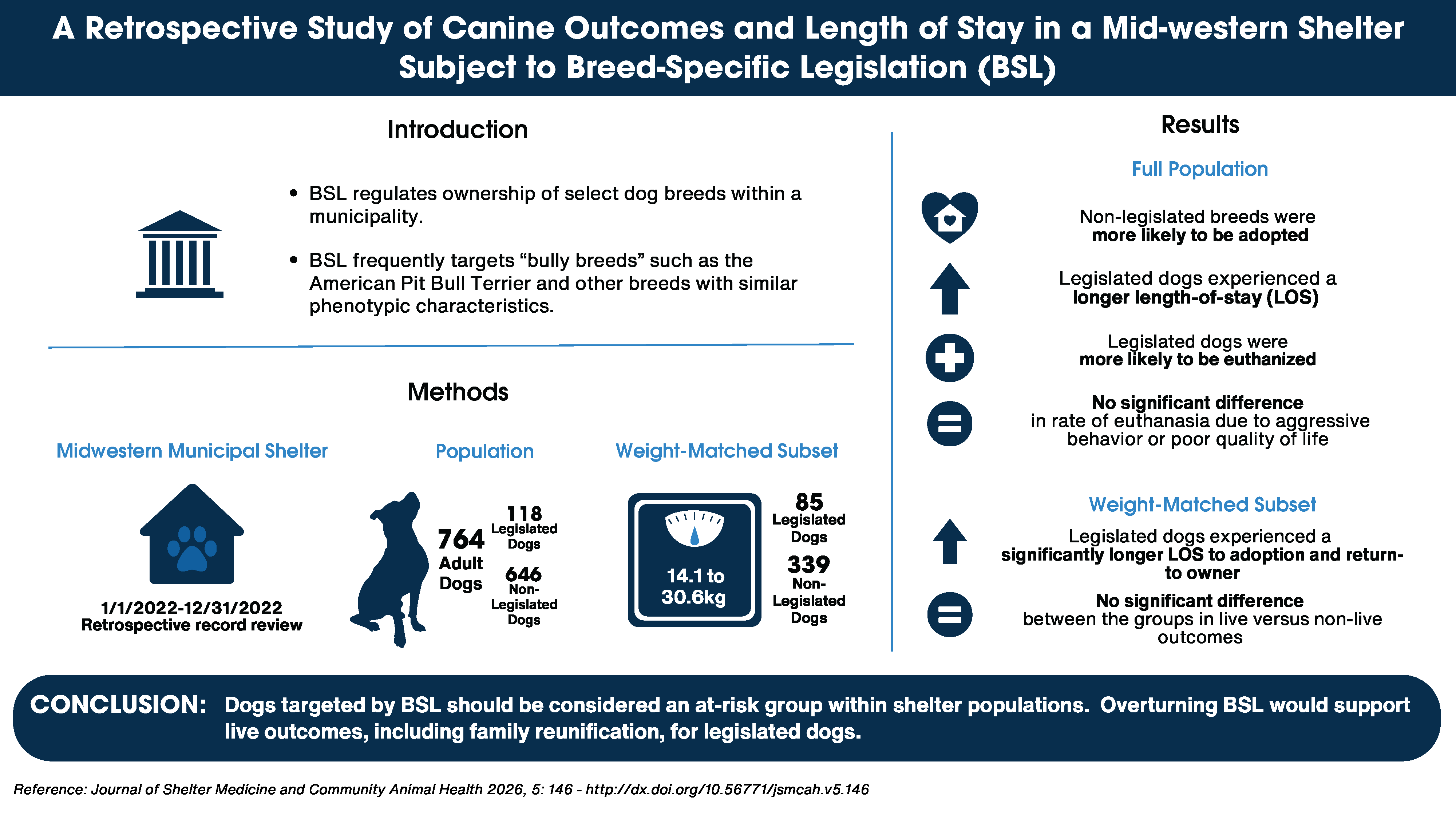
Introduction: Breed-specific legislation (BSL) is intended to restrict or reduce the ownership of selected breeds of dogs within a municipality. These laws frequently aim at ‘bully breeds’ such as the American Pit Bull Terrier and other pure or mixed breeds with similar phenotypic characteristics, which are heavily represented in animal shelters nationwide. This retrospective cohort study investigated differences in outcomes and length of stay (LOS) for legislated dogs versus dogs of other breeds in a managed admission municipal shelter subject to BSL.
Methods: Retrospective outcome data from January 1, 2022 through December 31, 2022 were analyzed. The study population included 764 adult dogs of which 118 were legislated breeds.
Results: Analysis of the full study population found legislated dogs were more likely to be euthanized (x2(4) = 23.76, p < 0.001) and experience a longer LOS (U = 32858.50, z = -2.385, p = 0.017). Non-legislated breeds were more likely to be adopted (x2(4) = 23.760, p < 0.001). In a weight-matched subset of dogs weighing 14.1–30.6 kg (n = 424, including 339 non-legislated and 85 legislated dogs), there was no longer a significant difference between the groups in the rate of live versus non-live outcomes (X2(1) = 2.022, p = 0.179); however, legislated dogs experienced a significantly longer LOS to adoption (U = 2039.00, Z = -2.04, p = 0.041) and return-to-owner (U = 1725.50, Z = -3.33, p = 0.001) and a reduced likelihood of adoption (x2(3) = 11.454, p = 0.010). Additional analysis performed for 80 dogs whose first outcome was euthanasia revealed non-legislated dogs were significantly more likely to be euthanized for medical reasons than legislated dogs, and there were no significant differences in euthanasia for aggressive behavior or behavioral evidence of poor quality of life (x2(2) = 6.528, p = 0.038).
Conclusion: Shelter dogs subject to BSL generally experience barriers to live outcomes. In this shelter, staff endeavored to find live outcomes for these dogs, including transport and reunification. Overturning BSL would support increased live outcomes, including family reunification, for legislated dogs.
Downloads
References
1.
Gunter LM, Barber RT, Wynne CD. A Canine Identity Crisis: Genetic Breed Heritage Testing of Shelter Dogs. PLoS One. 2018;13(8):e0202633. doi: 10.1371/journal.pone.0202633
2.
Mariti C, Ciceroni C, Sighieri C. Italian Breed-Specific Legislation on Potentially Dangerous Dogs (2003): Assessment of Its Effects in the City of Florence (Italy). Dog Behav. 2015;1:25–31. doi: 10.4454/db.v1i2.16
3.
Wyker B, Gupta M. Emergency Department Visits for Dog Bite Injuries in Missouri Municipalities with and without Breed-Specific Legislation: A Propensity Score-Matched Analysis. Front Public Health. 2024;12:1354698. doi: 10.3389/fpubh.2024.1354698
4.
Patronek GJ, Sacks JJ, Delise KM, Cleary DV, Marder AR. Co-Occurrence of Potentially Preventable Factors in 256 Dog Bite–Related Fatalities in the United States (2000–2009). J Am Vet Med Assoc. 2013;243(12):1726–1736. doi: 10.2460/javma.243.12.1726
5.
Hoffman CL, Harrison N, Wolff L, Westgarth C. Is that Dog a Pit Bull? A Cross-Country Comparison of Perceptions of Shelter Workers Regarding Breed Identification. J Appl Anim Welf Sci. 2014;17(4):322–339. doi: 10.1080/10888705.2014.895904
6.
Length of Stay (LOS). UC Davis Koret Shelter Medicine Program Resource Library. 2015. Accessed Dec 9, 2024. https://www.sheltermedicine.com/library/resources/length-of-stay-los
7.
Woodruff K, Smith DR, Cain C, Loftin C. The Number of Dogs Entering Shelters in Five States, and Factors that Affect their Outcomes: A Study of the Sheltering System. J Appl Anim Welf Sci. 2021;24(1):1–15. doi: 10.1080/10888705.2020.1852407
8.
Olson KR, Levy JK, Norby B, et al. Inconsistent Identification of Pit Bull-Type Dogs by Shelter Staff. Vet J. 2015;206(2):197–202. doi: 10.1016/j.tvjl.2015.07.019
9.
Morrill K, Hekman J, Li X, et al. Ancestry-Inclusive Dog Genomics Challenges Popular Breed Stereotypes. Science. 2022;376(6592):eabk0639. doi: 10.1126/science.abk0639
10.
Decoding the Bully Breeds: How We Now Test for American Pit Bull Terrier. Wisdom Panel. August 9, 2021. Accessed Dec 9, 2024. https://www.wisdompanel.com/en-us/blog/detecting-american-pit-bull-terrier#contributors
11.
Cain CJ, Woodruff KA, Smith DR. Phenotypic Characteristics Associated with Shelter Dog Adoption in the United States. Animals. 2020;10(11): 1959. doi: 10.3390/ani10111959
12.
Powell L, Reinhard C, Satriale D, Morris M, Serpell J, Watson B. Characterizing Unsuccessful Animal Adoptions: Age and Breed Predict the Likelihood of Return, Reasons for Return and Post-Return Outcomes. Sci Rep. 2021;11(1): 8018. doi: 10.1038/s41598-021-87649-2
13.
Gunter LM, Barber RT, Wynne CD. What’s in a Name? Effect of Breed Perceptions & Labeling on Attractiveness, Adoptions & Length of Stay for Pit-Bull-Type Dogs. PLoS One. 2016;11(3):e0146857. doi: 10.1371/journal.pone.0146857
14.
City of Independence Missouri. Adopted Budget 2022–2023. Self Published, 2022. Accessed Dec 15, 2024. https://issuu.com/cityofindepmo/docs/2022-23-proposed-budget?fr=xKAE9_zU1NQ
15.
Independence Health and Animal Services. 2019–24 Monthly Shelter Report. Self Published, 2024. Accessed Dec 15, 2024. https://www.independencemo.gov/government/city-departments/animal-services/frequently-asked-questions-animal-services
16.
Keeping of Pit Bulls Prohibited, Code of Ordinances City of Independence, Missouri. Sec. 3.03.006, August 23, 2022 archived version. Accessed Dec 15, 2024. https://library.municode.com/mo/independence/codes/code_of_ordinances/408401?nodeId=CH3ANFO_ART3LICODOCA_S3.03.006KEPIBUPR
17.
Cain CJ, Woodruff KA, Smith DR. Factors Associated with Shelter Dog Euthanasia versus Live Release by Adoption or Transfer in the United States. Animals. 2021;11(4):927. doi: 10.3390/ani11040927
Additional Files
Published
Issue
Section
License
Copyright (c) 2026 Sandra Kay Walker, Lauren Powell, Elizabeth A. Berliner

This work is licensed under a Creative Commons Attribution 4.0 International License.
How to Cite