Impact of Plasma Supplementation on Survival and Clinical Illness in Orphaned Neonatal Kittens in a Retrospective Shelter Cohort
DOI:
https://doi.org/10.56771/jsmcah.v5.143Keywords:
Age, Colostrum, Diarrhea, Failure Passive Transfer, Fresh Frozen Plasma, Hypothermia, Immunoglobulins, Kitten, Mortality, Shelter, Weight, Hazard ratioAbstract
Introduction: The San Diego Humane Society annually supports thousands of kittens, many of whom are orphaned and high risk for illness and death. Failure of passive transfer (FPT) is presumed common in orphaned neonatal kittens lacking colostrum-derived antibodies. Although subcutaneous plasma supplementation can increase circulating antibodies, its impact on survival and illness in shelter populations remains uncertain.
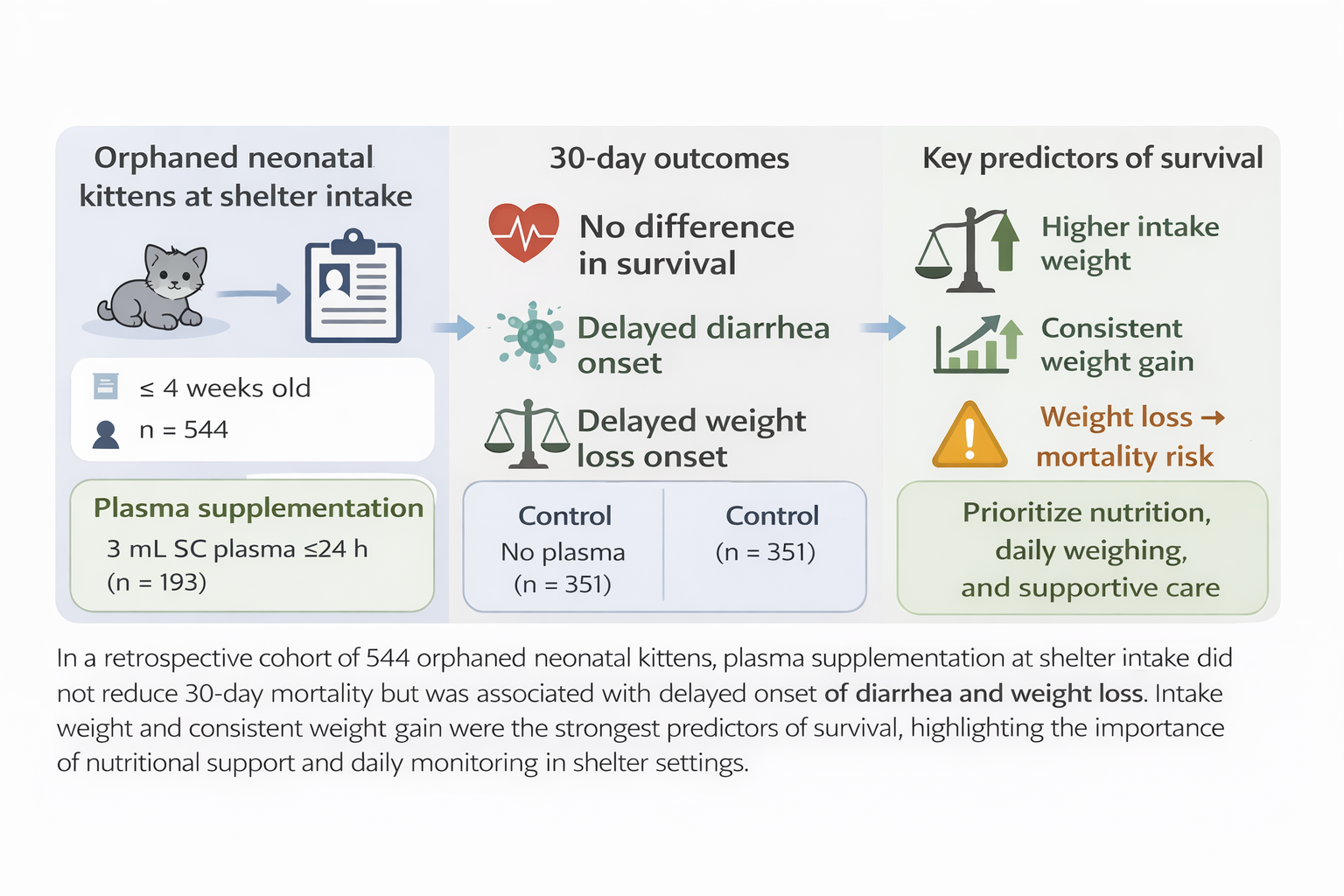
Objective: To assess the effect of plasma supplementation at shelter intake on (1) hazard of death within 30 days and (2) time to onset of common clinical signs in orphaned neonatal kittens.
Methods: Retrospective cohort study of medical records from February to August 2015. Allocation of plasma supplementation was non-randomized, based on operational constraints. Kittens ≤ 4 weeks at intake were eligible; exclusions were death or euthanasia within 24 h of intake or missing weights within 14 days. Exposure was standardized as 3-mL of subcutaneous plasma administered within 24 h of intake. Outcomes were death within 30 days of shelter intake and time to first onset of diarrhea, upper respiratory signs, hypothermia, anorexia, weight loss, or neurological signs.
Results: Cohort included 544 kittens (Plasma-Supplemented [PS] group n = 193; Control group n = 351). Review of Kaplan–Meier curves suggested early differences in survival rates between groups (days 3–11); however, after accounting for demographics and onset of clinical signs, plasma supplementation was not statistically associated with decreased mortality risk at any time during the first 30 days after intake. Strongest mortality predictors were intake weight, average weight gain, and onset of weight loss. Plasma supplementation demonstrated a significant impact on delaying onset of diarrhea and weight loss, but no other signs.
Conclusion: Subcutaneous plasma supplementation at intake did not reduce mortality risk but delayed onset of key morbidities. Intake weight and weight gain were the most important survival predictors, highlighting importance of nutrition and suggesting that plasma supplementation may reduce common clinical manifestations in shelter populations.
Downloads
References
1.
Chastant-Maillard S, Aggouni C, Albaret A, Fournier A, Mila H. Canine and Feline Colostrum. Reprod Domest Anim. 2017;52 Suppl 2:148–152. doi: 10.1111/rda.12830
2.
Levy JK, Crawford PC, Collante WR, Papich MG. Use of Adult Cat Serum to Correct Failure of Passive Transfer in Kittens. J Am Vet Med Assoc. 2001;219(10):1401–1405. doi: 10.2460/javma.2001.219.1401
3.
Day MJ. Immune System Development in the Dog and Cat. J Comp Pathol. 2007;137(Suppl 1):S10–S15. doi: 10.1016/j.jcpa.2007.04.005
4.
Veronesi MC, Fusi J. Feline Neonatology: From Birth to Commencement of Weaning – What to Know for Successful Management. J Feline Med Surg. 2022;24(3):232–242. doi: 10.1177/1098612X221079709
5.
Rossi L, Lumbreras AEV, Vagni S, Dell’Anno M, Bontempo V. Nutritional and Functional Properties of Colostrum in Puppies and Kittens. Animals (Basel). 2021;11(11):3260. doi: 10.3390/ani11113260
6.
Little S. Playing Mum: Successful Management of Orphaned Kittens. J Feline Med Surg. 2013;15(3):201–210. doi: 10.1177/1098612X13477542
7.
Dolan ED, Doyle E, Tran HR, Slater MR. Pre-Mortem Risk Factors for Mortality in Kittens Less than 8 Weeks Old at a Dedicated Kitten Nursery. J Feline Med Surg. 2021;23(8):730–737. doi: 10.1177/1098612X20974960
8.
Claus MA, Levy JK, MacDonald K, Tucker SJ, Crawford PC. Immunoglobulin Concentrations in Feline Colostrum and Milk, and the Requirement of Colostrum for Passive Transfer of Immunity to Neonatal Kittens. J Feline Med Surg. 2006;8(3):184–191. doi: 10.1016/j.jfms.2006.01.001
9.
Giger U, Casal ML. Feline Colostrum – Friend or Foe: Maternal Antibodies in Queens and Kittens. J Reprod Fertil Suppl. 1997;51:313–316.
10.
Mugnier A, Gaillard V, Chastant S. Association between Birth Weight and Mortality over the First Two Months of Life in Kittens. Animals (Basel). 2023;13(11):1822. doi: 10.3390/ani13111822
11.
Mugnier A, Gaillard V, Chastant S. Impact of Compensatory Growth on Survival in Newborn Kittens. Front Vet Sci. 2024;11:1419383. doi: 10.3389/fvets.2024.1419383
12.
Crawford PC, Hanel RM, Levy JK. Evaluation of Treatment of Colostrum-Deprived Kittens with Equine IgG. Am J Vet Res. 2003;64(8):969–975. doi: 10.2460/ajvr.2003.64.969
13.
Hanel RM, Crawford PC, Hernandez J, Benson NA, Levy JK. Neutrophil Function and Plasma Opsonic Capacity in Colostrum-Fed and Colostrum-Deprived Neonatal Kittens. Am J Vet Res. 2003;64(5):538–543. doi: 10.2460/ajvr.2003.64.538
14.
Stone AES, Brummet GO, Carozza EM, et al. 2020 AAHA/AAFP feline vaccination guidelines. J Am Anim Hosp Assoc. 2020;56(4):249–265. doi: 10.5326/JAAHA-MS-7123
15.
Yagi K, Holowaychuk MK, eds. Manual of Veterinary Transfusion Medicine and Blood Banking. Wiley-Blackwell; Ames, Iowa, 2016.
16.
Boller M, Burkitt-Creedon J, Byers CG, et al; RECOVER Newborn Resuscitation Domain Evidence Evaluators. RECOVER Guidelines: Newborn Resuscitation in Dogs and Cats. Evidence and Knowledge Gap Analysis with Treatment Recommendations. J Vet Emerg Crit Care (San Antonio). 2025;35(Suppl 1):3–59. doi: 10.1111/vec.70012
17.
Berliner EA, Scarlett JM, Cowan AC, Mohammed H. A Prospective Study of Growth Rate, Disease Incidence, and Outcomes in Kittens <9 Weeks at a Shelter. J Appl Anim Welf Sci. 2022;26(4):607–622. doi: 10.1080/10888705.2021.2021409
Additional Files
Published
Issue
Section
License
Copyright (c) 2026 Jonathan Chapman, Antoinette Piraino, Kelly Min, Pedro P.V.P. Diniz, Jacqueline Noble, Zarah Hedge

This work is licensed under a Creative Commons Attribution 4.0 International License.
How to Cite