SHORT REPORT
‘Find My Cat’: Using AirTags to Establish Home Ranges of Feral Cats on St. Kitts
Emily Hunt1*, Sarah Hooper2, Andrea Peda1 and Ryan Cavanaugh1
1Ross University School of Veterinary Medicine, Basseterre, St. Kitts, West Indies; 2Arkansas State University College of Veterinary Medicine, AR, USA
Abstract
Feral cats occupy home ranges that vary in size based on many factors, primarily sex, cat population density, and landscape productivity. As part of a companion study assessing the abundance of feral cats on St. Kitts, we analyzed the feasibility of a lightweight, cost-effective method for tracking their movements. In this observational study, we aim to determine the effectiveness of using Apple AirTags to track movements of feral cats. Quick-release collars with AirTags attached were placed on cats trapped for trap-neuter-return (TNR) during surgery ‘spay’ days while they were still heavily sedated in recovery from anesthesia. The results yielded limited success due to inconsistent location updates, likely because of insufficient numbers of Apple devices within range for the AirTags to ‘ping’ off of, as well as the abilities of feral cats to disable the quick-release mechanism. However, despite the issues encountered, our estimates were consistent with existing data, suggesting that sex and reproductive status impact the home ranges of feral cats. Further efforts with this method should be conducted in a region with a higher density of Apple devices, as knowledge of feral cat home ranges could provide valuable insight for TNR advocates and planning of trapping events.
Keywords: trap-neuter-return; population ecology; GPS collars; animal behavior; animal welfare
Citation: Journal of Shelter Medicine and Community Animal Health 2026, 5: 163 - http://dx.doi.org/10.56771/jsmcah.v5.163
Copyright: © 2026 Emily Hunt et al. This is an Open Access article distributed under the terms of the Creative Commons Attribution 4.0 International License (http://creativecommons.org/licenses/by/4.0/), allowing third parties to copy and redistribute the material in any medium or format and to remix, transform, and build upon the material for any purpose, even commercially, provided the original work is properly cited and states its license.
Received: 31 October 2025; Revised: 6 January 2026; Accepted: 7 January 2026; Published: 18 February 2026
Competing interests and funding: The authors declare no potential conflicts of interest. The project was funded by the RUSVM Research Center 4.
Correspondence: *Emily Hunt, PO Box 334, Basseterre St. Kitts West Indies. Email: emilyhunt@students.rossu.edu
Reviewers: Peter Wolf, Jennifer Weisent
Supplementary material: Supplementary material for this article can be accessed here.
Feral cats (Felis catus), like many species living in the wild, occupy home ranges that vary depending on various ecological and biological factors. A home range is defined as the area occupied by an animal for its day-to-day activities such as hunting for food, mating, and other reproductive and social behaviors.1 In feral cat populations, home range size is primarily influenced by sex, their population density, and the landscape productivity.2,3 Males typically maintain significantly larger home ranges than females due to being a polygamous mating species, in which a single male mates with multiple females during the breeding season.3 Nottingham et al. conducted a meta-analysis of available feral cat home range data. They found male home ranges varied from 22.1 hectares (ha) (0.221 km2) to 3,232 ha (32.32 km2), and females ranged from 9.6 ha (0.096 km2) to 2,078 ha (20.78 km2).3 Cats living in high-density colonies typically have smaller home ranges when compared to those living in low-density colonies. Cats in areas with consistently poor landscape productivity were found to have significantly larger home ranges compared to cats in resource-rich environments.2
In order to assess home ranges of feral cats, a reliable method for tracking their movements is required. While there are many different types of global positioning system (GPS) collars and other GPS tracking equipment available, these systems can be prohibitively expensive, and some are too heavy for small animals such as domestic cats. As part of a project assessing the impacts of a trap-neuter-return (TNR) program on feral cat populations of St. Kitts, we sought to explore the feasibility of a cost-effective alternative to traditional GPS collars for establishing home ranges and identifying potential overlap between colonies. The objective of this study was to determine the effectiveness of using Apple AirTags (Foxconn) as a lightweight, affordable tool for tracking the movements of feral cats.
Methods
Between February 7th and September 23rd 2024, the author (EH) randomly selected 14 feral cats, six females and eight males, from all Ross University School of Veterinary Medicine (RUSVM) Feral Cat Project (FCP) cats trapped for TNR who adequately fit the collars used for this pilot study. The cats were located in the Frigate Bay area of St. Kitts and were selected from the following known colonies: Angelus apartment complex, Poinciana Restaurant neighborhood, Timothy Beach Resort colony, and the St. Christopher’s Club apartment complex. Colony definitions are based on reports from caretakers in the community alerting the FCP trapping coordinators of cats in their areas. These caretakers are both self-identified and community identified as colony caretakers in addition to being located in the specific neighborhood areas. Apple AirTags (1st generation, Foxconn) were paired to the author’s (EH) iPad and attached to the cat collars prior to FCP’s surgery days. Cats were anesthetized for surgery using a combination of dexmedetomidine (0.01 mg/kg IM, Aspen Veterinary Resources), ketamine (5 mg/kg IM, Zoetis UK), and buprenorphine (0.015 mg/kg IM, Produlab Pharma B.V), commonly known as ‘kitty magic’. Once cats were sedated, they were given an injection of meloxicam (0.1 mg/kg SQ, Aspen Veterinary Services), an Non-Steroidal Anti-Inflammatory Drug (NSAID) used for pain management. Male cats then received an intra-testicular block using lidocaine (0.1 mL per testicle, Aspen Veterinary Services), while female cats received a line block of lidocaine (0.1 mL per quadrant, Aspen Veterinary Services) after the surgical incision was closed. A hemostat was placed on the left ear, and the distal ~1 cm tip was removed to indicate sterilization. Cats then underwent ovariohysterectomy or orchidectomy and subsequently moved to a recovery area where they were monitored by FCP’s Doctor of Veterinary Medicine (DVM) student volunteers. Quick release cat collars, each with a rubber sleeve (Dgerp cat collar with AirTag holder) containing an activated and paired AirTag (Foxconn) were fitted to each cat while they were still heavily sedated during recovery. Collars were adjusted to allow one finger to fit beneath to ensure they were not too tight. The quick-release mechanism was chosen to minimize the risk of injury and ensure cats could escape if the collars ever became snagged. In accordance with FCP’s protocols, male cats were released 2 days after surgery, and female cats were released 4 days after surgery.
The AirTags used in this study utilized Bluetooth and were detectable by local Apple devices and did not actively transmit live GPS signals. At all times, the AirTag will only show its last known location and does not retain a history of location points. Therefore, AirTag locations were monitored a minimum of four times daily via the author’s (EH) Apple devices, with new longitude and latitude points recorded as location updates were available. If AirTag locations failed to update or had minimal to no movement, two of the authors (EH, SH) would canvas the last known area to determine whether the collar had been removed. Longitude and latitude points were imported into Google Earth (Desktop Standard Version) to generate maps of each individual cat’s locations and movements. The minimum convex polygon method was used to create an outline of the plotted GPS points, and the area of each polygon was recorded to estimate cats’ home ranges.4 All work was completed under RUSVM IACUC#23.11.27Hooper.
Results
The estimated home ranges for 12 of the original 14 collared cats are summarized in Table 1 and are based on new data typically becoming available once per day. The remaining two cats were able to remove their collars before being released from FCP’s care. Individual home ranges varied widely among colonies and between sexes, ranging from 2,121.66 meters squared (m2) to 430,283.60 m2 (Table 1 and Fig. 1). Overall, the mean home range area for all cats was 63,093.37 m2, and the median was 20,529.11 m2 (Interquartile Range [IQR] = 49091.50–6935.67 m2) (Fig. 1). Male cats had larger home ranges (mean = 87,927.58 m2, median = 9,277.77 m2, IQR = 6,572.31–135,381.18 m2) than females (mean = 28,325.48 m2, median = 22,540.31 m2, IQR = 12,338.99–47,204.55 m2) (Fig. 2). The male cats ranged from 2,121.66 to 430,283.60 m2, and the females ranged from 6,160.07 to 50,978.44 m2 (Fig. 2).
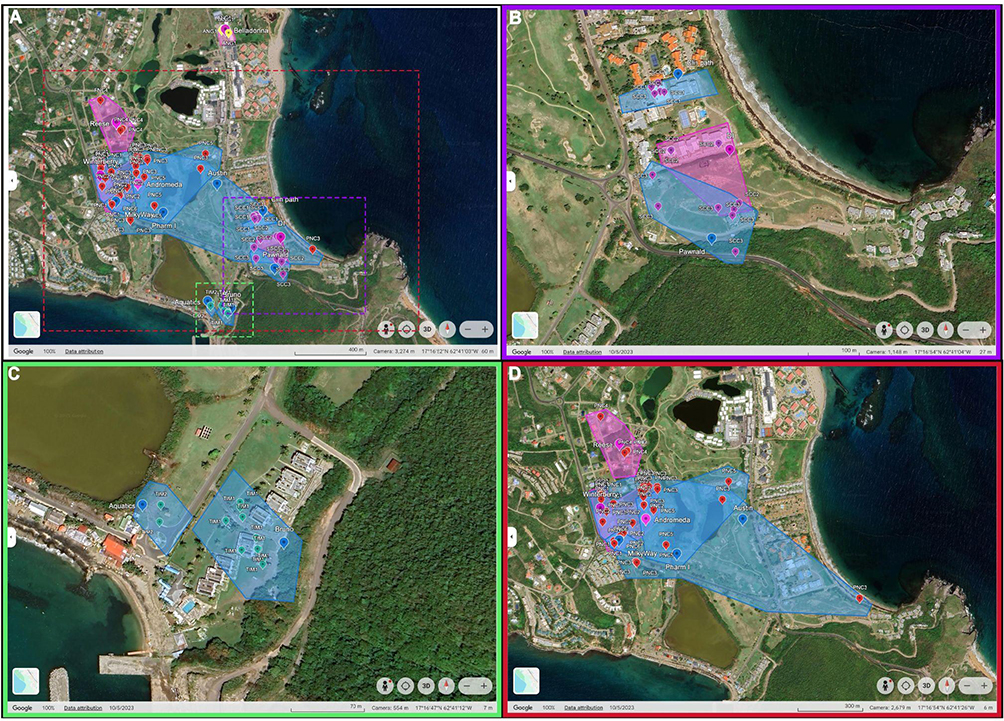
Fig. 1. (a) Map containing pins of each confirmed live cat location and polygon estimates of home ranges for all cats in the study. (b) Home ranges of three cats from the St. Christopher’s Club apartment complex colony. (c) Home ranges of two cats from the Timothy Beach Resort colony. (d) Home ranges of six cats from the Poinciana restaurant colony.
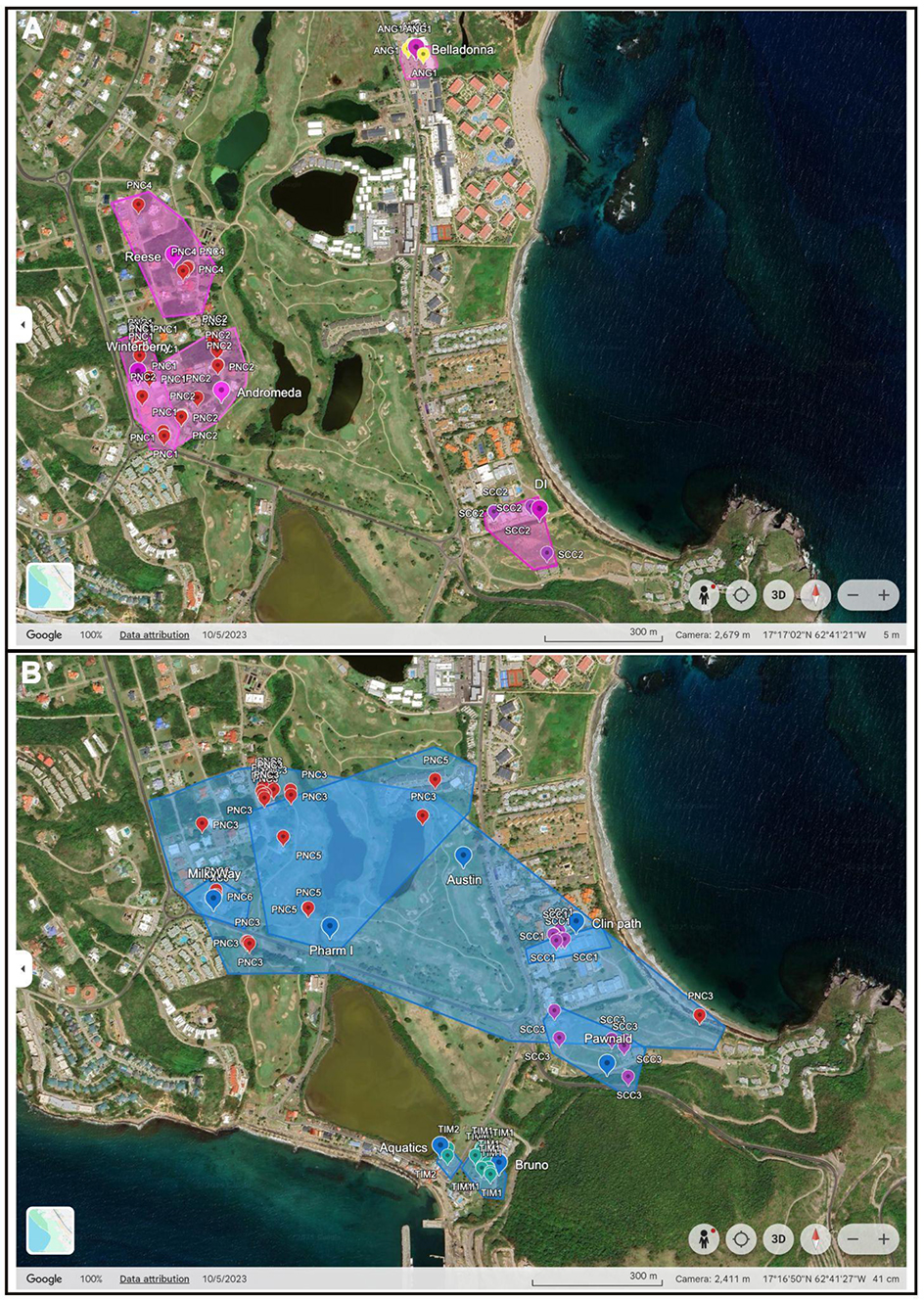
Fig. 2. (a) Home range estimates of females. (b) Home range estimates of males.
In the Angelus Apartments colony, the single collared female Belladonna had an estimated home range of 6,160.07 m2 (Supplementary Fig. 3D). In the Poinciana Restaurant colony, home ranges ranged from 9,577.77 to 430,283.6 m2. Female ranges in this colony were 22,340.31 m2 (Winterberry) (Supplementary Fig. 1A), 50,978.44 m2 (Andromeda) (Supplementary Fig. 1B), and 43,430.66 m2 (Reese) (Supplementary Fig. 1D), while male ranges were 9,577.77 m2 (MilkyWay) (Supplementary Fig. 2B), 135,381.18 m2 (Pharm I) (Supplementary Fig. 2A), and 430,283.60 m2 (Austin) (Supplementary Fig. 1C). At the Timothy Beach Resort, the two collared males had smaller home ranges: 6,572.31 m2 (Bruno) (Supplementary Fig. 2C) and 2,121.66 m2 (Aquatics) (Supplementary Fig. 2D). In the St. Christopher’s Club colony, one female and two males were tracked. The female’s range was 18,517.9 m² (DI) (Supplementary Fig. 3B), while males exhibited ranges of 8,025.76 m² (Clin Path) (Supplementary Fig. 3A) and 23,530.80 m² (Pawnald) (Supplementary Fig. 3C).
Discussion
The use of AirTag collars as an efficient, cost-effective method for tracking the home ranges of feral cats demonstrated limited success. Location data were inconsistent due to the lack of continuous live location updates when the AirTag locations were checked. This likely resulted from insufficient nearby Apple devices to relay signals or from the Apple devices that were nearby not being connected to the internet. AirTags rely on Apple’s Find My network by using Bluetooth connections to ‘ping’ off other Apple devices in the vicinity and transmit updated locations to the paired device.5 For location data to be transmitted, these Apple devices must be connected to the Internet. Despite deploying the AirTags in high residential areas where RUSVM students live, it appears that there were fewer iPhones and other Apple devices on St. Kitts than anticipated. Consequently, many collared cats were not within range of enough devices for location data to update as consistently as they could in regions, such as the United States, where Apple products are more common. It is important to note that the limited number of location points obtained through the use of the AirTags could have resulted in underestimates for the home ranges of the cats. Additionally, the Bluetooth range of AirTags is only about 10 m. It is possible that cats were not spending enough time within the necessary range of the Apple devices.
Another limitation involved the security of the collars themselves. Although quick-release collars were selected to ensure animal safety, their ease of removal proved problematic. Of the original 14 cats selected, two (1 female and 1 male) were able to get their collars off before they were released back into their colonies. For the remaining 12 cats, it is likely that the collars detached within 2–4 weeks postrelease, based on the observation that subsequent AirTag location updates showed minimal to no movement. The authors were able to locate and retrieve five of these collars, and three others were located outside but not accessible. The retrieved collars and inaccessible collars were found in areas of heavy vegetation with invasive thorny shrubbery in the original colonies where cats had been previously released. The remaining four collars were not able to be located.
Despite these challenges, our estimated home ranges were consistent with existing literature, demonstrating that male cats typically have larger home ranges than females. Previous research has also shown that neutered males may have smaller home ranges than intact males, due to a reduction in roaming and other reproductive behavior.6 This study did not assess the impact of sterilization on home range size, as our cats would not yet have displayed any noticeable changes in testosterone levels. The study cats were only tracked for a short period after neutering. However, further research could be conducted to assess this by tracking cats after enough time has passed to see a decrease in their testosterone.
Conclusion
Despite the technological limitations encountered, this study demonstrates the potential for affordable, minimally invasive tracking methods to contribute to our understanding of feral cat ecology and to support more effective population management. While the primary limitation of this study on the island was the AirTag’s inconsistent live location updates, future research should be undertaken to assess the use of AirTags in regions with a higher density of Apple devices. This may improve data reliability and allow a more accurate assessment of the method’s effectiveness for determining feral cat home ranges. Additionally, understanding how reproductive status influences movement and resource use as well as establishing the degree of home range overlap among feral cats could provide valuable insights for TNR advocates, helping to optimize resource allocation and management strategies for future feral cat colonies.
Author contributions
EH: Conceptualization, Data curation, Formal analysis, Investigation, Methodology, Project administration, Validation, Visualization, Writing – original draft, Writing – review and editing. SH: Conceptualization, Data conceptualization, Formal analysis, Funding acquisition, methodology, Project administration, Resources, Software, Supervision, Validation, Visualization, Writing – review and editing. AP: Conceptualization, Project administration, Supervision, Writing – review and editing. RC: Conceptualization, Project administration, Supervision, Writing – review and editing.
Acknowledgments
This project was also supported by the executive board of the RUSVM Feral Cat Project, which is the TNR program on St. Kitts. The author thanks them for the opportunity to attend surgery days to place collars on sedated cats.
Author notes
This manuscript is part of author EH’s thesis submission for her Master of Science by research degree.
References
| 1. | Boitani L, Fuller TK. Research Techniques in Animal Ecology: Controversies and Consequences. New York City: Columbia University Press; 2000. |
| 2. | Bengsen AJ, Algar D, Ballard G, et al. Feral Cat Home-Range Size Varies Predictably with Landscape Productivity and Population Density. J Zool. 2016;298(2):112–120. doi: 10.1111/jzo.12290 |
| 3. | Nottingham CM, Buckley HL, Case BS, Glen AS, Stanley MC. Factors Affecting Home Range Size of Feral Cats: A Meta-Analysis. N Z J Ecol. 2022;46(2):1–10. |
| 4. | Mohr CO. Table of Equivalent Populations of North American Small Mammals. Am Midl Naturalist. 1947;37(1):223. doi: 10.2307/2421652 |
| 5. | AirTag – Apple. Accessed October 31, 2025. https://www.apple.com/airtag/ |
| 6. | Vendramini THA, Amaral AR, Pedrinelli V, Zafalon RVA, Rodrigues RBA, Brunetto MA. Neutering in Dogs and Cats: Current Scientific Evidence and Importance of Adequate Nutritional Management. Nutr Res Rev. 2020;33(1):134–144. doi: 10.1017/S0954422419000271 |