ORIGINAL RESEARCH ARTICLE
Decrease in Proportion of Sterilized Dogs Entering Animal Welfare Organizations in the U.S. Post-pandemic
Samantha Hill1*, Lexis H. Ly2, John Cornelison1 and Julie K. Levy3
1Shelter Animals Count, Atlanta, GA, USA; 2Independent Researcher, Vancouver, British Colombia, Canada; 3Shelter Medicine Program, College of Veterinary Medicine, University of Florida, Gainesville, FL, USA
Abstract
Introduction: The SARS-CoV-2 (COVID-19) pandemic disrupted spay and neuter services for owned and unowned animals in the United States; however, the impact of this deficit on animal welfare organizations’ intake and capacity has not been reported. This study examined nationwide data for trends in sterilization status of dogs entering animal shelters and rescue organizations in 2019–2023.
Methods: A retrospective analysis was conducted using a national database for dogs admitted as owner surrenders or strays and outcomed to adoption in 2019–2023. Descriptive statistics were used for prealter status as a function of region, intake type, age, size, sex, and length of stay, and binary logistic regression to evaluate predictors of prealtered status.
Results: A total of 1,136,021 dogs admitted to 256 U.S. shelters and rescues across 46 states and Washington D.C. met the study criteria. The proportion of dogs entering shelters prealtered declined from 33.2% in 2019 to 22.3% in 2023, with varied decreases across regions, intake types, and size groups. Prealtered dogs had shorter median length of stay to adoption compared to unaltered dogs. Multiple factors influenced the odds of a dog being prealtered. For example, there were higher odds of being prealtered among senior and male dogs, and lower odds among juveniles and stray dogs. Lower dog intake partially offset the total number of unaltered dogs admitted from 185,138 dogs in 2019 to 173,314 in 2023.
Conclusion: The percentage of dogs prealtered at intake decreased year over year post-pandemic, which may impact time spent in care. Animal welfare organizations should consider assessing prealter status at intake to predict shelter capacity and identify trends in access to sterilization services.
Keywords: animal welfare; shelter medicine; access to care; spay; neuter; population management; capacity for care; reproductive control; animal shelter
Citation: Journal of Shelter Medicine and Community Animal Health 2025, 4: 157 - http://dx.doi.org/10.56771/jsmcah.v4.157
Copyright: © 2025 Samantha Hill et al. This is an Open Access article distributed under the terms of the Creative Commons Attribution 4.0 International License (http://creativecommons.org/licenses/by/4.0/), allowing third parties to copy and redistribute the material in any medium or format and to remix, transform, and build upon the material for any purpose, even commercially, provided the original work is properly cited and states its license.
Received: 5 September 2025; Revised: 20 October 2025; Accepted: 20 October 2025; Published: 9 December 2025
Correspondence: *Samantha Hill, Shelter Animals Count, Postal Code: 30308. Email: samantha@shelteranimalscount.org
Competing interests and funding: The authors declare no potential conflicts of interest. The authors have not received any funding or benefits from industry or elsewhere to conduct this study.
Reviewers: Carissa Jones, Sara White
Supplementary material: Supplementary material for this article can be accessed here
In the year 2024, 2,877,000 dogs entered shelter and rescue organizations in the U.S. from community sources (i.e. stray and owner surrender); an additional 680,000 dogs were transferred among organizations.1 While intakes in 2024 were 14.1% lower than 2019, the median length of stay (LOS) until adoption increased from 9 to 14 days for small dogs, 10 to 18 days for medium dogs, and 11 to 20 days for large dogs.1 Long stays in animal shelters can negatively impact the health and welfare of animals, as well as contribute to capacity concerns in organizations.2,3 Previous research has investigated multiple factors that impact LOS including intake type, dog phenotype, behavior, medical condition, and organizational policies.4–9
Another potential contributor to increased LOS is access to timely spay and neuter services. In North America, adoption policies typically include spay/neuter requirements prior to final outcome, which may require waiting or recovery time for the animal.10 Spay/neuter can reduce shelter intake by decreasing the general population of dogs and cats and reducing unwanted behaviors associated with intact animals. Understanding factors that predict whether an animal is altered prior to intake (i.e. prealtered status) would be helpful to target community programming. While studies have suggested that multiple animal, owner, organizational, and community factors (e.g. dog age, owner attitudes, access to low cost/free spay and neuter) may influence whether animals are sterilized,11–13 few studies have directly addressed prealtered status at the time of intake to animal shelters.
The purpose of this study was to examine trends in the sterilization status of dogs entering shelters as strays or owner surrenders between 2019 (the year prior to the COVID-19 pandemic) and 2023. Data from shelter and rescue organizations were reviewed to describe the percentage of altered dogs entering shelters over the 5-year period, highlight region-specific differences in altered status, compare LOS for prealtered and unaltered dogs, as well as analyze predictors of altered status at intake. During the SARS-CoV-2 (COVID-19) pandemic, spay and neuter surgeries were reduced as essential services were prioritized.14 Studies have shown that the number of surgeries has not rebounded to levels they were prior to the pandemic in the non-profit and municipal sectors,15,16 a situation compounded by a shortage of veterinarians.17 Therefore, we hypothesized that the percentage of prealtered dogs that entered shelters would decrease over time and LOS, particularly for unaltered dogs, would increase between 2019 and 2023. For predictors of prealtered status at intake, few studies directly analyze the relationship between dog characteristics and prealtered status. The purpose of the present analysis was mainly exploratory. Previous research has found that prealtered status on intake is related to age group of dogs,18 and intake type.19 As such, we hypothesized that older dogs and owner surrendered dogs were more likely to be prealtered on intake.
Methods
Data repository
The non-profit organization Shelter Animals Count has provided a centralized and voluntary repository of standardized data for animals in shelters and rescue groups since 2012. Data collection began with monthly organization-level intake and outcome summaries and later added integrations with multiple shelter management software systems to collect more detailed individual animal-level data. Individual animal-level records for dogs with an intake status of owner surrender or stray across a 5-year period of 2019 to 2023 were used in this retrospective study. If a dog had more than one intake for the time period, only the first intake was included. Intake type of transfer between agencies was not included to avoid double-counting individual dogs.
Organization types included government agencies, private shelters with municipal contracts for animal control services, and private shelters and rescues without animal control contracts. Organization location regional assignment was based on the U.S. Census regional divisions. Only organizations that had a minimum of one dog intake every month from January 2019 to December 2023 were included to allow for consistent year-over-year comparisons.
Animal-level data collected for each dog in the dataset included date of birth, intake type (owner surrender, stray), intake date, outcome type of adoption, outcome date (could be null if an outcome had not yet occurred at the time of data collection), predicted adult size (small, medium, large), sex (male, female), and whether the dog was sterilized (i.e. prealtered) prior to intake (yes, no, unknown). All data fields, including prealtered status, can be manually updated by organizational staff, making this dataset a specific snapshot in time. Dogs with an ‘unknown’ prealtered status were grouped with ‘no’ during analysis.
LOS to adoption was calculated from the outcome date minus intake date. This calculation excluded dogs that were still in care of the organization as of December 31, 2023. LOS varies based on outcome type, with adoption typically being the longest. Only animals with an outcome of adoption were included in LOS analysis as this is the primary outcome type for animals in shelters and prealtered status can directly impact LOS to adoption due to requirements to sterilize animals prior to adoption.
Analysis
The data were cleaned using Python and analyzed with R. Descriptive statistics are shown for animal-level data and LOS and reported by year. A binary logistic regression was performed to identify predictors of a dog’s altered status at intake (prealtered = 1; unaltered = 0). Predictors included in the model (age group, intake type, intake year, size, and sex) were selected based on a review of previous literature. Dogs were assigned the following age groups for analysis: Juvenile (>8 and ≤5 months), Adult (>5 months and ≤7 years), Senior (>7 years). For the regression, dogs less than 8 weeks old were removed because the earliest recommended age for sterilization surgery is 6 weeks.20 Given our sample size exceeded one million observations, every predictor achieved statistical significance (p < 0.001). Therefore, the results are reported as adjusted odds ratios (OR). To assess overall model fit, we performed a likelihood-ratio test comparing the full model,
logit(p)=β0+β1(age group)+β2(intake type)+β3(intake year)+β4(sex)+β5(size)
against the reduced (intercept-only) model,
logit(p)=β0
The likelihood-ratio statistic was large, and the p-value fell below 0.001, indicating that the full set of covariates provides a significantly better fit than the null model.
Results
Descriptive statistics
A total of 256 organizations and 1,136,021 dogs from 2019 to 2023 met the inclusion criteria. This included 54 government agencies (335,345 dogs), 99 private shelters with municipal contracts (499,422 dogs), 79 private shelters without contracts (247,361 dogs), and 24 rescues (53,893 dogs). The organizations represented 46 states and Washington D.C. in the United States. No organizations met the inclusion criteria from North Dakota, Utah, Delaware, or Wyoming.
Table 1 shows the descriptive characteristics by year. The percentage of prealtered dogs that entered organizations decreased from 33.2% in 2019 to 22.3% in 2023. The decrease was largest between 2019 and 2020, a 4.3-point drop.
In 2023, the New England region (includes the states of Connecticut, Maine, Massachusetts, New Hampshire, Rhode Island and Vermont) had the largest proportion of dogs that entered prealtered (46.3%), compared to any other region, while the East South Central region (includes the states of Alabama, Kentucky, Mississippi and Tennessee) had the smallest proportion (16.4%). All regions experienced a decrease in the percentage of prealtered dogs from 2019 to 2023, which ranged from a 2.6% decrease in the New England region to a 17.9% decrease in the West North Central region (includes the states of Iowa, Kansas, Minnesota, Missouri, Nebraska, North Dakota, and South Dakota).
Length of stay
In 2023, in the full sample, prealtered dogs had lower median lengths of stay until adoption compared to unaltered dogs (15 and 18 days, respectively; Fig. 1). In 2019, prealtered, stray dogs had a median LOS of 14 days until adoption, while prealtered, owner surrendered dogs had a median LOS of 10 days. Both intake types had increases in median lengths of stay over the time period; however, still in 2023, prealtered dogs entering as strays stayed 22 days until adoption while their owner surrender counterparts stayed 14 days in 2023.
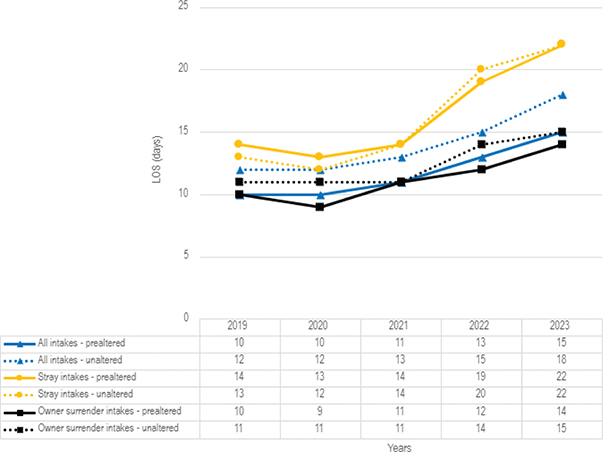
Fig. 1. Median length of stay to adoption for dogs by intake type and altered status at intake (n = 1,136,021). Data were collected from 256 animal welfare organizations across the U.S. between 2019 and 2023.
LOS until adoption for unaltered, stray dogs increased from a median of 13 to 22 days between 2019 and 2023. Unaltered, owner surrendered dogs had lower median LOS, as well as a smaller increase in median LOS (11 to 15 days) in comparison to unaltered, stray dogs.
Predictors of sterilization at intake
In the total sample, 27.9% of animals were prealtered. Multiple dog and intake characteristics impacted the odds of being prealtered on intake (Fig. 2).
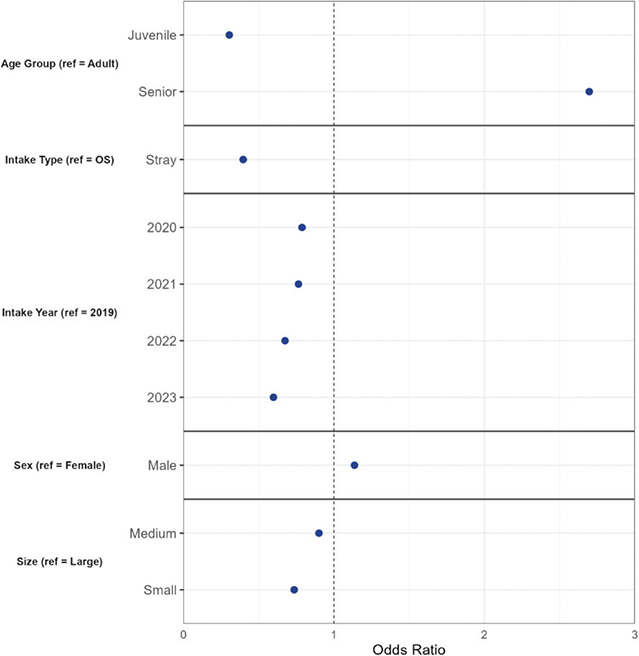
Fig. 2. Associations between dog characteristics and intake type and whether dogs were prealtered (=1) or unaltered (=0) upon intake to an animal welfare organization (n = 1,136,021). Data were collected from 256 animal welfare organizations across the U.S. between 2019 and 2023. Data are presented by odds ratios. All 95% CIs are narrower than ±0.05 and thus not visible at this plot scale. See Supplementary Table 2 for full bounds.
Compared to 2019, dogs were less likely to come into the shelter altered in 2020 (odds ratio [OR] = 0.79, 95% confidence interval [CI] = 0.77–0.80), 2021 (OR = 0.76, 95% CI = 0.75–0.78), 2022 (OR = 0.68, CI = 0.66–0.69), and 2023 (OR = 0.60, CI = 0.59–0.61).
Male dogs were more likely to be recorded as prealtered than female dogs (OR = 1.14, 95% CI = 1.12–1.15).
Compared with adult dogs (>5 months years and ≤7 years), senior dogs (>7 years) had higher odds of being altered (OR = 2.70, 95% CI = 2.68–2.74) at intake, whereas juvenile dogs (>8 weeks and ≤5 months) had lower odds (OR = 0.30, 95% CI = 0.30–0.31).
All size groups experienced decreases in the percentage entering prealtered. Large dogs (>60 and ≤100 lbs) had the largest percentage that were prealtered across all years, followed by medium dogs (>25 and ≤60 lbs). Small dogs (≤25 lbs) had the smallest percentage entering organizations as prealtered. Compared with large dogs, medium dogs had lower odds of being altered at intake (OR 0.90, 95% CI 0.89–0.91), with an even larger reduction for small dogs (OR 0.74, 95% CI 0.72–0.74).
The proportion of prealtered dogs that entered shelters decreased for both stray and owner surrendered dogs (Fig. 3). Overall, dogs that entered as strays (OR = 0.40, 95% CI = 0.39–0.40) were less likely to be altered compared to owner surrendered dogs. For dogs that entered as stray, prealtered percentage decreased from 24.7% in 2019 to 15.6% in 2023. For dogs with an initial intake type of owner surrender, prealtered percentage decreased from 44.7% in 2019 to 32.2% in 2023.

Fig. 3. Percentage of dogs prealtered by intake type and year (n = 1,136,021). Data were collected from 256 animal welfare organizations across the U.S. between 2019 and 2023.
Although the percentage of dogs prealtered at intake decreased year over year in the post-pandemic years, lower dog intake numbers partially offset the total number of unaltered dogs admitted. In 2019, 185,138 dogs were admitted unaltered, followed by 141,484 in 2020, 152,300 in 2021, 174,672 in 2022, and 173,314 in 2023.
Discussion
This study found a notable decrease in the percentage of dogs that were sterilized prior to entering animal welfare organizations across the U.S. between 2019 and 2023. With declining prealtered rates, animal welfare organizations may have to either increase timeliness of spay and neuter surgeries they complete prior to adoption or adjust their practices to adopt prior to sterilization.
The present data shows that there were regional differences in the percentage of prealtered dogs. While all organizations experienced a decrease over time, there remains a 29.9% difference between the New England region and the East South Central region in 2023. Percentage of prealtered dogs may differ by region due to multiple interacting issues such as the population of free-roaming unowned animals, access to veterinary care, efforts to neuter community animals, laws that mandate sterilization, climate that favors survival of offspring, or attitudinal differences among guardians.21–23 National data suggest that the New England region typically experiences a lower intake from community sources such as strays and owner surrenders overall, which may suggest a lower population of animals requiring sterilization surgeries.1 This study did not include information about why animals were prealtered upon intake; however, future research should consider contextualizing regional trends by analyzing organizational or community factors.
Analysis of LOS to adoption demonstrated that prealtered dogs stayed in care for fewer days than dogs that were unaltered. While both prealtered and unaltered dogs had longer lengths of stay in 2023 than 2019, unaltered dogs experienced a slightly larger increase (6 days) compared to prealtered dogs (5 days). A possible explanation for the widening gap between prealtered and unaltered dogs could be due to a lack of access to timely sterilization services while in the sheltering system,15 which may be compounded by a general veterinary shortage and increase in veterinary care costs.17,24 Although the proportion of dogs unaltered at intake decreased year over year in the post-pandemic years, lower dog intake numbers partially offset the total number of unaltered dogs admitted. In the year 2019, 185,138 dogs were admitted unaltered, whereas the highest number of unaltered dogs admitted in the following years was 174,673 in 2022. Additional research should investigate the relationship between access to veterinary care services, dogs that enter shelters prealtered, and LOS in animal shelters to support these hypotheses.
The difference in LOS between sterilization statuses (prealtered vs. unaltered) did not increase as quickly as the difference in LOS between dogs that entered as strays and those that entered as owner surrenders, regardless of sterilization status. This suggests that intake type may have a stronger influence on shelter capacity than sterilization status at intake. Previous studies have found mixed results regarding the impact of intake type on LOS.4,7,25
Multiple dog- and intake-related factors influenced the odds of a dog being prealtered upon entry. Few previous studies have investigated sterilization status at intake as a model outcome. Contrary to our results, one study found that a higher proportion of female dogs were sterilized (87.8%) than male dogs (45.0%); however, this was a survey of owned animals rather than those that entered animal welfare organizations.12 In addition, in our study, senior dogs were more likely to be prealtered, while juvenile dogs were less likely to be prealtered, compared to adult dogs. The largest decrease in prealtered percentage between 2019 and 2023 occurred in the adult group of dogs (13%). Dogs born just prior to and during the COVID-19 pandemic, when spay and neuter services were more limited,15 may fall into the adult category in our analysis. Guerios et al.16 found that a set of high-volume clinics performed nearly 200,000 fewer spay and neuter surgeries between January 2020 and December 2021 compared to 2019 levels. More recently, they found that the same clinics performed even fewer surgeries per quarter between 2021 and 2023.15 Our results support the notion that fewer owned and unowned animals were accessing sterilization services since the COVID-19 pandemic and were entering animal welfare organizations as unaltered adults.
Some studies have not included information about sterilization when analyzing LOS or outcome types of animals due to the lack of data about altered status at intake.26 In this study, understanding the number of animals that entered shelters unaltered was useful to determine trends in sterilization and shelter capacity. As such, organizations should collect and report these data where possible.
While the data represented all organization types, no information was collected about management of intake. For example, some organizations may choose which animals to accept and may not be required to accept any animals from the public.27 Future research should consider the relationship between intake management and the percentage of prealtered dogs.
In addition to prealtered status, intake, outcome and length of time in care of organizations are impacted by several complex factors, such as organizational policies or individual animal behavioral and medical care requirements. The variables included in this study were not exhaustive of possible variables, and causation should not be concluded on this analysis alone; however, the analysis suggests that the decrease in sterilization surgeries during and after COVID-19 have contributed to a decrease in the proportion of prealtered animals that entered animal welfare organizations. Further research should consider the impact of percentage of prealtered animals on shelter resources and capacity in tandem with other organizational and animal-level factors.
The large sample size of more than a million dogs in 256 animal welfare organizations providing continuous data from 2019 through 2023 in 46 states provided strong statistical power in support of the findings. However, several limitations are recognized. Firstly, sharing of animal-level shelter intake and outcome data is voluntary and dependent on the type of shelter management software used by the organizations. Therefore, this subset of participating organizations may not be representative of the overall sheltering community in the US. Animals with an ‘unknown’ alter status at intake (5.5% of total sample) were grouped in the unaltered category for analysis. Since the alter status of females is more difficult to determine than males, this may result in an underestimation of prealter status of females compared to males. This data field can be updated for the animal once an examination is completed. Similarly, size groups are intended to reflect the estimated adult weight of dogs. At this time, no validated method of predicting adult size in immature dogs exists, so some entries may instead represent recorded weight at admission, possibly increasing the number of unaltered dogs reported in the lower size ranges versus how the category was intended to be used. Retrospective studies are inherently affected by limited opportunity to identify data entry errors or omissions.
Conclusion
This study identified a decline in the proportion of dogs sterilized prior to entering U.S. animal welfare organizations between 2019 and 2023, with variation in decreases seen across regions, intake types, and dog size groups. Furthermore, unaltered dogs experienced longer LOS. Male dogs and senior dogs were more likely to be prealtered than female and adult dogs, respectively. Owner surrendered dogs were more likely to be prealtered compared to stray dogs. Continued analysis of sterilization trends is critical for understanding and addressing the challenges faced by animal welfare organizations in the post-pandemic landscape.
Authors’ contributions
Conceptualization: SH, JKL
Visualization, Investigation and methodology: SH, JC
Data curation and formal analysis: JC: JC
Writing—original draft: SH, JC, LHL
Writing—review & editing: SH, LHL, JKL
Authors’ contributions
A report, which included similar findings for both dogs and cats was published by Shelter Animals Count (Altered Status Data Report - 2019-2023 - Shelter Animals Count). The data included in this report differ from the originally published version slightly due to timing of the dataset pull.
References
| 1. | Shelter Animals Count. 2024 National Animal Welfare Statistics. 2024. Accessed Aug 10, 2024. https://www.shelteranimalscount.org/explore-the-data/statistics-2024 |
| 2. | Bradley J, Rajendran S. Increasing Adoption Rates at Animal Shelters: A Two-Phase Approach to Predict Length of Stay and Optimal Shelter Allocation. BMC Vet Res. 2021;17(1):1–16. doi: 10.1186/s12917-020-02728-2 |
| 3. | Koralesky KE, Rankin JM, Fraser D. Animal Sheltering: A Scoping Literature Review Grounded in Institutional Ethnography. Anim Welf. 2023;32:e3. doi: 10.1017/AWF.2022.4 |
| 4. | Protopopova A, Mehrkam LR, Boggess MM, Wynne CDL. In-Kennel Behavior Predicts Length of Stay in Shelter Dogs. PLoS One. 2014;9(12):e114319. doi: 10.1371/journal.pone.0114319 |
| 5. | McGuire B, Chan J, Jean-Baptiste K, Kok P, Rosenbaum E. Results of Behavioral Evaluations Predict Length of Stay for Shelter Dogs. Animals. 2021;11(11):3272. doi: 10.3390/ani11113272 |
| 6. | Nakamura M, Dhand NK, Starling MJ, McGreevy PD. Descriptive Texts in Dog Profiles Associated with Length of Stay via an Online Rescue Network. Animals. 2019;9(7):464–76. doi: 10.3390/ani9070464 |
| 7. | Brown WP, Davidson JP, Zuefle ME. Effects of Phenotypic Characteristics on the Length of Stay of Dogs at Two No Kill Animal Shelters. J Appl Anim Welf Sci. 2013;16(1):2–18. doi: 10.1080/10888705.2013.740967 |
| 8. | Janke N, Berke O, Flockhart T, Bateman S, Coe JB. Risk Factors Affecting Length of Stay of Cats in an Animal Shelter: A Case Study at the Guelph Humane Society, 2011–2016. Prev Vet Med. 2017;148:44–48. doi: 10.1016/j.prevetmed.2017.10.007 |
| 9. | Gunter LM, Barber RT, Wynne CDL. What’s in a Name? Effect of Breed Perceptions & Labeling on Attractiveness, Adoptions & Length of Stay for Pit-Bull-Type Dogs. PLoS One. 2016;11(3):e0146857. doi: 10.1371/journal.pone.0146857 |
| 10. | Protopopova A, Gunter LM. Adoption and Relinquishment Interventions at the Animal Shelter: A Review. Anim Welf. 2017;26(1):35–48. doi: 10.7120/09627286.26.1.035 |
| 11. | Weng HY, Kass PH, Chomel BB, Hart LA. Educational Intervention on Dog Sterilization and Retention in Taiwan. Prev Vet Med. 2006;76(3–4):196–210. doi: 10.1016/j.prevetmed.2006.05.002 |
| 12. | Manning AM, Rowan AN. Companion Animal Demographics and Sterilization Status: Results from a Survey in Four Massachusetts Towns. Anthrozoos. 1992;5(3):192–201. doi: 10.2752/089279392787011368 |
| 13. | White SC, Jefferson E, Levy JK. Impact of Publicly Sponsored Neutering Programs on Animal Population Dynamics at Animal Shelters: The New Hampshire and Austin Experiences. J Appl Anim Welf Sci. 2010;13(3):191–212. doi: 10.1080/10888700903579903 |
| 14. | Powell L, Houlihan C, Stone M, et al. Animal shelters’ response to the COVID-19 pandemic: A pilot survey of 14 shelters in the Northeastern United States. Animals. 2021;11(9):2669–82. doi: 10.3390/ani11092669 |
| 15. | Guerios SD, Clemmer G, Levy JK. The pandemic’s cruel aftermath: progressive decline in spay/neuter capacity. Front Vet Sci. 2025;12:1558235. doi: 10.3389/FVETS.2025.1558235/BIBTEX |
| 16. | Guerios SD, Porcher TR, Clemmer G, Denagamage T, Levy JK. COVID-19 Associated Reduction in Elective Spay-Neuter Surgeries for Dogs and Cats. Front Vet Sci. 2022;9:912893. doi: 10.3389/FVETS.2022.912893/BIBTEX |
| 17. | Kogut S, Montgomery ML, Levy JK. The Nonprofit Veterinarian Shortage: Who Will Care for the Pets Most in Need? J Shelter Med Community Anim Health. 2024;3(1):3. doi: 10.56771/JSMCAH.V3.75 |
| 18. | Eagan BH, Gordon E, Protopopova A. Reasons for Guardian-Relinquishment of Dogs to Shelters: Animal and Regional Predictors in British Columbia, Canada. Front Vet Sci. 2022;9:448. doi: 10.3389/fvets.2022.857634 |
| 19. | Hemy M, Rand J, Morton J, Paterson M. Characteristics and Outcomes of Dogs Admitted into Queensland RSPCA Shelters. Animals. 2017;7(9):67. doi: 10.3390/ANI7090067 |
| 20. | Association of Shelter Veterinarians. The Guidelines for Standards of Care in Animal Shelters. 2nd ed. Apex, NC: Journal of Shelter Medicine and Community Animal Health; 2022. |
| 21. | Dolan ED, Scotto J, Slater M, Weiss E. Risk Factors for Dog Relinquishment to a Los Angeles Municipal Animal Shelter. Animals. 2015;5(4):1311–1328. doi: 10.3390/ani5040413 |
| 22. | Glasser CL. Attitudes Toward Spay/Neuter in the US Population: Urban/Rural, cat/Dog, and Demographic Differences. Anthrozoos. 2021;34(1):93–107. doi: 10.1080/08927936.2021.1874112 |
| 23. | White SC, Scarlett JM, Levy JK. Characteristics of Clients and Animals Served by High-Volume, Stationary, Nonprofit Spay-Neuter Clinics. J Am Vet Med Assoc. 2018;253(6):737–745. doi: 10.2460/javma.253.6.737 |
| 24. | Croney C, Applebaum JW, Delgado M, Stella J. How Does Access to Veterinary Care Relate to Animal Welfare? Adv Small Anim Care. 2025;6(1):209–21. doi: 10.1016/j.yasa.2025.06.014 |
| 25. | Protopopova A, Gilmour AJ, Weiss RH, Shen JY, Wynne CDL. The Effects of Social Training and Other Factors on Adoption Success of Shelter Dogs. Appl Anim Behav Sci. 2012;142(1–2):61–68. doi: 10.1016/j.applanim.2012.09.009 |
| 26. | Patronek GJ, Crowe A. Factors Associated with High Live Release for Dogs at a Large, Open-Admission, Municipal Shelter. Animals. 2018;8(4):45. doi: 10.3390/ani8040045 |
| 27. | Shelter Animals Count. Animal Welfare Glossary. 2024. Accessed Jun 14, 2024. https://www.shelteranimalscount.org/glossary |