ORIGINAL RESEARCH ARTICLE
Impact of Plasma Supplementation on Survival and Clinical Illness in Orphaned Neonatal Kittens in a Retrospective Shelter Cohort
Jonathan Chapman1,2†*, Antoinette Piraino2†, Kelly Min1, Pedro P.V.P. Diniz3, Jacqueline Noble1 and Zarah Hedge1,2
1San Diego Humane Society, San Diego, CA, USA; 2Western University of Health Sciences, College of Veterinary Medicine, Pomona, CA, USA; 3Western University of Health Sciences, College of Osteopathic Medicine of the Pacific and Pacific Northwest, Pomona, CA, USA
Abstract
Introduction: The San Diego Humane Society annually supports thousands of kittens, many of whom are orphaned and high risk for illness and death. Failure of passive transfer (FPT) is presumed common in orphaned neonatal kittens lacking colostrum-derived antibodies. Although subcutaneous plasma supplementation can increase circulating antibodies, its impact on survival and illness in shelter populations remains uncertain.
Objective: To assess the effect of plasma supplementation at shelter intake on (1) hazard of death within 30 days and (2) time to onset of common clinical signs in orphaned neonatal kittens.
Methods: Retrospective cohort study of medical records from February to August 2015. Allocation of plasma supplementation was non-randomized, based on operational constraints. Kittens ≤ 4 weeks at intake were eligible; exclusions were death or euthanasia within 24 h of intake or missing weights within 14 days. Exposure was standardized as 3-mL of subcutaneous plasma administered within 24 h of intake. Outcomes were death within 30 days of shelter intake and time to first onset of diarrhea, upper respiratory signs, hypothermia, anorexia, weight loss, or neurological signs.
Results: Cohort included 544 kittens (Plasma-Supplemented [PS] group n = 193; Control group n = 351). Review of Kaplan–Meier curves suggested early differences in survival rates between groups (days 3–11); however, after accounting for demographics and onset of clinical signs, plasma supplementation was not statistically associated with decreased mortality risk at any time during the first 30 days after intake. Strongest mortality predictors were intake weight, average weight gain, and onset of weight loss. Plasma supplementation demonstrated a significant impact on delaying onset of diarrhea and weight loss, but no other signs.
Conclusion: Subcutaneous plasma supplementation at intake did not reduce mortality risk but delayed onset of key morbidities. Intake weight and weight gain were the most important survival predictors, highlighting importance of nutrition and suggesting that plasma supplementation may reduce common clinical manifestations in shelter populations.
Keywords: age; colostrum; diarrhea; failure of passive transfer; fresh frozen plasma; hypothermia; immunoglobulins; kitten; mortality; shelter; weight; hazard ratio
Citation: Journal of Shelter Medicine and Community Animal Health 2026, 5: 143 - http://dx.doi.org/10.56771/jsmcah.v5.143
Copyright: © 2026 Jonathan Chapman et al. This is an Open Access article distributed under the terms of the Creative Commons Attribution 4.0 International License (http://creativecommons.org/licenses/by/4.0/), allowing third parties to copy and redistribute the material in any medium or format and to remix, transform, and build upon the material for any purpose, even commercially, provided the original work is properly cited and states its license.
Received: 7 May 2025; Revised: 5 January 2026; Accepted: 5 January 2026; Published: 16 June 2026
Competing interests and funding: The authors declare no conflict of interest related to this study. Funding in support of this study was provided by San Diego Humane Society, Western University of Health Sciences, and Boehringer Ingelheim.
Correspondence: *Jonathan Chapman, San Diego Humane Society, 5500 Gaines St., San Diego, CA 92110. Email: jchapman@sdhumane.org
Reviewers: Meagan Wentworth, Jennifer C. Bennett
Supplementary material: Supplementary material for this article can be accessed here.
The San Diego Humane Society supports over 20,000 kittens annually, many of whom are orphaned, and despite high standards of care, may perish or be humanely euthanized. In large animal species, failure of passive transfer (FPT) is a well-documented major cause of death that greatly increases the risk of infectious disease and mortality.1 Therefore, FPT has been assumed to be present in orphaned neonatal kittens.1 Previous research has shown that subcutaneous serum injection produces satisfactory serum IgG levels in neonetal kittens with FPT.2
Neonatal kittens acquire passive immunity through gastrointestinal absorption of maternal colostrum, which provides immunoglobulins, particularly IgG, for protection from disease during their first weeks of life.3 As documented in many other species, this process is vital to neonatal survival.4 FPT, a well-known cause of mortality in neonatal animals,1 and assumed to be a leading cause of mortality in orphaned neonatal kittens,1,5–7 results from failure to receive adequate immunological defense through colostrum. Without passive immunity from colostrum, neonatal animals, including kittens,8 cannot initiate a robust immune response. These antibodies are the primary defense against infections in neonates for the first weeks of life.1,5,7
Neonatal kittens are particularly at risk of FPT if they do not receive colostrum within the first few hours of birth due to limited gut absorption. This can occur if kittens are orphaned before nursing, part of a large litter, if the queen fails to lactate, or if kittens are intentionally separated.9 Additionally, increased mortality risk in kittens has been associated with low body weight, low body condition score (BCS), presence of infectious diseases, and presence of diarrhea.4,7,10,11
A previous study evaluating IgG levels in felines affected by FPT found that after 2 days, the quantity of IgG in the queen’s colostrum rapidly diminishes. Furthermore, intestinal absorption of IgG in the neonate stops within 24 h after birth.8 For these reasons, it is vital that neonates receive colostrum immediately following birth.
Various methods of IgG supplementation have been utilized in large animals due to the economic importance, including oral and subcutaneous routes. Minimal data exist on the use of similar forms of supplementation in neonatal kittens. One study found that adult feline serum administered subcutaneously or intraperitoneally corrected IgG deficiencies in neonatal kittens with FPT. This is advantageous as these routes of administration can be used beyond the 24-h window following birth, which is needed for gut absorption of IgG. However, the optimal concentration of serum IgG needed for immunological protection remains unknown. Additionally, the serum must be collected in large quantities from donors who have been blood typed and screened for infectious diseases.2
In another study, the efficacy of a commercially available supplement derived from equine IgG was evaluated on neonatal kittens that received colostrum, neonatal kittens that received feline IgG, and neonatal kittens that received equine IgG. Subcutaneous and oral routes of administration were compared. The ability of foreign IgG to opsonize bacterial pathogens was analyzed using in vitro studies. Findings suggested that supplementation was more effective in the subcutaneous route than the oral route due to increased absorption and higher peak serum concentrations for longer periods. Additionally, when supplemented subcutaneously, the equine-derived IgG was found to have a significantly shorter half-life in neonatal kittens compared to feline-derived IgG, suggesting that species-specific antibodies circulate for longer periods. Ultimately, the study found that both feline and equine-derived IgG reached concentrations that mirror those in neonatal kittens that naturally received colostrum. While species-specific IgG antibodies seem more effective, further studies are needed to determine their efficacy in mitigating infectious disease and neonatal mortality.12
Another study explored the ability of IgG obtained via plasma transfer to opsonize pathogens for phagocytosis by feline neutrophils. This is a key process utilized by the immune system to recognize and destroy pathogens. In theory, FPT in neonatal kittens could compromise neutrophil function, a phenomenon seen in colostrum-deprived horses. The study determined in vitro that passive transfer of IgG in colostrum-deprived neonatal kittens was not statistically different from neonatal kittens that received supplementation or natural colostrum. In fact, neutrophil function seemed more dependent on age than on the source of IgG.13 This shows that supplemented IgG does not compromise neutrophil opsonization ability. However, more research is still needed to determine the efficacy of supplementation.
Based on these reports,1,2,8,12,13 the San Diego Humane Society implemented plasma supplementation to provide immune support within 24 h of intake to orphaned neonatal kittens aged ≤ 4 weeks. Orphaned neonates presented without a queen were presumed colostrum deprived and therefore at risk for FPT. Because allocation depended on operational constraints, including space for monitoring, plasma inventory, and funding, some eligible kittens did not receive plasma supplementation. This variability created an opportunity to evaluate the impact of plasma administration on mortality risk in orphaned neonatal kittens.
Animal shelters across the United States, such as San Diego Humane Society, care for many orphaned neonatal kittens each year in addition to all the other animals that enter the shelter. The cost of treatment is a significant expense for animal shelters, which can equate to tens of thousands of dollars each year in some instances. Unfortunately, many of these ill orphaned neonatal kittens succumb to disease or are humanely euthanized due to health-related suffering. With the high volume of ill orphaned neonatal kittens treated every year, along with the high financial expense, it is crucial that the impact of plasma supplementation on kitten survival is explored. This study aimed to estimate the effect of plasma supplementation at shelter intake on mortality risk among orphaned neonatal kittens at any time during the first 30 days following intake into the shelter. This study also evaluated the impact of plasma supplementation on the time to onset of common clinical signs associated with mortality in the same kitten population.
Methods
Study population and design
A retrospective cohort study was conducted as depicted in Fig. 1. All orphaned neonatal kittens admitted to the San Diego Humane Society between February and August 2015 were eligible. Exclusion criteria included estimated age older than 4 weeks at intake, lack of recorded body weight within the first 14 days after intake, death or euthanasia within 24 h of intake, or euthanasia for nonmedical reasons.
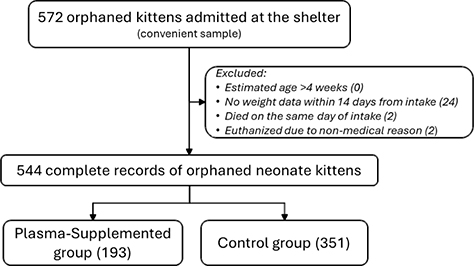
Fig. 1. Study design flowchart.
At this shelter, subcutaneous plasma supplementation had been implemented as standard practice for orphaned neonates; however, because delivery required dedicated post-procedure monitoring space and adequate plasma inventory and funding, not all eligible kittens received plasma supplementation. Therefore, allocation occurred by operational convenience rather than clinical triage, yielding a non-randomized exposure. Based on shelter protocol, clinical condition at intake (including severity of signs), age, and body weight were not used to determine whether plasma was administered, and allocation decisions were made by shelter staff without investigators’ involvement. These site-level constraints resulted in two exposure groups within the consecutively enrolled cohort: Plasma-Supplemented (PS, n = 193) and Control (n = 351). Orphaned neonatal kittens in the PS group received subcutaneous plasma within 24 h of intake. The primary outcomes were mortality within 30 days of intake, given that it has been demonstrated that the lowest mean serum IgG concentrations for kittens administered adult feline serum were recorded approximately 4 weeks after initial plasma supplementation.2 All analyses used shelter intake as time zero and evaluated outcomes over the subsequent 30 days (e.g. 30 days post-intake), rather than relative to estimated age in days of life.
Plasma was purchased from Animal Blood Resources International. Donor cats were fully vaccinated with feline viral rhinotracheitis, calicivirus, and panleukopenia (FVRCP) vaccine and rabies per standard protocols,14 and plasma was collected and screened under laboratory conditions according to veterinary transfusion and blood banking standards.15 Plasma processing and handling occurred as follows: plasma was frozen in 25-mL bags, shipped on dry ice, thawed at room temperature on arrival, aliquoted into 3-mL vials, refrozen, and later thawed individually for use. A nursery fluid chart recommended a maximum volume of 3-mL for the smallest neonates, so a standardized 3-mL dose was used for all plasma recipients. The approximate cost was $20 per kitten, including handling and storage, and pre-treatment or post-treatment antibody levels were not measured due to financial limitations.
All orphaned neonatal kittens received a standardized diet, care, and supportive treatment. Staff recorded key data in ShelterBuddy®, including outcomes (unassisted death, humane euthanasia, or adoption), clinical signs, and concurrent diagnoses. The pre-shelter medical history of orphaned neonatal kittens was unknown, so FPT was assumed in all orphans, given their likely lack of colostrum and associated health risks.
Medical records review
Medical records were retrieved from the shelter’s electronic system (ShelterBuddy®) and reviewed in detail. A neonate kitten was defined as aged ≤ 4 weeks.4,16 The following variables were extracted: intake age (days), intake weight (grams), and occurrence of clinical signs within 30 days (days from intake date). The following clinical signs were tabulated: diarrhea, upper respiratory signs (URI), hypothermia, anorexia, weight loss, and neurological signs. Test results were recorded for the following infections: feline panleukopenia, feline leukemia virus (FeLV), and feline immunodeficiency virus (FIV). Concomitant treatments recorded included antibiotics (metronidazole, doxycycline, amoxicillin/clavulanic acid), anthelmintics (fenbendazole, pyrantel pamoate), antiprotozoals (ponazuril), and probiotics (FortiFlora®).
Statistical analysis
Since this study was a retrospective cohort with exposure allocated by operational convenience, the sample size was fixed by data availability rather than prospectively determined. With n = 544 (PS = 193; Control = 351) and α = 0.05, the study would have approximately 80% power to detect absolute mortality differences of approximately 10–11 percentage points if the true control mortality were 25–35%.
We summarized cohort characteristics by treatment group (PS vs. Control) as counts/percentages for categorical variables and medians with interquartile ranges for continuous variables. Absolute standardized differences (ASD) were calculated to quantify between-group imbalance for baseline and univariate comparisons. Univariate and bivariate comparisons used Fisher’s exact test for proportions and Wilcoxon rank-sum tests for continuous measures. For clinical signs, we evaluated both composite (‘any sign ≤ 30 days’) and individual signs (e.g. diarrhea, URI) and described time-to-onset (days from intake) with medians (interquartile range [IQR]) and Wilcoxon tests.
The primary multivariable analysis used a Cox proportional hazards model to estimate the effect of plasma supplementation on time to death within 30 days. The model adjusted for intake age (days), intake weight (g), weight gain (g/day), sex (male/female), and whether the kitten came from a litter (yes/no). To estimate the direct effect of plasma supplementation on mortality not mediated through subsequent evolving illness, time-varying covariates were created for each clinical sign (diarrhea, URI, anorexia, weight loss, and neurological signs) if it occurred within 30 days of intake. Motivated by inspection of the Kaplan–Meier curve, a piecewise Cox model was used on a prespecified interval (3–11 days). For the impact of plasma supplementation on the onset of clinical signs, cause-specific Cox models were fit for time to first onset of each sign, censoring kittens at death or 30 days. These models included treatment group, age, weight, sex, and litter status. Hazard ratios with 95% confidence intervals (CI) were reported for all survival models. A two-sided α = 0.05 defined statistical significance. Analyses were performed in Python and JMP Pro version 18 (JMP Statistical Discovery LLC, Cary, NC).
Results
Does plasma supplementation correlate with clinical signs and overall survival without controlling for covariates?
Table 1 compares baseline characteristics of the 544 kittens by treatment group. The groups were similar in proportion of males/females, kittens belonging to a litter, estimated age at intake, weight at intake, and weight gain. In univariate, exploratory analyses with no correction for multiple testing (Supplemental Table 1), mortality was approximately 17% in both groups (Table 2), with no difference in odds (odds ratio [OR] = 1.0; 95% CI: 0.64–1.62; P = 1.000). By day 30, mortality remained similar (about 19% vs. 20%), again with no between-group difference in odds (OR = 1.0; 95% CI: 0.66–1.61; P = 0.911). PS kittens were less likely than Controls to develop any clinical signs within 30 days from intake (53% vs. 66%; P = 0.0033, Fisher’s exact, Supplemental Table 1). Conversely, Control kittens experienced 1.72 higher odds of developing any clinical signs by day 30 compared to PS kittens (95% CI: 1.20–2.46). For specific signs, plasma supplementation was associated with a delay in diarrhea onset among affected kittens (median 12 vs. 10 days; IQR: 8.25–16 vs. 6–14; P = 0.0105, Wilcoxon, Supplemental Table 1), although the proportion developing diarrhea by day 30 (42% vs. 48%; P = 0.178) did not differ significantly. Weight loss was less frequent in PS kittens (25% vs. 33%, P = 0.0412). Among kittens who developed neurological signs, time to onset was longer in the PS group (median 15 vs. 9.5 days; P = 0.0413, Wilcoxon), while the cumulative incidence at 30 days was not different (P ≥ 0.076). We observed no between-group differences for URI, hypothermia, or anorexia at either time point (all P ≥ 0.19). These preliminary univariate results must be interpreted cautiously and were used to inform the development of multivariate models. Of note, no kitten was positive for FeLV or FIV within 30 days of intake.
| Variable | Category | PS (N = 193) | Control (N = 351) | Pa | ASD |
| Sex | Male | 104 (53.9%) | 188 (53.6%) | 0.9074 | 0.01 |
| Female | 88 (45.6%) | 160 (45.6%) | |||
| Unknown | 1 (0.5%) | 3 (0.9%) | |||
| Part of a litter | Yes | 174 (90.2%) | 317 (90.3%) | 1.000 | 0.01 |
| Estimated age at intake (days) | Median (IQR) | 9 (4–14) | 8 (4–19) | 0.6518 | 0.00 |
| Earliest weight (g) | Median (IQR) | 168 (118.5–238) | 168 (114–239) | 0.6049 | 0.03 |
| Weight gain (g/day) | Median (IQR) | 13.6 (9.4–16.7) | 13.8 (11.1–16.1) | 0.9287 | 0.02 |
| aExploratory univariate analysis without adjustment for multiple comparisons; ASD: Absolute standardized difference. | |||||
| Outcome | Plasma (N = 193) | Control (N = 351) | Pa | ASD | |
| Alive at 21 days | 160 (82.9%) | 290 (82.6%) | 1.0000 | 0.01 | |
| Alive at 30 days | 156 (80.8%) | 282 (80.3%) | 0.9105 | 0.01 | |
| aExploratory univariate analysis without adjustment for multiple comparisons; ASD: Absolute standardized difference. | |||||
A modest broad benefit from plasma supplementation identified by univariate analysis was the need for any treatment, where a smaller proportion of the PS group (36%) required treatment within 30 days of intake when compared to the Control group (46%, P = 0.0294, Fisher’s exact, Supplemental Table 2). Controls had modestly higher odds of requiring treatment than PS kittens (OR = 1.51, 95% CI: 1.05–2.16). However, when individual treatment types were analyzed (amoxicillin–clavulanate, metronidazole, FortiFlora, fenbendazole, pyrantel, and ponazuril), no between-group differences were detected. The exception was doxycycline, which was used less often in the PS group than in Controls (2% vs. 5%, P = 0.0226, Fisher’s exact). Out of 106 kittens who died within 30 days from intake, the suspected cause of death was inferred from 74 kittens based on medical record notes and/or necropsy reports (Supplemental Table 3). None of the study groups was associated with a higher proportion of specific causes of death.
Does plasma supplementation impact kitten survival when demographics and onset of clinical signs are taken into consideration?
Kaplan–Meier estimator was generated for survival curves within 30 days from intake for the PS and Control groups (Fig. 2), which indicated similar survival rates between groups, with the exception of days 3 to 11 post-intake. To further investigate this finding, we used a Cox proportional-hazards model with time-varying covariates for each major clinical sign. After accounting for when clinical signs appeared and adjusting for baseline differences, plasma supplementation had no detectable effect on mortality within 30 days (hazard ratio [HR]: 1.4, 95% CI: 0.90–2.34, P = 0.1259) or specifically within days 3–11 post-intake (Table 3). The strongest predictors of death were the first weight after intake, the average weight gain, and weight loss within 30 days from intake. Age, sex, and litter status had non-significant effects, similar to other clinical signs, including anorexia, URI, diarrhea, and neurological signs, probably due to the smaller number of affected kittens. In practical terms, these results suggest that a 50 g higher intake weight (e.g. 150 g vs. 100 g) corresponds to a 36% lower risk of death, and that gaining an extra 5 g/day decreases the mortality risk by 66%, on any given day in the first 30 days post-intake.
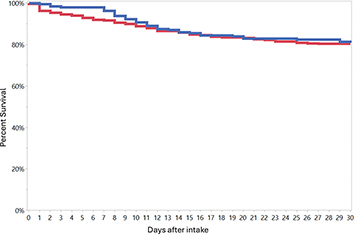
Fig. 2. Kaplan–Meier survival through 30 days after intake among orphaned neonatal kittens, stratified by plasma supplementation at intake (Plasma, n = 193; Control, n = 351). Event = death; adoption or alive at last follow-up = censored. The time scale is days since shelter intake. Curves show a small early separation (≈ days 1–11) with convergence thereafter; overall 30-day survival is similar between groups.
| Variable / covariate | HR | 95% CI | P* | Interpretation | |
| Plasma effect (days 3–11) | 1.45 | 0.67–3.12 | 0.346 | Kittens given plasma did not show a survival advantage in days 3–11 post-intake. | |
| Intake age | 0.99 | 0.93–1.05 | 0.691 | NS | |
| Intake weight | 0.99 | 0.985–0.998 | 0.0086* | Heavier kittens are more resilient: every extra gram at intake reduces the hazard of death by about 0.9%. | |
| Weight gain | 0.80 | 0.77–0.84 | < 0.001* | Weight gain is a major protective factor: each extra gram gained per day decreases the hazard of death by ~20%. | |
| Male vs. female | 1.26 | 0.76–2.09 | 0.368 | NS | |
| Part of a litter | 1.65 | 0.76–3.58 | 0.204 | NS | |
| Weight loss onset | 2.70 | 1.37–5.33 | 0.004* | Kittens that start losing weight have 2.7 times increased risk of dying on any given day. | |
| Diarrhea onset | 1.15 | 0.61–2.17 | 0.667 | NS | |
| URI onset | 1.70 | 0.82–3.50 | 0.152 | NS | |
| Anorexia onset | 1.78 | 0.89–3.55 | 0.103 | NS | |
| Neurological signs onset | 1.20 | 0.37–3.94 | 0.762 | NS | |
| *Significant at α = 0.05. | |||||
Does plasma supplementation reduce the development of common clinical signs in orphaned neonatal kittens?
For each major clinical sign analyzed, we fit a Cox model for time-to-first onset, censoring at death or day 30 and adjusting for age, weight, weight gain, and sex. Kittens that had a particular clinical sign at intake were excluded from that clinical sign-specific analysis. The hazard ratio for plasma supplementation is interpreted as the relative risk on any given day of developing the clinical sign in PS kittens versus Controls. Plasma supplementation was associated with a 31% lower risk of developing diarrhea and 36% lower risk of developing weight loss at any time during the 30 days post-intake (Table 4). No meaningful effect was observed for URI, anorexia, hypothermia, or neurological signs.
| Clinical sign | Plasma hazard ratio | 95% CI | P* | Interpretation | |
| Diarrhea | 0.69 | 0.52–0.91 | 0.008* | PS kittens had a 31% lower instantaneous risk of developing diarrhea compared with Controls. | |
| Weight loss | 0.64 | 0.46–0.91 | 0.012* | PS kittens were 36% less likely to develop clinically significant weight loss at any given time. | |
| Hypothermia | 1.35 | 0.60–3.05 | 0.469 | NS | |
| URI | 1.15 | 0.77–1.71 | 0.497 | NS | |
| Neurological signs | 0.81 | 0.45–1.47 | 0.492 | NS | |
| Anorexia | 0.92 | 0.59–1.42 | 0.692 | NS | |
| *Significant at α = 0.05. | |||||
Discussion
The findings of this retrospective cohort study, based on robust multivariate analyses, have important implications for the use of plasma supplementation for orphaned neonatal kittens suspected of FPT, especially in resource-limited settings such as animal shelters. This study showed that plasma supplementation did not impact survival, while weight was a dominant predictor of outcome. Kittens weighing more at intake and those that consistently gained weight during their stay had a lower hazard of death, while kittens experiencing weight loss were at increased risk of death on any given day. These results emphasize the importance of considering intake weight during initial triage. Given these findings and support from previous studies,7,10,11,17 shelters should prioritize supportive care for neonates with low body weight, stunted growth, and during weight loss.
Our data did not show statistically significant protective effects of plasma supplementation on 30-day survival after accounting for demographics and onset of clinical signs. However, plasma supplementation was associated with delayed onset of diarrhea and weight loss, clinical signs routinely monitored in shelter settings. Taken together, these findings call into question routine plasma supplementation at intake for orphaned neonatal kittens as a survival intervention. At the same time, development of gastrointestinal signs, especially resulting from infectious diseases and nutritional causes, is clinically important, particularly in neonatal kittens.10,11 This study supports plasma supplementation for its potential value in reducing or delaying common clinical signs, such as diarrhea and weight loss, in shelter settings.
A key limitation of the study is its retrospective design, with exposure allocated by operational convenience rather than randomization, which may introduce residual confounding despite multivariable adjustment and the inclusion of time-varying illness. Although we controlled for the effect of important variables such as age, weight, sex, litter status, weight gain, and clinical signs, unmeasured factors such as undiagnosed infections could have affected outcomes. In future work, prospective designs with standardized data collection and lab testing may offer additional insight regarding the impact of plasma supplementation on survival and morbidity.
Another limitation is the lack of diagnostic confirmation of FPT. Orphaned neonatal kittens in this study were assumed to be at risk based on history and presentation without a queen at intake. IgG concentrations were not measured before or after plasma supplementation. It is also important to acknowledge dosing differences from a previous study, which administered 5-mL subcutaneously at birth and again at 12 and 24 h, totaling 15-mL or an estimated 360 mg of IgG, approximately 3,650 mg/kg.2 In contrast, and due to resource limitations, the standardized protocol used in the shelter was a single 3-mL subcutaneous dose of plasma at intake. Differences in total IgG delivered, dose, and frequency may help explain why delays in diarrhea and weight loss without an associated survival benefit were observed.
The standardized 3-mL subcutaneous dose of plasma used may also warrant further investigation. While this procedure did not yield a survival benefit in adjusted analyses, the delayed onset of clinical signs suggests that an optimal strategy for plasma supplementation, including weight-based dosing and repeated dosing, warrants further research. Future studies should also evaluate immunologic response with pre-treatment and post-treatment IgG.
Financial impact has a significant role in resource-limited settings such as shelters. With an approximate cost of $20 per kitten for plasma administration and no survival impact, shelters may benefit from reallocating resources toward other interventions that may be more impactful for kittens, such as nutritional support, early and frequent weighing, and supportive care when weight loss occurs. Targeted plasma supplementation for diarrhea or weight loss could be considered to improve the supportive care of orphaned neonatal kittens, but further studies to validate this use are indicated.
Despite these limitations, this study contributes to the growing research aimed at improving neonatal kitten care in shelters. Continued investigation is needed to better understand FPT and optimal dosing for plasma supplementation. Future studies should include IgG measurements and evaluate plasma dose, frequency, and route of administration, as well as dose–response relationships. Cost-effectiveness and resource allocation will be essential considerations for plasma supplementation in shelter settings.
Conclusion
While plasma supplementation in orphaned neonatal kittens was associated with a delayed onset of diarrhea and weight loss, which are key clinical signs monitored in shelters, it did not impact overall survival within 30 days from intake. Our study demonstrated that kittens weighing more at intake and those that continuously gained weight over their length of stay in the shelter had a reduced risk of death on any given day. These findings reinforce the importance of prioritizing early supportive care, feeding plans, and daily weight tracking for neonatal kittens. Plasma supplementation may have a role in delaying diarrhea and weight loss, but the findings of this study do not support routine use of plasma solely to improve survival. Routine monitoring of weight and diarrhea is a practical, low-resource approach shelters can use to guide pathway planning for neonatal kittens. Future studies should clarify whether different dosing ranges or more frequent plasma administration provide additional benefits.
Author contributions
All authors contributed to the study and approved the final version of the manuscript.
Contributing to study conception and design were Jacqueline Noble, Kelly Min, Pedro P.V.P. Diniz, Antoinette Piraino, Jonathan Chapman, and Zarah Hedge. Data collection was performed by Kelly Min, Antoinette Piraino, and Jacqueline Noble. Data analysis and interpretation were conducted by Pedro P.V.P. Diniz, Antoinette Piraino, and Jonathan Chapman. Manuscript drafting and revision were completed by co-first authors, Jonathan Chapman and Antoinette Piraino, and by Pedro P.V.P. Diniz.
Acknowledgments
The authors would like to thank the staff and volunteers at the San Diego Humane Society for their dedication to animal care and Jacqueline Noble for her role in observing and gathering data at the San Diego Humane Society’s kitten nursery.
Ethics and consent
This study was exempt from IACUC approval through Western University of Health Sciences due to the retrospective nature of the study. Kittens related to the medical records reviewed in the study were owned by the San Diego Humane Society. Medical record review was authorized by the San Diego Humane Society. Treatment interventions provided to the kittens were based on best practices and literature available at the time of the intervention. The procedures of the study followed local ethical and consent regulations and are in accordance with the Helsinki Declaration of 1975 as revised in 2008. No experiments were conducted on human or animal subjects during this retrospective study.
Author notes
Material contained in this manuscript has been presented in a public forum as a poster for the 2023 Veterinary Scholars Symposium in San Juan, Puerto Rico from August 3–5, 2023.
References
| 1. | Chastant-Maillard S, Aggouni C, Albaret A, Fournier A, Mila H. Canine and Feline Colostrum. Reprod Domest Anim. 2017;52 Suppl 2:148–152. doi: 10.1111/rda.12830 |
| 2. | Levy JK, Crawford PC, Collante WR, Papich MG. Use of Adult Cat Serum to Correct Failure of Passive Transfer in Kittens. J Am Vet Med Assoc. 2001;219(10):1401–1405. doi: 10.2460/javma.2001.219.1401 |
| 3. | Day MJ. Immune System Development in the Dog and Cat. J Comp Pathol. 2007;137(Suppl 1):S10–S15. doi: 10.1016/j.jcpa.2007.04.005 |
| 4. | Veronesi MC, Fusi J. Feline Neonatology: From Birth to Commencement of Weaning – What to Know for Successful Management. J Feline Med Surg. 2022;24(3):232–242. doi: 10.1177/1098612X221079709 |
| 5. | Rossi L, Lumbreras AEV, Vagni S, Dell’Anno M, Bontempo V. Nutritional and Functional Properties of Colostrum in Puppies and Kittens. Animals (Basel). 2021;11(11):3260. doi: 10.3390/ani11113260 |
| 6. | Little S. Playing Mum: Successful Management of Orphaned Kittens. J Feline Med Surg. 2013;15(3):201–210. doi: 10.1177/1098612X13477542 |
| 7. | Dolan ED, Doyle E, Tran HR, Slater MR. Pre-Mortem Risk Factors for Mortality in Kittens Less than 8 Weeks Old at a Dedicated Kitten Nursery. J Feline Med Surg. 2021;23(8):730–737. doi: 10.1177/1098612X20974960 |
| 8. | Claus MA, Levy JK, MacDonald K, Tucker SJ, Crawford PC. Immunoglobulin Concentrations in Feline Colostrum and Milk, and the Requirement of Colostrum for Passive Transfer of Immunity to Neonatal Kittens. J Feline Med Surg. 2006;8(3):184–191. doi: 10.1016/j.jfms.2006.01.001 |
| 9. | Giger U, Casal ML. Feline Colostrum – Friend or Foe: Maternal Antibodies in Queens and Kittens. J Reprod Fertil Suppl. 1997;51:313–316. |
| 10. | Mugnier A, Gaillard V, Chastant S. Association between Birth Weight and Mortality over the First Two Months of Life in Kittens. Animals (Basel). 2023;13(11):1822. doi: 10.3390/ani13111822 |
| 11. | Mugnier A, Gaillard V, Chastant S. Impact of Compensatory Growth on Survival in Newborn Kittens. Front Vet Sci. 2024;11:1419383. doi: 10.3389/fvets.2024.1419383 |
| 12. | Crawford PC, Hanel RM, Levy JK. Evaluation of Treatment of Colostrum-Deprived Kittens with Equine IgG. Am J Vet Res. 2003;64(8):969–975. doi: 10.2460/ajvr.2003.64.969 |
| 13. | Hanel RM, Crawford PC, Hernandez J, Benson NA, Levy JK. Neutrophil Function and Plasma Opsonic Capacity in Colostrum-Fed and Colostrum-Deprived Neonatal Kittens. Am J Vet Res. 2003;64(5):538–543. doi: 10.2460/ajvr.2003.64.538 |
| 14. | Stone AES, Brummet GO, Carozza EM, et al. 2020 AAHA/AAFP feline vaccination guidelines. J Am Anim Hosp Assoc. 2020;56(4):249–265. doi: 10.5326/JAAHA-MS-7123 |
| 15. | Yagi K, Holowaychuk MK, eds. Manual of Veterinary Transfusion Medicine and Blood Banking. Wiley-Blackwell; Ames, Iowa, 2016. |
| 16. | Boller M, Burkitt-Creedon J, Byers CG, et al; RECOVER Newborn Resuscitation Domain Evidence Evaluators. RECOVER Guidelines: Newborn Resuscitation in Dogs and Cats. Evidence and Knowledge Gap Analysis with Treatment Recommendations. J Vet Emerg Crit Care (San Antonio). 2025;35(Suppl 1):3–59. doi: 10.1111/vec.70012 |
| 17. | Berliner EA, Scarlett JM, Cowan AC, Mohammed H. A Prospective Study of Growth Rate, Disease Incidence, and Outcomes in Kittens <9 Weeks at a Shelter. J Appl Anim Welf Sci. 2022;26(4):607–622. doi: 10.1080/10888705.2021.2021409 |